
| Pages: | 300 pages |
| Book Art: | 10 pages of illustrations |
| Size: | 6 x 9 inch |
| Publisher: | Polyface |
| Pub. Date: | September 21, 2010 |
| ISBN: | 9780963810960 |
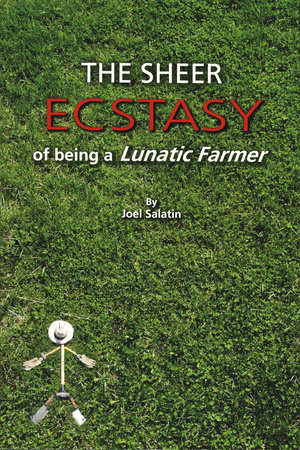
The Sheer Ecstasy of Being a Lunatic Farmer
Foodies and environmentally minded folks often struggle to understand and articulate the fundamental differences between the farming and food systems they endorse and those promoted by Monsanto and friends. With visceral stories and humor from Salatin’s half-century as a “lunatic” farmer, Salatin contrasts the differences on many levels: practical, spiritual, social, economic, ecological, political, and nutritional.
In today’s conventional food-production paradigm, any farm that is open-sourced, compost-fertilized, pasture-based, portably-infrastructured, solar-driven, multi-speciated, heavily peopled, and soil-building must be operated by a lunatic. Modern, normal, reasonable farmers erect “No Trespassing” signs, deplete soil, worship annuals, apply petroleum-based chemicals, produce only one commodity, erect Concentrated Animal Feeding Operations, and discourage young people from farming.
Anyone looking for ammunition to defend a more localized, solar-driven, diversified food system will find an entire arsenal in these pages. With wit and humor honed during countless hours working on the farm he loves, and then interacting with conventional naysayers, Salatin brings the land to life, farming to sacredness, and food to ministry.
Divided into four main sections, the first deals with principles to nurture the earth, an idea mainline farming has never really endorsed. The second section describes food and fiber production, including the notion that most farmers don’t care about nutrient density or taste because all they want is shipability and volume. The third section, titled “Respect for Life,” presents an apologetic for food sacredness and farming as a healing ministry. Only lunatics would want less machinery and pathogenicity. Oh, the ecstasy of not using drugs or paying bankers. How sad. The final section deals with promoting community, including the notion that more farmers would be a good thing.

About Joel Salatin
Joel Salatin and his family own Polyface Farm in Virginia’s Shenandoah Valley, chemical-free and carbon-driven since 1961. This is his 17th book dealing with practice and philosophy in farming that is economically, ecologically, and emotionally enhancing. Featured in countless media outlets, from print to audio to video, Salatin is known as America’s most famous farmer. He speaks worldwide to farmers, foodies, and food freedom advocates about healing food systems and farmscapes.
Books by Joel Salatin


You may also like...
-
 $27.00
 -
$34.95
-
$35.00


