

Preparing and Cooking Rabbit

Ever wonder how you can mix up you or your family’s meal routine? How about substituting in some rabbit instead of conventional meats! The idea of eating a rabbit for dinner may feel overwhelming, but here are some quick tips and tricks to get you started on preparing and cooking one of your own.
The following is an excerpt from Raising Pastured Rabbits for Meat by Nichki Carangelo. It has been adapted for the web.
We display our meats at the farmers market in a Cambro (a restaurant-grade insulated container) packed with ice, because whole chickens and pork chops are beautiful, and people buy more when they can see it without having to ask. Usually once per market someone will pick up a fresh rabbit, and I can see the wheels start spinning in their head. Based on a few years’ experience, I know they are probably asking themselves these three questions:
1. Do I have time to cook a rabbit this week?
2. Will my kids or spouse freak out?
3. How do I cut this thing up?
To quell their anxiety about question three, I start by asking them if they know how to part a chicken. If the answer is yes, I say, Great! Then you can definitely part a rabbit. If they say no, my follow-up question is: Do you have a sharp knife?
How to Butcher a Rabbit
Butchering a rabbit is simple and similar to breaking down a chicken. The following is a step-by-step guide to help you through the process.
1. To butcher a rabbit, start with a sharp knife—ideally a cleaver.
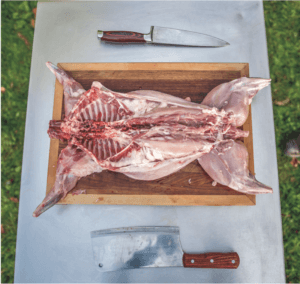
2. Stand up the rabbit and use the tip of the knife to break through the breastbone.
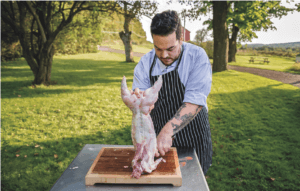
3. Split the rib bones going down either side of the back.
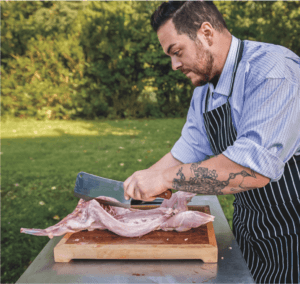
4. Using the tip of the knife again, remove the hind legs at the joint.
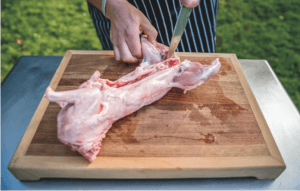
5. Similarly, remove the forelegs.
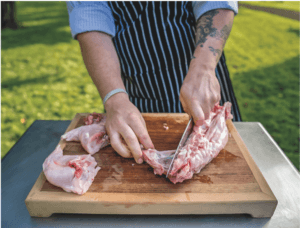
6. Use the cleaver to break through the backbone, behind the ribs, and separate the ribs from the loin.
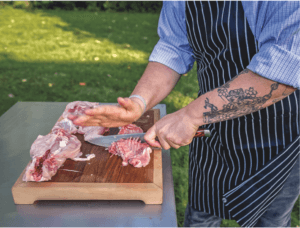
7. Separate the loin from the backbone.
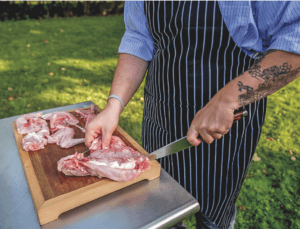
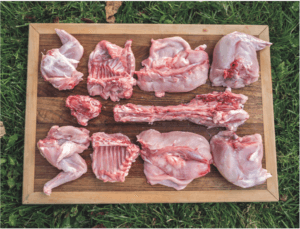
8. When you’re done, you will have eight pieces plus the backbone and the collar.
Cooking with Rabbit
Rabbits are incredibly versatile in the kitchen. With a few minor adjustments, you can basically cook them all the ways you can do a chicken: roasted, sautéed, poached, grilled, stewed, braised, shredded, and the list goes on. Laszlo and I served buttermilk-fried rabbit at our wedding.
Most cultures around the world have their own ways of cooking rabbits, and if you eat out a lot you have probably seen it on a menu without even realizing it was there. The French call it lapin, the Italians coniglio, and in Chinese it’s tù ròu. So roast it with a bouquet garni, make a rustic cacciatore, poach it with soy sauce, or cook it in a tagine—it’s all delicious. Just remember these three quick tips:
- Fryers, or young rabbits that are less than 31⁄2 pounds (1.6 kg) dressed, are the sweetest and most tender. They can be used successfully in virtually any preparation.
- Older, larger rabbits are considered roasters or stewers. Their meat is tougher than fryers, so they should be cooked slowly— either braised or, as the name suggests, stewed. Ironically, roasters are not very good when roasted.
- For safety, the USDA recommends cooking rabbit to an internal temperature of at least 160°F (71°C).
Those are the basics, but otherwise go nuts.
Recommended Reads
Read The Book

Raising Pastured Rabbits for Meat
An All-Natural, Humane, and Profitable Approach to Production on a Small Scale
$24.95
You may like...
-
 $29.95
 -
$39.95
-
$35.00


Recent Articles

Hot sauce fans, this one’s for you! This easy recipe for fermented hot sauce with wild greens is sure to add an extra punch of flavor to your favorite meal.
Read More
Known for their tall stature and distinctive flower heads, cattails thrive near lakes and marshes. From edible shoots and nutrient-rich roots to pollen used in baking, cattails offer a wealth of uses.
Read More
Building a desert pantry means celebrating how an arid climate shapes flavor. Learn the essential ingredients needed to build a well-stocked desert pantry!
Read More
You may have heard of dandelion wine, but have you ever made dandelion beer? We have a recipe for dandelion beer that will be ready in just a week!
Read More
Make your own kombucha at home – it’s easier than you think! Kombucha is not only great for your gut health. It’ll make your taste buds happy, too. Get bubbling with this easy recipe to make your own kombucha!
Read More