

Getting Started: Basics of Foraging Wild Seeds and Grains
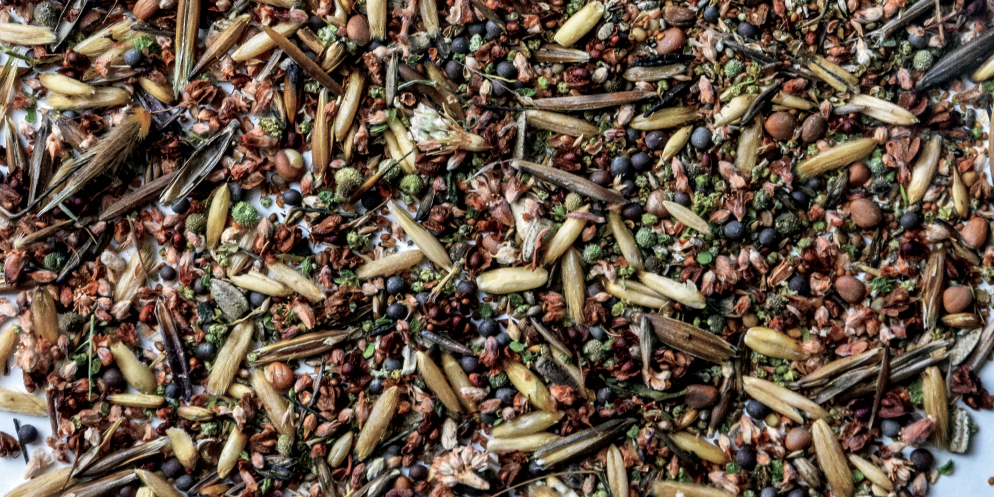
Wild seeds and grains are not only nutritious and versatile but also perfect for adding variety to off-grid or wildcrafted meals. They are exceptionally flavorful and provide a wealth of nutrients.
If you’re interested in foraging for wild seeds and grains but aren’t sure where to start, read on! This guide covers the fundamentals, provides a checklist of essential tools for processing, and offers tips for drying and storing your finds.
The following excerpt is from Wildcrafted Seeds and Grains by Pascal Baudar. It has been adapted for the web.
All photographs copyright © 2025 by Pascal Baudar
Getting Started
We begin by looking at the difference between seeds, nuts, and grains—terms that are often used interchangeably but mean different things. Understanding what makes a grain a grain, or why a nut isn’t always just a seed, will help you feel more confident as you begin collecting and processing these wild foods.While this book focuses mainly on seeds and grains, it’s useful to understand where nuts fit in, even if we won’t spend much time on them.
We’ll also go over the practical side of things—how to harvest, clean, and store what you collect. You’ll learn what husks and chaff are, why they matter, and how to remove them using simple tools and techniques. I’ve included a basic list of equipment to get you started, along with some tips for properly drying and storing your harvests.
Seeds, Nuts, and Grains
To make it simple, seeds, nuts, and grains are all plant parts that are often used as a source of food. While they share some similarities that can make them difficult to differentiate, they do have distinct characteristics.
Seeds are the reproductive structures of plants that contain the embryo of a future plant, along with the nutrients it needs to germinate and grow into a new plant. They can be either edible or nonedible and come in various shapes and sizes. Examples of edible seeds include chia seeds, sunflower seeds, lamb’s-quarter seeds, pumpkin seeds, curly dock (Rumex crispus) seeds, and sesame seeds—but there are many more.
Nuts are a type of seed that is surrounded by a hard shell or fruit that does not open on its own. Examples of nuts include acorns, walnuts, pecans, almonds, and cashews. In this book, I skip the nuts and concentrate on seeds and grains.
Grains are the edible fruits or kernels of cereal crops (or their wild ancestors), such as wild barley (Hordeum spontaneum), wheat, corn, regular rice, and wild oats.
One of the main differences between these three plant parts is their composition. Nuts are typically higher in fat and protein than seeds and grains, while seeds can be high in fat and protein but also contain fiber and other nutrients. Grains are mainly a source of carbohydrates and fiber.
Another difference is their culinary use. All three can be used in baking, but nuts are often eaten as a snack, either raw or roasted; seeds are often used as flavoring or a source of oil; and grains are used in side dishes or processed into breads, pastas, and breakfast cereals.
Even with these distinctions, it can still be tricky to categorize plant parts. For example, American wild rice (Zizania spp.) is technically a seed rather than a grain. It comes from aquatic grasses that grow in marshes and other shallow water. While it is commonly referred to as “wild rice,” it is not directly related to the rice found in stores (Oryza sativa). Apparently, great brome produces seeds, but I’ve always called them grains because they simply fit the nutrient profile (carbohydrates and fiber), and they look like grains. So, there you go!

Of Husk and Chaff
Before we get into collecting and processing wild seeds and grains, it helps to understand two terms that come up a lot: husk and chaff. These are common terms in farming, but they are very useful in foraging, too. They help us keep things simple and avoid technical words such as pericarp, endosperm, and bran.
Both husk and chaff refer to the outer layers that surround a seed or grain, but they’re used a bit differently.
Husk is the tough, often fibrous outer shell that encases and protects grains and some seeds, such as corn, wheat, and sesame. The term hull is sometimes used interchangeably with husk. In many cases, the husk doesn’t need to be removed before you use the grain or seed.
Chaff, on the other hand, is the lighter, dry, flaky material that sticks to cereal grains like wheat, wild barley, and wild oats. It usually includes small, scaly protective casings and other lightweight plant parts that are not edible but are somewhat easy to separate with winnowing—a process that uses airflow to blow away the lighter material from the heavier seeds or grains, whether by tossing the seeds or grains into the air on a windy day, using a fan, or gently blowing.
Note that when you’re working with wild or farmed grasses—including wheat, barley, rye, and rice—the grain is covered by several thin, dry layers (technically called glumes, lemmas, and paleas). These layers form a dry husk around the grain, but once they’re removed and floating around, people often refer to them as chaff. It can be a little confusing!
To keep things simple and clear, the terms husk and hull refer to the tougher, more fibrous outer layer that’s attached to the grain, and chaff refers to the lighter, loose material that easily can be removed with airflow.
Removing chaff is usually necessary, since it’s light and gets in the way, but removing the husk is not always a priority. It depends on the grain and how you plan to use it. In traditional grinding, people often crushed the whole grain—husk and all—using stone tools. The flour was then sifted if they wanted a finer texture, but many ancient breads and flatbreads were made with coarse flour that still contained bits of husk.
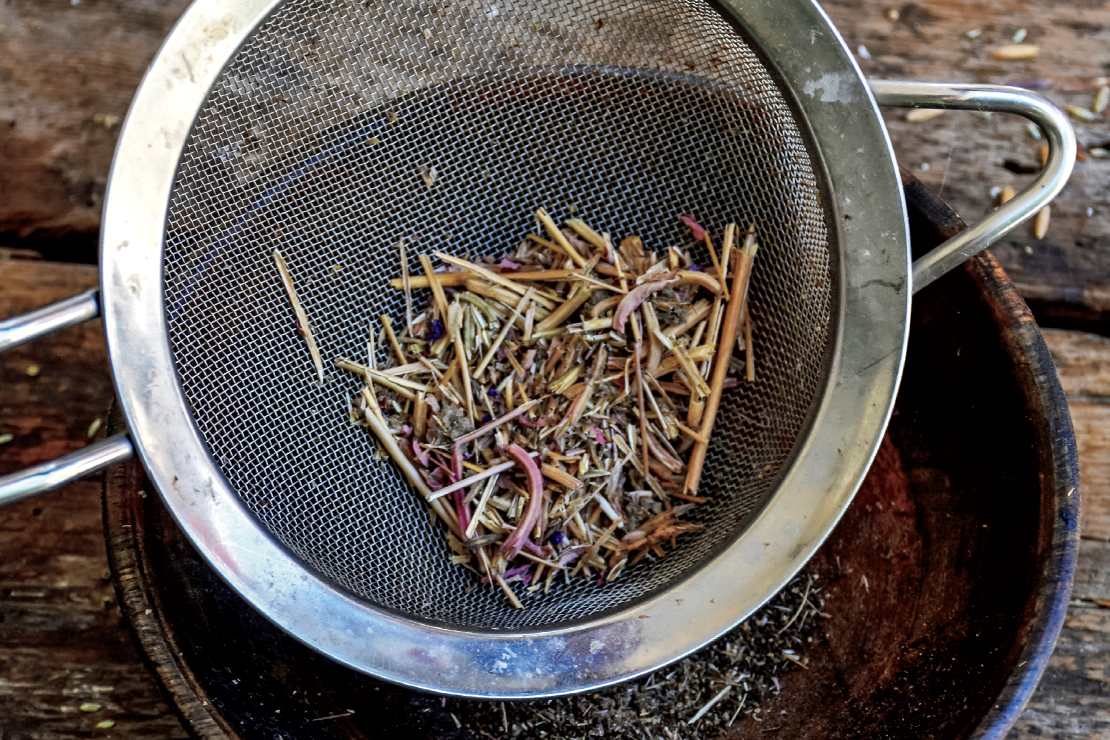
The perfect sieve for processing mustard seeds. Notice how the chaff stayed in the sieve but the seeds went through.
Collection and Processing Equipment
To collect, clean, and process wild grains and seeds, you’ll need a few basic tools. You’ll find more equipment suggestions in the chapters that follow, but here is a brief list to get you started.
Collection Equipment
- Gloves: Protect your hands from thorns, sharp edges, or irritating plants. In Southern California, gloves are especially useful for foraging seeds like chia, thistle sage (Salvia carduacea), and some mustard seeds.
- Bags or baskets: Use breathable bags, such as paper bags, or baskets to collect seeds and grains. These containers allow air circulation, which prevents mold. Plastic bags also work, but you’ll need to empty them as soon as you get home to prevent rotting.
- Scissors or pruning shears: For cutting stems and branches easily.
- Handheld sickle or knife: Useful for cutting stems or seedpods if you intend to forage a large quantity of grains.
Cleaning and Processing Equipment

- Sieve or strainer: To separate seeds and grains from chaff and other debris. Having sieves with various mesh sizes is essential—you can never have too many. I’ve collected a large assortment over the years, some with holes just big enough for tiny wild amaranth seeds to fall through.
- Mortar and pestle: For small-scale processing to remove seeds from husks or break open hard seedpods, such as wild radish (Raphanus raphanistrum).
- Winnowing basket or large bowl: To help separate seeds and grains from lighter debris using airflow.
- Screens or trays: For drying seeds and grains evenly.
- Cloth or tarp: For spreading out grains for drying (if you don’t use screens or trays) or threshing.
- Bowls: Trust me, you’ll need bowls of all sizes for winnowing and otherwise processing your grains and seeds.
- Airtight containers: For storing cleaned and dried grains and seeds. Personally, I use glass jars or plastic containers, and sometimes paper bags.
Optional Equipment
- Fan: For additional drying or assisting with winnowing. There is a decent amount of wind in the mountains where I live, so I’ve never needed to use a fan.
- Desiccant packs: To keep stored grains and seeds dry. I don’t use them since I usually eat my foraged grains within a year, but they are an option for long-term storage.
- Notebook, pen, and labeling supplies: To keep track of different batches and types of seeds and grains. Also good for labeling bags, jars, and containers for storage. While many people use phones to record and take photos, I also like using pen and paper.
Drying and Storage

Properly storing grains and seeds is crucial to maintaining their freshness and nutritional value and preventing spoilage. It’s heartbreaking to spend hours collecting something only to lose it due to improper storage.
If there’s one basic piece of advice I can give you, it is this: dry your seeds or grains before storing them in a closed jar or similar container by spreading them out on a clean, flat surface that allows for good air circulation. You can use a fine mesh screen, a plate, baking sheets lined with parchment paper, or a clean cloth spread out on a table. Place the seeds or grains in a warm, dry area away from direct sunlight, ideally at a temperature of around 70°F (21°C). Stir them occasionally to ensure even drying and to prevent mold growth. Once they are completely dry, you can store them in airtight jars to keep them fresh.
Drying seeds and grains takes about one to two weeks
I usually do a visual and tactile inspection to see if they appear dry and feel hard. You can even try breaking a larger grain or seed with a knife or your fingernail; if it snaps cleanly, it is dry. If you have a large quantity, weighing them at the start and during the drying process can also help; when they stop losing weight, they are likely dry.
That’s my basic procedure, but let’s go into greater detail for those of you who intend to store seeds or grains for longer than a year and for different purposes, such as planting, sprouting, and growing microgreens.
- Cool and dry environment: Store grains and seeds in a cool, dry place. The ideal temperature is below 60°F (15°C), and the humidity should be low to prevent mold and insect infestations. Living in California, it’s hard for me to meet that temperature criterion. It hasn’t been too much of a problem, but I store oilrich seeds (sunflower, mustard, etc.) in the fridge. The lower temperature helps slow down the degradation of oils, preventing rancidity and extending the shelf life of the seeds. I do the same thing with oil-rich nuts such as acorns or walnuts.
- Airtight containers: Use airtight containers such as glass jars, metal canisters, or food-grade plastic containers to protect against moisture and pests.
- Labeling: Clearly label containers with the type of grain or seed and the date of storage to keep track of freshness.
- Freezing: For longer-term storage, freezing seeds or grains can significantly extend the shelf life to several years. Freezing also protects against insect infestations, making it a reliable method for long-term preservation.
In summary, make sure your seeds are dry before you store them in closed containers. Label and store the containers in a cool, dry place, preferably below 60°F (15°C). I’ve never had any trouble with my harvest lasting up to a year at room temperature, even with the warmer storage conditions in Southern California. However, if I want to extend the shelf life beyond a year for some of my seeds or grains, I store them in the refrigerator or freezer.
Storing Sprouted Grains and Seeds
Make sure the sprouts or microgreens are completely dry before storing to prevent mold growth. To ensure safety and freshness, discard any that smell bad, look slimy, or have discoloration. Store them in the refrigerator in an airtight container or a resealable plastic bag.
As an extra step for microgreens, I usually place them between damp paper towels to create a humid environment that prevents early wilting. Your sprouts/ microgreens should stay fresh for up to a week.
Recommended Reads
Read The Book

Wildcrafted Seeds and Grains
An Introduction to Extracting, Preparing, Storing, and Cooking with Common Wild Varieties
$34.95
You may like...
-
 $34.95
 -
$40.00
-
$49.95


Recent Articles
Having an indoor sprout garden is easier than you might think and yields a bountiful harvest. Here’s how to get started — right from your windowsill!
Read More
This bright, yet delicate flavor profile is both sweet and sour – a unique taste that you’ll keep coming back to. This recipe is intended for long, slow fermentation starting at persimmon harvest time in the autumn and continuing into winter.
Read More
This triple apple snack cake uses applesauce, cider, and apples for a one-two-three apple punch. Don’t take our word for it though, give it a go yourself!
Read More
These small fruits are a delicious source of nutrients that you can find almost anywhere. Get started on acorn harvesting with help from these simple tips!
Read More
Want an on-the-go snack without having to go to the grocery store? Whip up this homemade applesauce for a fresh fall snack whenever you get the craving!
Read More