

Delightfully Fizzy Honeysuckle Cordial
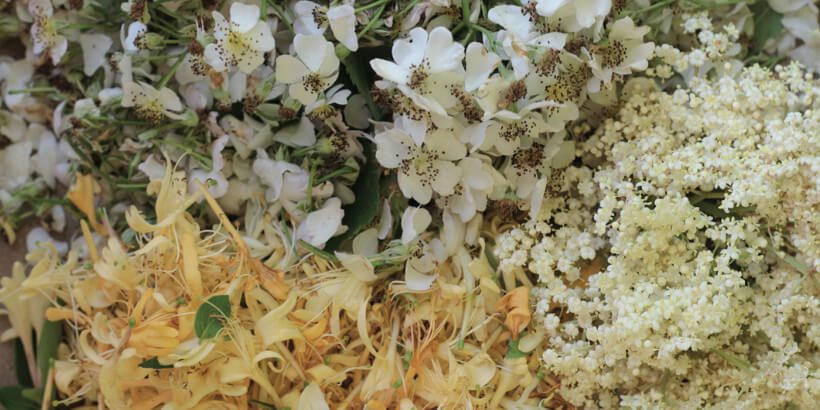
Oh, honeysuckle…how we love thee. If only there was a way to capture the sweet essence of this plant so we could enjoy it more than just in passing. Luckily, foraging and some preparation can help make that happen!
Here’s a springtime recipe that tastes exactly like honeysuckle smells.
The following excerpt is from Forage, Harvest, Feast by Marie Viljoen. It has been adapted for the web.
(All photos courtesy of Marie Viljoen unless otherwise noted.)
Collecting & Preparing Honeysuckle
Other common names: Japanese honeysuckle
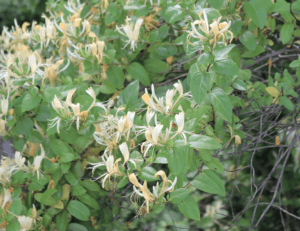
Botanical name: Lonicera japonica
Status: Noxiously invasive perennial vine
Where: Woodlands, clearings, meadows, and gardens across the US and Canada
Season: Late spring
Use: Aromatic
Parts used: Flowers
Grow? No
Tastes like: Honeysuckle

Where Does Honeysuckle Grow?
Widespread across the United States and Canada, as well as Europe and as far south as New Zealand, its tenaciously twining habit is responsible for significant habitat transformation as it outcompetes native plants by shading them and stealing their lunch money (well, sucking up their nutrients from the soil).
Its black fruits, ripening in autumn, are readily eaten by birds, and the seed is spread as they travel.
Stateside, Japanese honeysuckle first appeared on Long Island early in the nineteenth century (preceding garlic mustard by a few decades), encouraged to the continent by horticulturists. Like garlic mustard, war has been declared on it by almost every state.
The Sweet Scent of Honeysuckle
My own romantic notions of honeysuckle have been hard to shake. I remain smitten by that scent.
So when I spend a quiet hour in early summer picking its tubular flowers on an empty pathway in a city woodland, an intense sense of nostalgia is evoked by the delicate petals that I am dropping into my paper bag, which fills slowly with memories from childhood, and a subliminal chatter provided by a lifetime of literature.
But the rationalist in me appreciates the fact that fewer flowers mean fewer fruits, which means a slower spread. It is a drop in the biodiversity bucket, but what a delectable drop.
Honeysuckle has one use for me: as an aromatic.
The flowers make the most heady cordial I have tasted, and its seamless translation from one sense to the next—smell to taste—seems miraculous.
Sweet cordial is partnered by a complex and tart vinegar, and these two simple infusions inform countless subsequent creations.
Pick only the flowers (the green parts and fruit are considered toxic). This takes patience, but the reward is a few heady cupfuls. Use a paper bag for collection, as they sweat too much in plastic. Try to use them within a few hours of collection while their perfume is strongest. Do not wash them, or scent-be-gone.
 RECIPE: Fermented Honeysuckle Cordial
Makes 5 cups (11⁄4 liters)
This is probably the most delightful fizzy drink I know. It tastes exactly the way that honeysuckle smells.
Make it with just honeysuckle flowers, or combine with Rosa multiflora (which will make it slightly pink), or elderflower.
Ingredients
- 3 cups (3 ounces/85 g) honeysuckle flowers
- 5 cups (11/4 liters) water
- 2 cups (400 g) sugar
Instructions
Combine all the ingredients in a large clean jar and stir until the sugar has dissolved. Cover the mouth with cheesecloth secured with string or a rubber band and stir daily. After several days, once fermentation is very active (lots of bubbles, flowers slowly rising out of the jar), push the flowers down and keep stirring.
Give it an extra day, then strain through a fine-mesh sieve. Strain again through a double layer of cheesecloth. Pour into clean bottles and close. For peace of mind keep the bottles in the fridge, as some fermentation will continue. A bottle can explode, left out and warm.
Reserve the strained flowers to make Quick Honeysuckle Vinegar.
Recommended Reads
Read The Book

Forage, Harvest, Feast
A Wild-Inspired Cuisine
$40
You may like...
-
$34.95
-
$29.95
-
$29.95


Recent Articles

Did you know that more than just the seeds of a sunflower are edible? Almost every part of a sunflower are completely safe and delicious when cooked correctly.
Read More
With this recipe for a rainbow pickled veg plate, you can turn simple vegetables into a delectable dish that your guests will be craving all season long.
Read More
Dig into the many varieties of grass seeds, learn about toxicity, and review a list of edible grass seeds. Happy foraging!
Read More
All hail the joyful juneberry! While these berries taste wonderful when they’re fresh, you can also preserve them and create beverages with them.
Read More
Looking for something to munch on that’s both tasty and good for you? These ginger carrots are a healthy snack that are easy to make at home! The following excerpt is from The Heal Your Gut Cookbook by Hilary Boynton and Mary G. Brackett. It has been adapted for the web. Ginger Carrots Recipe…
Read More