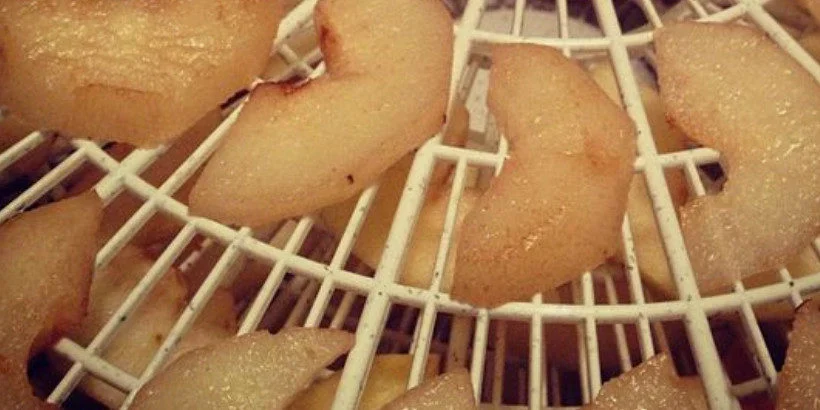
Looking for a new way to enjoy the benefits of your garden all year long?Follow this easy tutorial for making drying trays to expand the lifespan of fruits, vegetables, and herbs.
Food is usually dried on a flat surface, such as a tray or screen, using a natural or artificial heat source. Solar drying is obviously the preferred method because it consumes only the sun’s energy and that energy is free. Trays should be placed in a dry, well-ventilated spot, generally out of the direct sun, or in specially designed solar dryers.
In lieu of natural sunshine, we can take advantage of the heat generated by a radiator, kitchen range, wood stove, or oven. If all these are lacking, we can settle for a low-wattage electric food dehydrator. Several models are available for home use.
Variation 1: Screened Drying Trays (60” x 20”)
Materials
Square battens (cross section 1.25″ x 1.25″)
Flat battens (cross section 1⁄8″ x 1.25″)
20″-wide roll of galvanized metal or rigid plastic screen with fine mesh (25–50 mm or 1–2 sq. in.)
Nails (2″ and 1″ long)
Procedure
First assemble the square battens to form a frame sixty inches long by twenty inches wide. To make the frame more rigid, add one or two square battens across the middle. Hammer the frame together with 2-inch nails.
Unroll the screening and flatten it against the frame using the flat battens to hold it in place.
Fasten with 1-inch nails. This creates the bottom of the tray.
The tray is now ready to use. Note that the trays can be stacked to save space.
Henry Rouy, Cournon-D’Auvergne
Variation 2: Small Multipurpose Dryer (for those with limited space)
Materials
Two 24″ x 2.5″ boards
Two 14″ x 2.5″ boards
Small wooden laths (strips)
Small nails
Procedure
This is a basket that can be hung from a beam or a nail, in the cellar or kitchen. It is very simple to make.
Make the sides of the basket with the four boards. Then nail the small wooden laths three-quarters of an inch apart to make the bottom.
To make the handle, add two small boards of the same length as the basket to each side. Connect them with a round stick.
You can dry cheese, mushrooms, prunes, and herbs for infusions, for example, by placing some netting over the bottom of the basket.
This bright, yet delicate flavor profile is both sweet and sour – a unique taste that you’ll keep coming back to. This recipe is intended for long, slow fermentation starting at persimmon harvest time in the autumn and continuing into winter.
This triple apple snack cake uses applesauce, cider, and apples for a one-two-three apple punch. Don’t take our word for it though, give it a go yourself!
These small fruits are a delicious source of nutrients that you can find almost anywhere. Get started on acorn harvesting with help from these simple tips!
Want an on-the-go snack without having to go to the grocery store? Whip up this homemade applesauce for a fresh fall snack whenever you get the craving!
The possibilities are pretty much endless with wild ingredients — use almost any fresh fruit or juice and a sweetener to create your own custom jam or syrup!