

A Guide to Growing Oyster Mushrooms Indoors
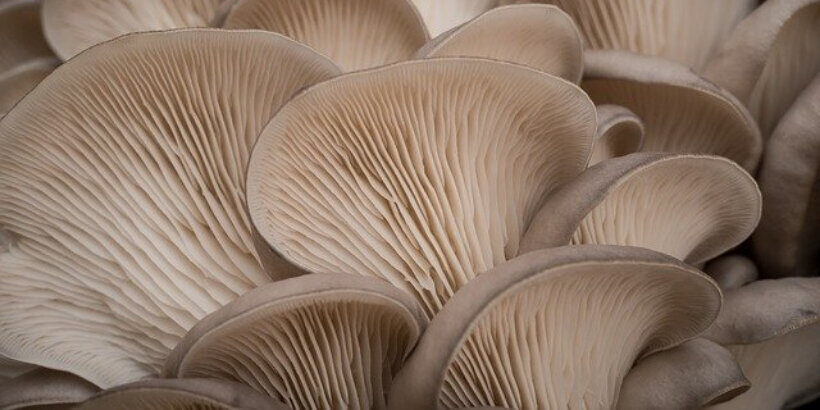
What’s so great about oyster mushrooms? First, you can add them to the list of foods that can be grown indoors!
They are tasty, easy to grow, multiply fast, and they love a variety of substrates, making oyster mushrooms the premium choice.
The following is an excerpt from Fresh Food from Small Spaces by R. J. Ruppenthal. It has been adapted for the web.
Oyster Mushrooms: The Easiest Mushrooms to Grow
Though they are accustomed naturally to growing in wood, you also can raise oyster mushrooms in a variety of other growing media, including straw or sawdust. The easiest way to begin is with a kit.
If you want to experiment on your own, then oysters give you a greater chance of success than other mushrooms.
There are dozens of varieties of oyster mushrooms, from pin-sized to trumpet-sized, so check with your kit or spore supplier to see which kinds are available and recommended for your climate. Most grow in an ideal temperature range of about 55 to 65 °F.
Growing Kits for Oyster Mushrooms

You can make your own kit using any of these materials, but I will recommend one other method that has worked well for many indoor mushroom growers.
Oyster Mushrooms: What You Need
For this you will need two milk cartons or small waxed-cardboard boxes, enough sawdust to fill them, 2 cups of whole grain flour or coffee grounds, and some oyster mushroom spawn.
The basic steps are as follows, but feel free to improvise. If sawdust is unavailable, you could also use straw for this.
-
Cut out the top of the milk cartons so that their edges are of even height. Punch several small holes in each side of both cartons.
-
Sterilizing (optional): If you are using sawdust that has already been inoculated with spawn, then do not try to sterilize it or you will kill the fungi. If you are using additional sawdust that has not been inoculated yet, then you may want to sterilize it. The easiest ways to do this are by boiling, steaming, or microwaving it. If anyone else in your household might object to cooking sawdust in the kitchen, then you might want to try this step when no one else is home. To sterilize with a microwave oven, fill a microwave-safe bowl with sawdust, plus the flour or coffee grounds, and wet down this mass with enough water so that it is the consistency of a wet sponge. You may need to do several successive batches to sterilize all of your sawdust. Nuking the sawdust on high for two minutes or until the water begins to boil off will kill any unwanted organisms and leave your kitchen smelling like either a wood shop or coffee shop. You also can boil or steam the growing medium in a pot of water in the kitchen or over a campfire, with or without a steamer basket. After it has boiled for a few minutes, turn off the heat, keep the sawdust covered, and let it return to room temperature.
-
Using non-chlorinated water, wet the sawdust until it’s thoroughly damp.
-
Then mix in your spores or inoculated material.
-
Tightly pack this damp growing medium into your milk cartons and leave them in a cellar, garage, storage locker, or dark cabinet. You can put some plastic underneath the cartons and cover them loosely with plastic if desired. If insects are a problem, then spray cooking oil around the plastic to trap them.
-
Keep the sawdust mix moistened regularly with non-chlorinated water, and in a few months your fungi should fruit repeatedly. To harvest mushrooms, twist them out gently so that their stems do not break.
Recommended Reads
Drill, Plug, Wax, Wait: 6 Simple Steps to Growing Mushrooms Outdoors
Read The Book

Fresh Food from Small Spaces
The Square-Inch Gardener's Guide to Year-Round Growing, Fermenting, and Sprouting
$27.95
You may like...
-
 $34.95
 -
$14.95
-
$34.95


Recent Articles

Wild seeds and grains are not only nutritious and versatile but also perfect for adding variety to off-grid or wildcrafted meals.
Read More
Ancient mushroom medicine for modern times! Mushrooms help us understand medicine is not only through chemical compounds. Get your daily dose of health with recipes for:
– Medicinal Mushroom Crackers
– Medicinal Mushroom and Vegetable Broth
– Chaga-Reishi Chai

Growing your own vegetables may be easier than you think! All you need is an indoor or outdoor space & some seeds, and you’ll be starting plants in no time.
Read More
There are reasons that miso paste has become popular around the world: it’s versatile, relatively inexpensive, and can be made in a range of flavors you’d be hard-pressed to find anywhere else. And better yet, you can even make miso at home!
Read More
Wondering where to forage for greens this spring? Look no further than hedges, which serve as natural havens for wild greens and herbs!
Read More