

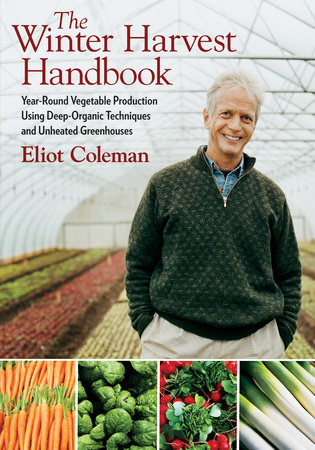
The Winter Harvest Handbook
Year Round Vegetable Production Using Deep-Organic Techniques and Unheated Greenhouses

EXCERPTS
| Pages: | 264 pages |
| Book Art: | Color photos illustrations throughout |
| Size: | 7 x 10 inch |
| Publisher: | Chelsea Green Publishing |
| Pub. Date: | March 31, 2009 |
| ISBN: | 9781603580816 |
The Winter Harvest Handbook
Year Round Vegetable Production Using Deep-Organic Techniques and Unheated Greenhouses
Paperback
$29.95
“Brimming with ingenuity, hope, and eminently practical advice, The Winter Harvest Handbook is an indispensable contribution.”—Michael Pollan
“Useful, practical, sensible, and enlightening information for the home gardener.”—Martha Stewart
With The Winter Harvest Handbook, everyone can have access to organic farming pioneer Elliot Coleman’s hard-won experience. Gardeners and farmers can use the innovative, highly successful methods Coleman describes in this comprehensive handbook to raise crops throughout the coldest of winters.
Building on the techniques that hundreds of thousands of farmers and gardeners adopted from Coleman’s The New Organic Grower and Four-Season Harvest, this book focuses on growing produce of unparalleled freshness and quality in customized unheated or, in some cases, minimally heated, movable plastic greenhouses.
Inside, you’ll find Coleman’s clear, concise, and meticulous details [including many accompanying illustrations] on:
- Greenhouse construction and maintenance
- Planting schedules
- Crop management
- Harvesting practices
- Marketing methods
Coleman’s painstaking research and experimentation with more than 30 different crops will be valuable to small farmers, homesteaders, and experienced home gardeners who seek to expand their production seasons.
A passionate advocate for the revival of small-scale sustainable farming, Coleman provides a practical model for supplying fresh, locally grown produce during the winter season, even in climates where conventional wisdom says it “just can’t be done.”
“The incomparable Eliot Coleman is back.”—The New York Times
“A Renaissance man for a new generation.”—Dan Barber
Reviews & Praise
"When does gardening become farming? When are you no longer having dinner parties and running a restaurant instead? For those who are ready to graduate beyond coffee-can retail, the incomparable Eliot Coleman is back with THE WINTER HARVEST HANDBOOK: Year-Round Vegetable Production Using Deep-Organic Techniques and Unheated Greenhouses (Chelsea Green, paper, $29.95). I'm not one to quibble over the details of a "T-post anchor and homemade attaching bracket for securing the corners of a new rolling greenhouse design." Suffice it to say that this serious, meticulous, inspiring farmer and writer solves the problem of growing lettuce in Maine -- in January. Anyone living near Coleman's Four Season Farm is thrice blessed -- 1) to live in intense denial of the back-breaking effort he or she is 2) being spared in order to acquire what is surely 3) the tastiest, most wholesome and pure food available. Coleman's opus is as much a call to action for town planners to embrace local farms as it is a bible for small farmers. This book is for people who know what they're doing."—The New York Times Book Review
"I just finished picking my first carrots, beets, and radishes from my new 'cold house' in Bedford, New York. It is so rewarding to harvest fresh vegetables and salads in the middle of winter and I grow them following the techniques of Eliot Coleman. I have been a devotee of Eliot's for years, fully agreeing with his methods for growing in winter, spring, summer, and fall, tasty, nutritious produce with a minimum consumption of fossil fuels. Congratulations on another volume of useful, practical, sensible, and enlightening information for the home gardener."—Martha Stewart
"Eliot Coleman's books have been called Bibles for small farmers and home gardeners. I suspect that's because he writes about not just gardening but about everything that connects to good food and pleasure; a Renaissance man for a new generation, he'll quote Goethe in the same breath as Ghandi, and as a result, you'll dig, weed, eat, think, and live more fully."—Dan Barber, Chef, Blue Hill and Blue Hill Stone Barns
"'Attention to detail is the major secret to success in any endeavor,' writes Eliot Coleman on page 156 of this absorbing and happily detailed report on his ongoing efforts to grow flawless vegetables without hothouses on the frozen 'back side' of the year. In chapters covering everything from The Yearly Schedule and Greenhouse Design to Weed Control and Marketing, Coleman tracks his own constant search for perfection, a quality that has led more than one young farmer to exclaim 'I'd follow him anywhere.' Well worth reading even if you don't grow vegetables, just to watch a master's mind at work."—Joan Dye Gussow, author of This Organic Life
"The Winter Harvest Handbook is a treasure trove of practical, proven techniques for producing crops on a year-round basis in any climate. Based on decades of on-farm research, this book is packed with useful ideas, tips and practices that anyone can use in pursuing the increasingly vital dream of local, organic food production using a minimum of precious resources. A masterful book from a master organic farmer. I wish I had had a copy 35 years ago!"—Amigo Bob Cantisano, President, Organic Ag Advisors
"How do you produce first-rate food all year-round in northern places? This is the big question facing the local food movement, and Eliot Coleman, one of America's most innovative farmers, has come up with excellent answers. Brimming with ingenuity, hope, and eminently practical advice, The Winter Harvest Handbook is an indispensable contribution."—Michael Pollan
"If we are going to create a good, clean, fair food system, we've got to learn how to grow affordable, local food year-round and make a living at it. Eliot Coleman knows more about this than anyone I've met. Here he gives the detailed information needed to make it work. The only way to learn it better would be to follow him around for a few seasons. And he won't let you."—Josh Viertel, President, Slow Food USA

About Eliot Coleman
Eliot Coleman is the author of The New Organic Grower, Four Season Harvest, and The Winter Harvest Handbook. He has more than 50 years’ experience in all aspects of organic farming, including field vegetables, greenhouse vegetables, rotational grazing of cattle and sheep, and range poultry. During his careers as a commercial market gardener, the director of agricultural research projects, and as a teacher and lecturer on organic gardening, he studied, practiced, and perfected his craft. With his wife, Barbara Damrosch, he was the host of the TV series, Gardening Naturally, on The Learning Channel, which featured their market garden and home garden projects at Four Season Farm in Harborside, Maine.
Connect with Eliot Coleman
Books by Eliot Coleman


You may also like...
-
 $24.95
 -
$29.95
-
$34.95

