

Northeastern Kvass

When you’re on a fall hike, taking in the colorful leaves, sharp snaps of twigs beneath your feet, marveling at the beautifully knotted roots of the trees in front of you, you’re probably not thinking about how delicious they all taste together. But boy, you should be! Almost every ingredient in this nature-infused Northeastern Kvass can be found in a forest and with just one sip you will be transported deep into the woods whilst sipping from the comfort of home.
The following excerpt is from The Wildcrafting Brewer by Pascal Baudar. It has been adapted for the web.
This recipe is based on the forest I like to hike in Vermont. It’s a mix of pine and root flavors, a bit like a kvass root beer. It’s quite enjoyable and nutritious. The method is a bit different, as the pine branches and spruce are not boiled. Of course, maple syrup is the source of sugar for this fermentation, and the wild yeast is from a dandelion flower starter.
Ingredients
1 ⁄2–1 pound (227–454 g) rye (or other) bread 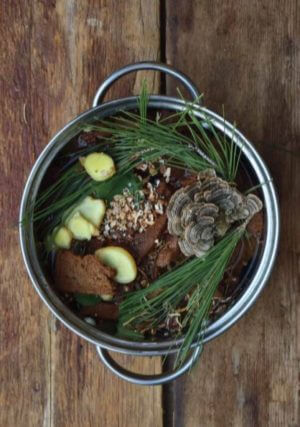
1 gallon (3.78 L) water
1–1 1 ⁄2 cups (250–360 ml) maple syrup
2 tablespoons (10 g) sassafras root bark
1 tablespoon (5 g) sarsaparilla roots (optional)
1 tablespoon (5 g) chopped dandelion roots
1 ⁄2 teaspoon (1 g) dried wintergreen leaves
Handful of turkey tail mushrooms (just because I like them and they’re good for you)
Small piece (3 ⁄4–1 inch/2 cm) gingerroot (optional)
A couple of small spruce or white pine branches, or any lemony-tasting pine needles (you can also use a couple of lemons if you want; juice them and then throw them in the pot)
1 ⁄2–3 ⁄4 cup (120–180 ml) wild yeast or commercial beer yeast
Procedure
Use a similar brewing method as Traditional Bread Kvass. The main differences are that you can place the turkey tail mushrooms in the water from the start (at the same time as the sugar) so they boil longer than the other ingredients. The spruce or white pine branches are added when the liquid is cooled down and the yeast goes in. It’s a personal choice, but I don’t like the flavor of boiled spruce/fir/pine. Don’t forget to cut the top of the needles so the flavors can be extracted. Because I use lots of barks, dried leaves, and roots in this recipe, I don’t place the pot in cold water but simply set it outside. The warm water cools slowly, and I extract more flavors that way.
- Slice the bread and break the slices into smaller pieces. Place them in a preheated 350°F (177°C) oven for 10 minutes, then broil on high until golden brown—this can take 3 to 5 minutes depending on your oven. You basically want your bread to look like slightly overdone toast, which will give the brew a nice amber look and better flavors.
- Meanwhile, pour the water and sugar into a pot and bring the liquid to a boil. Place the toasted bread, herbs, and raisins in the boiling liquid and stir briefly. Bring the liquid back to a boil, then remove the pot from the heat.
- Place the pot (with the lid on) in cold water and cool the liquid to 70°F (21°C), then add the yeast (1 ⁄2 to 3 ⁄4 cup or 120–180 ml for wild yeast starter). Either keep everything in the original pot with the lid on or transfer the contents into a fermenting bucket fitted with an airlock or a clay pot/glass container with a clean towel on top.
- Ferment for 8 to 12 hours, until you see some bubbling going on, then strain the liquid into a bottle or into recycled soda bottles if you want carbonation. Check the pressure and place the bottles in the refrigerator when ready. Drink within a couple of weeks.
Recommended Reads
Read The Book

The Wildcrafting Brewer
Creating Unique Drinks and Boozy Concoctions from Nature's Ingredients
$29.95
You may like...
-
 $24.95
 -
$24.95
-
$27.95


Recent Articles

Before yanking out the next patch of lambsquarter you find in your yard or garden, consider trying one of the many edible and medicinal uses of this “super weed.”
Read More
Looking to add another recipe to your fermenting repertoire? This recipe for kvass calls for just a few ingredients and only takes a couple days to ferment.
Read More
Having a lack of outdoor greenspace doesn’t mean you can’t enjoy homegrown food. Sprouts are a quick, simple, and healthy way to keep your appetite satisfied.
Read More
Yogurt making is having a moment! Join the fun and create your own natural yogurt at home. Try our simple recipe using kefir as a starter and taste the difference for yourself!
Read More
Vermont’s sweet tradition in a glass! This recipe is inspired by the classic maple taffy-like candy Sugar on Snow. Unlike flavor-neutral simple syrup, maple syrup’s contribution to cocktails isn’t just sweetness but also buttery, nutty & vanilla flavors.
Read More