

Making the Best Sauerkraut on Earth in Four Simple Steps: Chop, Salt, Pack, Wait
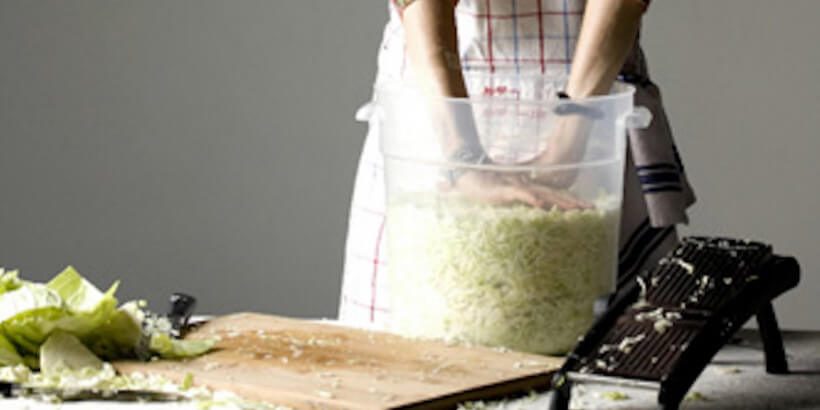
Make your own delicious, healthy, probiotic sauerkraut! Four easy steps are all you need to turn fresh garden veggies into a long-lasting, tangy, pungent condiment.
The following excerpt is from The Art of Fermentation by Sandor Ellix Katz. It has been adapted for the web.
4 Simple Steps to Making Sauerkraut
The English language does not have its own word for fermented vegetables. It would not be inaccurate to describe fermented vegetables as “pickled,” but pickling covers much ground beyond fermentation.
Pickles are anything preserved by acidity. Most contemporary pickles are not fermented at all; instead they rely upon highly acidic vinegar (a product of fermentation), usually heated in order to sterilize vegetables, preserving them by destroying rather than cultivating microorganisms.
“For pickles, fermentation was the primary means of preservation until the 1940s, when direct acidification and pasteurization of cucumber pickles was introduced,” writes Fred Breidt of the USDA.
Vegetable Ferments

But of course, everything I’ve learned about sauerkraut and kimchi reveal that neither of them constitutes a homogeneous tradition.
They are highly varied, from regional specialties to family secrets.
Nonetheless, certain techniques underlie both (and many other related) traditions, and my practice is a rather free-form application of these basic techniques rather than an attempt to reproduce any particular notion of authenticity.
Steps for Fermenting Vegetables
In a nutshell, the steps I typically follow when I ferment vegetables are:
- Chop or grate vegetables.
- Lightly salt the chopped veggies (add more as necessary to taste), and pound or squeeze until moist; alternatively, soak the veggies in a brine solution for a few hours.
- Pack the vegetables into a jar or other vessel, tightly, so that they are forced below the liquid. Add water, if necessary.
- Wait, taste frequently, and enjoy!
Of course, there is more information and nuance, but really, “Chop, Salt, Pack, Wait” is what most of it amounts to.
Recommended Reads
Read The Book

The Art of Fermentation
With Practical Information on Fermenting Vegetables, Fruits, Grains, Milk, Beans, Meats, and More
$39.95
You may like...
-
 $34.95
 -
$34.95


Recent Articles

These small fruits are a delicious source of nutrients that you can find almost anywhere. Get started on acorn harvesting with help from these simple tips!
Read More
Want an on-the-go snack without having to go to the grocery store? Whip up this homemade applesauce for a fresh fall snack whenever you get the craving!
Read More
The possibilities are pretty much endless with wild ingredients — use almost any fresh fruit or juice and a sweetener to create your own custom jam or syrup!
Read More
Fermenting mead is an ancient practice. With step-by-step instructions, learn how to brew fruit-based and flower meads, from foraging to fermenting.
Read More
Small But Mighty! Crab Apples are easy to find, simple to store, and incredibly flavorful. Keep reading to learn more about the unsung heroes of the apple family.
Read More