

Mushrooms as Food & Medicine: Ancient Medicine for Modern Times
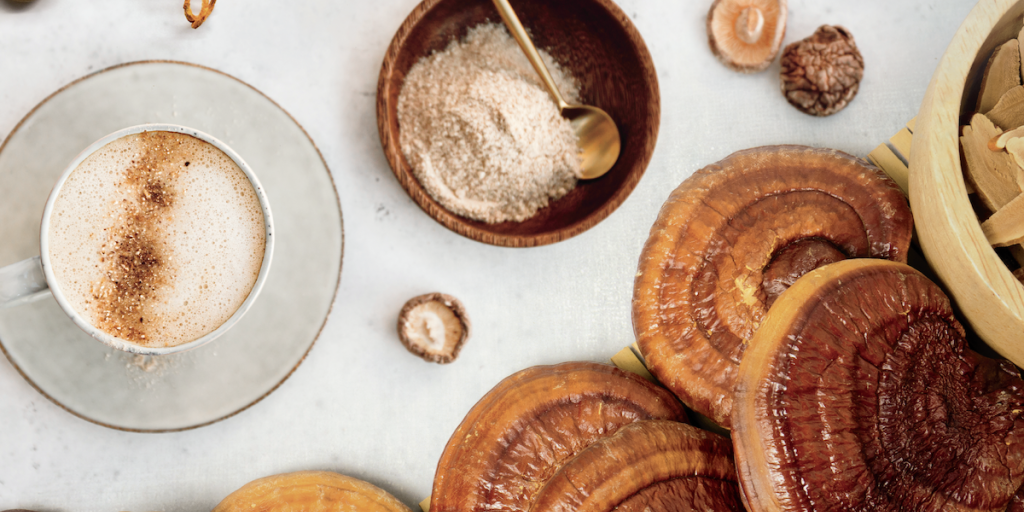
Mushrooms help us understand medicine is not only through chemical compounds. They remind us that medicine isn’t something we consume alone. It’s something we grow, share, and live.
Get your daily dose of health with recipes for:
– Medicinal Mushroom Crackers
– Medicinal Mushroom and Vegetable Broth
– Chaga-Reishi Chai
The following excerpt is from The Mycelial Healer by Christopher Parker and Katherine Parker. It has been adapted for the web.
We call mushrooms our daily dose of health.
We add them to homemade broths, we brew mushroom tea, and we cook with mushrooms. We also use some special methods to increase the potency of the medicinal mushrooms we grow, including sun treating them. We make double extractions—a long alcohol extraction followed by a hot-water extraction—to harvest as much of the medicinal goodness as possible.
Increasing the potency of our medicinal mushrooms may seem like a new concept. However, people have been doing this for a long time. It is slow a form of medicine-making that results in very potent medicine. We live in a world where everything has been bigger, faster, and more. Not only does this reduce the quality of our life, but it also reduces the quality of the food we eat, and it creates a sense that the slow process is unsatisfactory, not worth the effort.
Deep within, though, we know that when something takes time and energy to create, we will be more satisfied when our efforts come to fruition. Making an alcohol extract takes eight weeks, and even the hot-water extraction for mushrooms can take up to two hours, much longer than what is required to brew a medicinal plant tea or decoction.

Black beans being colonized by Lion’s Mane mycelium.
The surge in popularity of medicinal mushrooms has resulted in the arrival of many brands and formulations of mushroom supplements in the marketplace.
A lot of the mushroom coffee products are made with myceliated rice that has been ground and added to coffee. But for the majority of medicinal mushrooms, the fruiting body is the part that contains the highest amount of medicinal compounds.
Some supplement labels will list the ingredients as simply the name of the mushroom, e.g., “Lion’s Mane,” and others will say something more specific like “Lion’s Mane extract.” It is likely that the “extract” contains compounds that have been extracted from the mushroom rather than simply dried and ground mushroom parts, which our bodies cannot absorb. It is best to thoroughly research the company and learn about their extraction methods before you buy.
Medicinal Mushrooms as Food
Many medicinal mushrooms are, by a large portion, not only medicinal but also great culinary mushrooms. The top two, in my opinion, are Wishi (Grifola frondosa, also called Maitake) and Milky mushrooms (Lactarius and Lactifluus spp.).
You may have loved ones who are in need of medicinal mushrooms but do not want to ingest them on a frequent basis, even though doing so could improve their physical and mental health and well-being, or help cure a disease.
Many children have not yet developed a palate for mushrooms. We know that caretakers or parents can struggle with getting their children to eat well.
The easiest way to consume the medicinal properties of mushrooms is to incorporate them into the diet a few times a week or month. There are pros and cons to just simply cooking with mushrooms. When mushrooms are cooked in a meal, they may not be fully cooked so as to break the cell walls down, which is necessary to free up some of the beneficial heavy molecular weight compounds.
Additionally, some of the volatile medicinal compounds can be driven off, which is a loss. So we want to share with you the basics of cooking with mushrooms to make the medicinal properties as available as possible.
Cooking mushrooms in soups or stews is the best method of using mushrooms as medicine in food. The low-and slow cooking exposes the mushroom cell walls to a longer cook time, breaking them apart and releasing more of the beneficial polysaccharides into the food.
MEDICINAL MUSHROOM CRACKERS

Rustic rosemary–mushroom crackers
Adding mushrooms to dough for homemade crackers is a simple way of incorporating medicinal mushrooms into the diet, especially if you have fussy eaters in your household. You can start with your favorite cracker recipe. If you make substantially more hot-water mushroom extract than you can use for one batch, it will freeze well until ready for next time.
We like to make crackers using Oyster mushrooms, but any mild-flavored mushroom works well. Lion’s Mane is a good substitute.
For a recipe calling for 2 cups flour, we add 1 cup hot-water-extracted mushrooms.
We start with 1/2 pound of Oyster mushrooms, chop them fine, and simmer them for 90 minutes in 2 to 3 cups of water.
After they cool, we blend them in a blender until thoroughly homogenized. Take 1 cup of the blended mushrooms and mix it into 2 cups of flour. At this point, we also like to add 1 tablespoon of chopped fresh rosemary or 3/4 tablespoon dried rosemary.
If you’ve never made crackers, there are plenty of good recipes and instructional videos available online.
Once you’ve mixed the dough and adjusted it for the right level of moistness, roll it out and cut it, slide it onto parchment paper and then onto a baking sheet, and bake them. We use a 400°F (204°C) oven and bake for 12 to 17 minutes.
Don’t get busy and forget about your crackers! They can overcook quickly.
The edge crackers may brown a bit more than the center ones. Remove the whole sheet from the oven and allow them to cool before snapping the crackers apart. They will become crispier as they cool. Store in an airtight container and enjoy.

Medicinal mushroom–vegetable stock.
MEDICINAL MUSHROOM AND VEGETABLE BROTH
We save onion skins, carrot tops and tips, parsnip trimmings, celery, and other vegetable trimmings whenever we are prepping vegetables for a meal. We toss the trimmings in the freezer, and when we have collected enough, we put them a slow cooker with water, add in medicinal and culinary mushrooms, then set the cooker on simmer overnight. You can then use this broth for making soup, or you can add sea salt and run the broth through the pressure canner to have on hand whenever needed. Broths have seen a resurgence in recent years. This is part of us taking back the power to give our bodies the healthy nourishing components they need to heal or maintain health. We also make a supercharged bone broth from scrappy mushrooms, mushroom stems, perfect mushrooms, vegetable scraps, wild herbs, and bones from animals we have hunted. This broth can be made vegan if you do not consume animal parts.
We usually wait until we have about 12 cups of mushroom and vegetables scraps, which is enough to produce 1.5 gallons of stock. We like to have about a one-to-one ratio of veggie material to mushrooms. We simmer this broth in a large stockpot on the stove for 90 minutes for best flavor and to process the mushrooms for ultimate extraction. We store the broth in pint jars; 1.5 gallons of stock will produce 12 pints of stock. This is simply what works for us, but you can adjust and make broth at the scale that works for you.

Home-canned medicinal bone broth.
For the mushrooms, we like to use Oysters, Shiitake (especially the stems), Turkey Tail, and Birch Polypore. Use any soup bones you have available. Another option is to add a couple of venison bones, or a front shank with the bone cut into two so that the marrow can be extracted. If you are not using bones, some type of fat will be needed to improve the flavor of the broth. Avocado oil is a great high-heat oil that adds a mild buttery flavor.
Add some wild herbs too, such as Queen Anne’s Lace (Daucus carota), Wild Violet (Viola sororia) greens, or mallow leaves. We advise against using brassicas (such as kale, cabbage, or Brussels sprouts). They will impart bitterness to the finished stock.
Just like the ceremony of making tea, this ceremony of tending to all of the vegetables, picking wild greens, and even processing the bones of the animals from your local farms can be very beneficial for your mental and spiritual health. You are closing the nutrient cycle and winding the circle of life a bit closer to you.

Dried medicinal mushrooms and chai ingredients and a cup of chai ready to drink.
CHAGA-REISHI CHAI
Reishi (Ganoderma lucidum) has been called the “Mushroom of Immortality” for centuries. Its bitter compounds support the liver, and modulate immune function.
Our Chaga-Reishi Chai is not only delicious and soothing for the body, but it is a heavy-hitting medicinal as well. Feel free to experiment with other combinations of ingredients to find what works best for you. We use a 1-gallon slow cooker.
Making this chai is a long process, so we like to prepare a large batch, which we keep in the fridge to heat up whenever we want to enjoy it. If you don’t have a slow cooker, you can use a stock pot with a capacity of 1 gallon or more. You can leave it cooking for several hours.
This is a good project to start in the evening—you’ll have chai in the morning!

We first put the medicinal mushrooms into the cooker and add water up to about an inch from the top. We set the cooker on high, and once the water reaches a simmering point, we reduce the heat to low.
After the mushrooms have cooked for several hours or overnight, they can be removed from the water extract in the cooker, or left in the extract. Either way, at this point we add the spices. We use a mortar and pestle to crush the whole spices, but we don’t pulverize the spices into a powder. We partially crush them just until they are open, which releases the flavors better. (The orange peel and sliced ginger do not need to be crushed.) Once we have added the spices, we turn the heat back up to high for 30 minutes, or until the chai becomes fragrant, then strain. We enjoy this chai with honey and whole milk or halfand- half. The choice is up to you. We find it will last for at least five to seven days in the refrigerator.
Sometimes the bitter compounds from Reishi can still come through all of these different flavors. The peppercorns add a bit of sharpness to take the edge off of the Reishi flavor. Most of the time, we opt to make this chai without black tea. If we want black tea, we add a mix of Assam, Darjeeling, and Ceylon to a tea ball or strainer and pour the hot chai over it into a cup. In this case, cover and let steep for 5 to 10 minutes. Remove the tea strainer, add the milk and honey, and enjoy.
Recommended Reads
Read The Book
The Mycelial Healer
A Comprehensive Guide to the Cultivation and Traditional Uses of Medicinal Mushrooms
$34.95
You may like...
-
 $39.95
 -
$42.95
-
$34.95


Recent Articles

This triple apple snack cake uses applesauce, cider, and apples for a one-two-three apple punch. Don’t take our word for it though, give it a go yourself!
Read More
These small fruits are a delicious source of nutrients that you can find almost anywhere. Get started on acorn harvesting with help from these simple tips!
Read More
Want an on-the-go snack without having to go to the grocery store? Whip up this homemade applesauce for a fresh fall snack whenever you get the craving!
Read More
The possibilities are pretty much endless with wild ingredients — use almost any fresh fruit or juice and a sweetener to create your own custom jam or syrup!
Read More
Fermenting mead is an ancient practice. With step-by-step instructions, learn how to brew fruit-based and flower meads, from foraging to fermenting.
Read More