

How To Make Sour Pickles
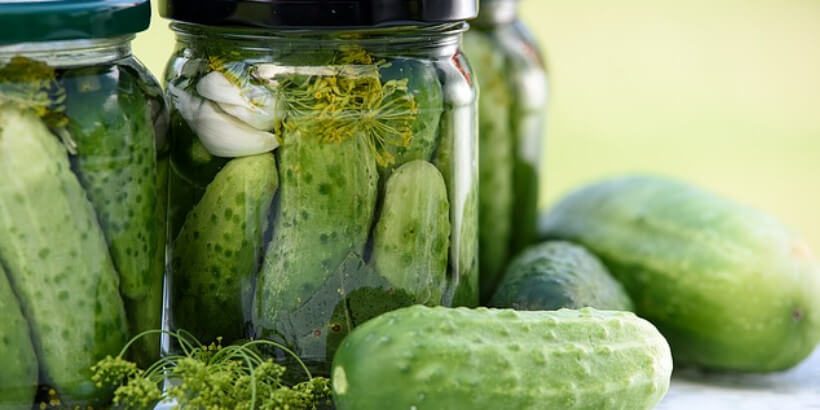
Sour pickles have a deep, robust taste, with a strong sourness that comes from the extended fermentation of the cucumbers in a brine solution. They are wonderfully sour and crisp with a flavor that’s guaranteed to make you smile.
The following is an excerpt from Wild Fermentation by Sandor Katz. It has been adapted for the web.
Growing up in New York City, experiencing my Jewish heritage largely through food, I developed a taste for sour pickles. Most of what is sold in stores as pickles, and even what home canners pickle, are preserved in vinegar.
My idea of a pickle is one fermented in a brine solution.
Pickle-making requires close attention. My first attempt at brine pickle-making resulted in soft, unappealing pickles that fell apart, because I abandoned it for a few days, and perhaps because the brine was not salty enough, and because of the heat of the Tennessee summer. And and and. “Our perfection lies in our imperfection.” There are, inevitably, fermentation failures. We are dealing with fickle life forces, after all.
I persevered though, compelled by a craving deep inside of me for the yummy garlic-dill sour pickles of Guss’s pickle stall on the Lower East Side of Manhattan and Zabar’s on the Upper West Side and Bubbie’s in upscale health food stores elsewhere. As it turns out, brine pickles are easy. You just need to give them regular attention in the summer heat, when cucumbers are most abundant.
One quality prized in a good pickle is crunchiness.
Fresh tannin-rich grape leaves placed in the crock are effective at keeping pickles crunchy. I recommend using them if you have access to grape vines. I’ve also seen references in various brine pickle recipes to using sour cherry leaves, oak leaves, and horseradish leaves to keep pickles crunchy.
The biggest variables in pickle-making are brine strength, temperature, and cucumber size. I prefer pickles from small and medium cucumbers; pickles from really big ones can be tough and sometimes hollow in the middle. I don’t worry about uniformity of size; I just eat the smaller ones first, figuring the larger ones will take longer to ferment.
The strength of brine varies widely in different traditions and recipe books. Brine strength is most often expressed as weight of salt as a percentage of weight of solution, though sometimes as weight of salt as a percentage of volume of solution. Since in most home kitchens we are generally dealing with volumes rather than weights, the following guideline can help readers gauge brine strength: Added to 1 quart of water, each tablespoon of sea salt (weighing about .6 ounce) adds 1.8% brine. So 2 tablespoons of salt in 1 quart of water yields a 3.6% brine, 3 tablespoons yields 5.4%, and so on. In the metric system, each 15 milliliters of salt (weighing 17 grams) added to 1 liter of water yields 1.8% brine.
Some old-time recipes call for brines with enough salt to float an egg.
This translates to about a 10% salt solution. This is enough salt to preserve pickles for quite some time, but they are too salty to consume without a long desalinating soak in fresh water first. Low-salt pickles, around 3.5% brine, are “half-sours” in delicatessen lingo.
This recipe is for sour, fairly salty pickles, using around 5.4% brine. Experiment with brine strength. A general rule of thumb to consider in salting your ferments: more salt to slow microorganism action in summer heat; less salt in winter when microbial action slows.
TIMEFRAME: 1 to 4 weeks
SPECIAL EQUIPMENT:
- Ceramic crock or food-grade plastic bucket
- Plate that fits inside crock or bucket
- 1-gallon/4-liter jug filled with water, or other weight
- Cloth cover
INGREDIENTS (for 1 gallon/4 liters):
- 3 to 4 pounds/1.5 to 2 kilograms unwaxed cucumbers (small to medium size)
- 3⁄8 cup (6 tablespoons)/90 milliliters sea salt
- 3 to 4 heads fresh flowering dill, or 3 to 4 tablespoons/45 to 60 milliliters of any form of dill (fresh or dried leaf or seeds)
- 2 to 3 heads garlic, peeled
- 1 handful fresh grape, cherry, oak, and/or horseradish leaves (if available)
- 1 pinch black peppercorns
PROCESS:
- Rinse cucumbers, taking care to not bruise them, and making sure their blossoms are removed. Scrape off any remains at the blossom end. If you’re using cucumbers that aren’t fresh off the vine that day, soak them for a couple of hours in very cold water to freshen them.
- Dissolve sea salt in 1/2gallon (2 liters) of water to create brine solution. Stir until salt is thoroughly dissolved.
- Clean the crock, then place at the bottom of it dill, garlic, fresh grape leaves, and a pinch of black peppercorns.
- Place cucumbers in the crock.
- Pour brine over the cucumbers, place the (clean) plate over them, then weigh it down with a jug filled with water or a boiled rock. If the brine doesn’t cover the weighed-down plate, add more brine mixed at the same ratio of just under 1 tablespoon of salt to each cup of water.
- Cover the crock with a cloth to keep out dust and flies and store it in a cool place.
- Check the crock every day. Skim any mold from the surface, but don’t worry if you can’t get it all. If there’s mold, be sure to rinse the plate and weight. Taste the pickles after a few days.
- Enjoy the pickles as they continue to ferment. Continue to check the crock every day.
- Eventually, after one to four weeks (depending on the temperature), the pickles will be fully sour. Continue to enjoy them, moving them to the fridge to slow down fermentation.
Recommended Reads
Read The Book

Wild Fermentation
The Flavor, Nutrition, and Craft of Live-Culture Foods, 2nd Edition
$29.95
You may like...
-
 $27.95
-
$34.95
-
$34.95


Recent Articles

This bright, yet delicate flavor profile is both sweet and sour – a unique taste that you’ll keep coming back to. This recipe is intended for long, slow fermentation starting at persimmon harvest time in the autumn and continuing into winter.
Read More
This triple apple snack cake uses applesauce, cider, and apples for a one-two-three apple punch. Don’t take our word for it though, give it a go yourself!
Read More
These small fruits are a delicious source of nutrients that you can find almost anywhere. Get started on acorn harvesting with help from these simple tips!
Read More
Want an on-the-go snack without having to go to the grocery store? Whip up this homemade applesauce for a fresh fall snack whenever you get the craving!
Read More
The possibilities are pretty much endless with wild ingredients — use almost any fresh fruit or juice and a sweetener to create your own custom jam or syrup!
Read More