

The Perfect Slice: Watermelon Radish and Preserved Lemon Gremolata
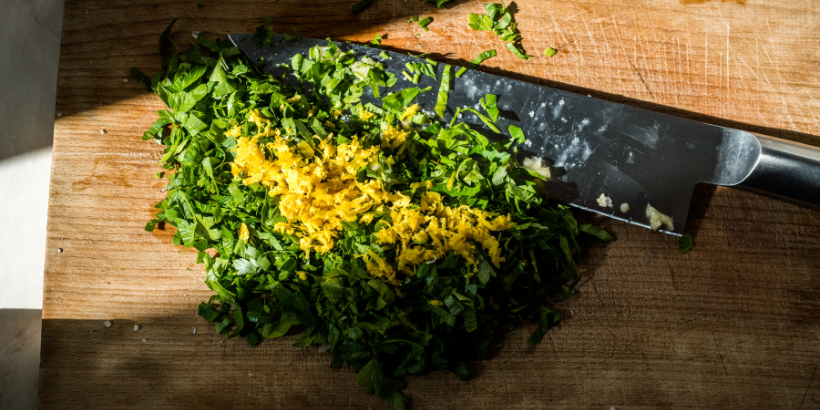
Gremolata is most commonly used for a final flourish of flavor to add a fresh taste to rich meaty dishes. This traditional Italian condiment is sprinkled over any number of dishes and it will make every mouthful pop with its bright flavor. It is a great addition to grilled meat, roasted or grilled vegetables, and pasta dishes.
This recipe uses watermelon radishes and preserved lemons, resulting in a fresh and flavorful combination.
The following is an excerpt from Black Trumpet by Evan Mallett. It has been adapted for the web.
RECIPE: Watermelon Radish and Preserved Lemon Gremolata
At the risk of offending home cooks, most folks don’t have in their possession sharp enough knives or the requisite skills to make beautiful gremolata, but I believe everyone can, and should, learn the basic culinary knife skills if he or she wants to execute food like a chef.
Gremolata, traditionally served with veal chops or other grilled meats, also tastes great on plump fish like halibut or grouper. On our menu, this particular gremolata garnished a braised beef short rib.
If you don’t have time to preserve lemons on your own, preserved lemons are increasingly common, available in most specialty food stores, especially those with Middle Eastern products.
Ingredients
- 1 large watermelon radish, brunoised (see Brunoise: Cuts to Create the Perfect Gremolata)
- 1 medium shallot, brunoised
- 1 large clove garlic, minced
- 2 tablespoons finely chopped flat-leaf fresh parsley
- 2 tablespoons finely chopped. fresh chervil
- 1⁄2 preserved Meyer lemon, the rind separated from the interior of the lemon, and brunoised (throw away the interior or save for a salad dressing or brine)
- 2 tablespoons plus 1 teaspoon olive oil
- 3⁄4 teaspoon salt
Procedure
Combine all the ingredients in a large bowl. Serve immediately, or refrigerate for up to 2 days.
Brunoise: Cuts to Create the Perfect Gremolata

For making gremolatas and mignonettes, this cut is important. The uniformity of cuts gives all the proverbial players on the field equal playing time on the palate, and the diminutive size of the cut maximizes flavor in a short period of time.
And, a well-cut brunoise gives its creator bragging rights. When you serve a mignonette or gremolata at a party, you want to be able to boast, “Have you seen my brunoise?”
To execute this cut, and not your fingertips, follow these simple instructions.
For a shallot, top and tail the shallot, then cut it in half in the direction of the fiber. Peel the skin off both halves and place flat-side down. Parallel to the cutting surface, slide the sharp knife almost through the shallot four or five times in increments of 1⁄16 inch (0.2 cm).
Now cut in the same direction straight up and down, at the same increment, again not quite all the way through the shallot. Finally, perpendicular to the first two sets of cuts, keeping your fingertips away from the blade, cut straight up and down to form tiny shallot cubes.
For almost all other vegetables, begin by “squaring off” what nature gives us in a spherical or cylindrical form, snacking on the scraps, saving them for dipping in hummus or other dips, or adding them to a vegetable stock. The resulting rectangular cube can then be easily cut in minuscule, even intervals to resemble the shallot brunoise in size and shape.
For the lemon rind in the gremolata recipe, remove the rind, lay it flat on the board, and cut into thin strips and then crosswise into tiny cubes.
Recommended Reads
Read The Book

Black Trumpet
A Chef's Journey Through Eight New England Seasons
$40
You may like...
-
 $40.00
 -
$34.95
-
$39.95


Recent Articles

This recipe is inspired by the classic maple taffy-like candy Sugar on Snow. A much enjoyed tradition! Unlike flavor-neutral simple syrup, maple syrup’s contribution to cocktails isn’t just sweetness but also buttery, nutty & vanilla flavors.
Read More
Unwind with a twist! Ditch the booze and elevate your evenings with this delightful herbal nightcap mocktail syrup. Relax before bed or spice up your tea time!
Read More
Searching for a new way to utilize seasonings? Shake up your cooking routine with a fresh twist on salt and seasonings. Introducing… Mint Salt Recipe!
Read More
Warm up from the inside out with Fire Cider! Great for stimulating digestion and warming you up from the inside out, no matter the season. It can be prepared in water or tea as desired.
Read More
Ready to shake up your fermentation game? Try making Kvass, the ultimate beginner-friendly recipe! This nourishing beverage calls for just a few simple ingredients and only takes a couple of days to ferment. It’s easy, delicious & perfect for beginners.
Read More