

How to Make Fermented Farinata: Italian Chickpea Flour Cake
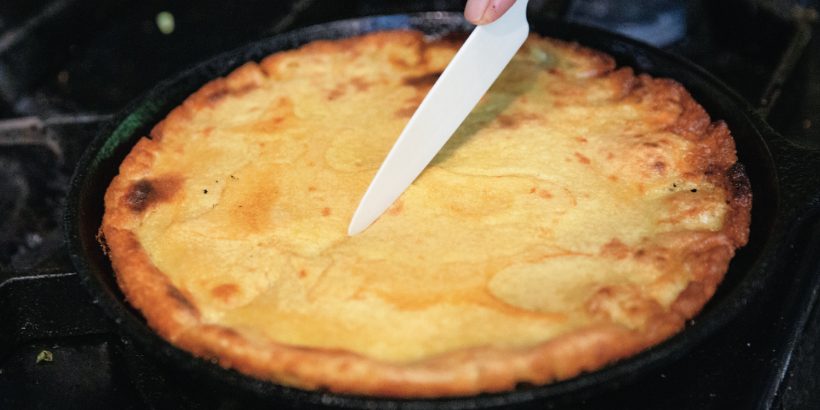
What is Farinata? We’re glad you asked! Farinata is an Italian fried cake made from chickpea flour. Sanor Katz describes it as “a luscious, light, and creamy treat that is almost like a fluffy omelet or soufflé.”
The following is an excerpt from Sandor Katz’s Fermentation Journeys by Sandor Ellix Katz. It has been adapted for the web.
What Is Farinata?
Farinata is an Italian fried cake made from chickpea flour. Variations of it are eaten in different regions of Italy, as well as France, and beyond. It is known by a variety of names, among them socca, fainá, cecina, and torta di ceci.
I was curious about these chickpea cakes, because I have often been asked what bean fermentation traditions exist outside of Asia, where the practice is so widespread. I have not encountered farinata in my travels, but I have done some investigating and experimenting.
None of the recipes I have found for farinata call explicitly for fermenting it.
They all mention letting the batter sit for a period, with suggestions ranging from 20 minutes to hours. According to Enrica Monzani, who studies, teaches, and blogs about the cuisine of her native province of Liguria in Italy, the proper amount of time is “at least four hours, better eight.”
Her blog, A Small Kitchen in Genoa, guided me as to proportions and technique for making farinata.
According to Enrica, the reason for the long soak is because “the flour must absorb the water very well.” No doubt this is true, and when the ingredients need time to sit together, what happens if you give them more time, measured in days rather than hours?
RECIPE: Fermented Farinata
In my experiments, fermenting the farinata batter for a day or two or three, until the batter gets frothy and foamy, makes for a luscious, light, and creamy treat that is almost like a fluffy omelet or soufflé.

Equipment
- Whisk
- Copper or cast-iron crepe pan with a 10-inch/25-centimeter diameter (If you use a bigger pan, scale up the recipe so that the layer of fresh batter in the pan maintains a depth of about ¹/4 to ¹/3 inch/7 to 9 millimeters)
Ingredients
For one 10-inch/25-centimeter cake
- 3/4 cup / 100 grams chickpea flour
- 1 teaspoon / 5 grams salt
- 3 1/2 tablespoons / 50 grams olive oil (or other vegetable oil)
- A small amount of finely sliced vegetables (onion, sweet pepper, artichoke hearts, mushrooms, anything) and/or grated or crumbled cheese, to sprinkle onto the surface of the farinata (optional)
Process
- Combine the chickpea flour with 10 ounces/300 milliliters water, using a whisk to work it well and eliminate any lumps of flour. (Do not add salt until later.)
- Ferment this batter, loosely covered, for a few days (shorter in warmer places, longer in cooler places).
- Whisk at least once each day, until you notice that it is getting frothy. Then, it is ready to use.
- Preheat the oven at its highest setting.
- Preheat the pan in the oven. I use a cast-iron pan. A lot of the recipes specify a copper pan, which, alas, I do not have.
- While the pan is heating, add the salt to the batter and give it its final whisking.
- Carefully remove the hot pan from the oven.
- Add the oil and make sure it spreads evenly over the entire surface of the hot pan.
- See “An Important Detail of Farinata Technique” for Enrica’s most helpful advice about how to pour the batter into the hot oil gently, so it floats above the oil rather than mixing with it. Slowly pour the batter down the length of a wooden spoon, held at a 45-degree angle just above the center of the pan, onto the hot oil.
- If desired, sprinkle some small pieces of vegetables or cheese or whatever else you can imagine onto the surface of the batter.
- Place the pan on the bottom rack of the oven and bake for 10 to 15 minutes, until it has set and it is golden in color.
- Broil for a few more minutes to brown the surface.
- Cool for a minute, then cut into pieces.
- Enjoy farinata fresh and still warm.
Recommended Reads
Read The Book

Sandor Katz's Fermentation Journeys
Recipes, Techniques, and Traditions from around the World
$35
You may like...
-
 $39.95
 -
$29.95
-
$29.95


Recent Articles

Eating wild food is a radical act! Look no further than the ultimate comfort dinner recipe: Juniper & Elderberry Braised Short Ribs — served up alongside tips on how to forage juniper berries.
Read More
Before yanking out the next patch of lambsquarter you find in your yard or garden, consider trying one of the many edible and medicinal uses of this “super weed.”
Read More
Looking to add another recipe to your fermenting repertoire? This recipe for kvass calls for just a few ingredients and only takes a couple days to ferment.
Read More
Having a lack of outdoor greenspace doesn’t mean you can’t enjoy homegrown food. Sprouts are a quick, simple, and healthy way to keep your appetite satisfied.
Read More
Yogurt making is having a moment! Join the fun and create your own natural yogurt at home. Try our simple recipe using kefir as a starter and taste the difference for yourself!
Read More