

Pros and Cons of Tillage
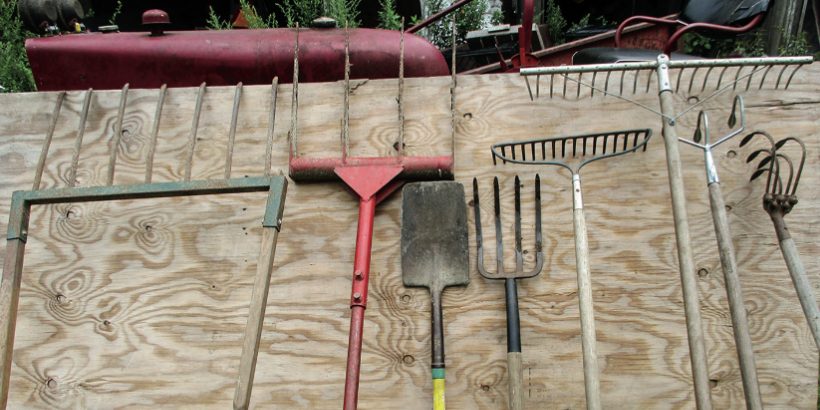
When it comes to tilling your soil, less equals more. “Why?” you may ask? Traditional tilling is exceptionally damaging to the soil in the long run. Occasional tillage may be necessary, such as before you start growing vegetables, or when you need to add supplements to depleted areas. In these cases, use a hand tool or a simpler tractor-till to save your soil.
The following is an excerpt from No-Till Intensive Vegetable Culture by Bryan O’Hara. It has been adapted for the web.
(All photography by Bryan O’Hara.)
Tillage, though inherently detrimental, can also provide some benefits to the vegetable grower. The natural state of agriculturally suitable land is a cover of perennial vegetation such as grasses, shrubs, and trees. Tillage is the traditional method to convert such land to vegetable production.
Most vegetables are fast-growing annuals, and annual plants are nature’s response to disturbance.

Our tractor-mounted tillage tools include a moldboard plow, a tined rod weeder, and a water-filled drum roller. We use these when converting new grow- ing areas to no-till.
Thus vegetables, to some degree, are a reasonable plant to cover a tilled soil. Tilling not only quickly converts land out of its natural perennial growth but also creates a surface that is appropriate for seeding or planting. Tillage destroys weeds and mixes fertilizers and organic materials into the soil profile and can break up plow pans and surface crusts.
Thus tillage may have beneficial results in terms of air and water movement, soil temperature, and residue decay. The need for many of these improvements, however, may actually arise from inappropriate past tillage events. To some degree tillage may lead to conditions where more tillage is needed, a sort of tillage treadmill effect.
For growers to best utilize tillage for potential benefits and avoid perpetuating the need for tillage, they must first identify a clear purpose for tilling and understand the damage that tillage events may cause. This provides the best chance that they will achieve their goal and inflict the least possible damage. Though nature is forgiving, over time repeated disturbance by tillage can wear down a soil’s ability to effectively recover.
The deterioration of soil structure leading to soil crusting and subsurface plow pans, increased erosion of soil, destruction of soil life, and the dramatic impact on the soil temperature and imbalance of soil air:water biology and nutrients are just the short list. The ramifications of these conditions on crop health can be extensive. Weeds respond to the disturbance with rampant growth. Damage and imbalance to the soil biology lead to nutrient imbalances that if unmanaged by growers quickly lead to disease and insect assault as well as poor growth with all manner of production difficulties, leading to lack of profitability. Fortunately, there is a better way.

A chisel plow can cut deep but produce minimal soil disturbance, even in a high-residue environment.
The transition from tillage systems to reduced tillage and finally to no-till is often gradual. As well, no-till may not be a permanent field condition, and some form of tillage may be reintroduced in order to achieve a specific goal such as eliminating an infestation of aggressive perennial weeds, with an eventual return to no-till when that goal is achieved.
Growers whose systems presently incorporate tillage may need to approach the conversion to reduced and no-tillage carefully, because it may take time to learn the intricacies of a new system. Experimentation with various methods on smaller areas as opposed to going cold turkey with tillage may well be more financially stable.
Likely there is no soil that would not benefit from an appropriate no-till system, as tillage is inherently unnatural and disruptive to soil biology and function.
No-till, in common agricultural terms, is often synonymous with herbicide usage, as the herbicide performs the primary function of elimination of existing vegetation.
Recommended Reads
Read The Book

No-Till Intensive Vegetable Culture
Pesticide-Free Methods for Restoring Soil and Growing Nutrient-Rich, High-Yielding Crops
$32.95
You may like...
-
 $24.95
 -
$45.00
-
$39.95


Recent Articles
Having an indoor sprout garden is easier than you might think and yields a bountiful harvest. Here’s how to get started — right from your windowsill!
Read More
Growing no-till arugula is a simple way to grow your own food. These greens can be used on pizzas, salads, and as a garnish on almost any dish.
Read More
The leaves are falling, which means it’s time start figuring out what to do with them. This year, try turning your fallen leaves into mulch for your garden!
Read More
Enjoy fresh produce all year long by growing your own food! Achieving a twelve-month growing season is as simple as using the right crop protection structure.
Read More
Beets can be grown year-round and are a perfect, flavorful addition to meals. Get started on growing your own no-till beets with help from these tips!
Read More