

The Endless Arugula Bed
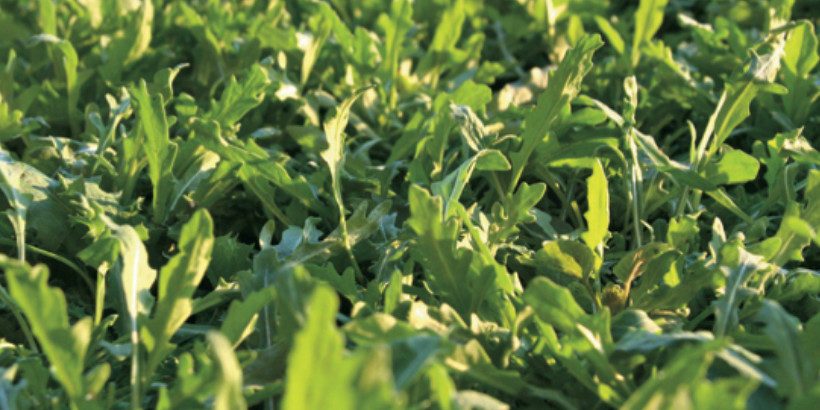
What if we told you that there was a way to extend your growing season and save time & money? The answer is all in arugula.
With quick hoops and greenhouse film, you’ll be on your way to harvesting sweet & flavorful arugula in no time.
The following excerpt is from The Resilient Farm and Homestead, Revised and Expanded Edition by Ben Falk. It has been adapted for the web.
The Growing Power of Arugula
The power of overwintering plants so they can begin growing again in the spring was fully realized at the WSRF in the late winter and early spring of 2012, beginning with a late September 2011 sowing of arugula from seed in a 3’–8′ raised bed.
This bed was established in September 2011 with a local college course group that was visiting the farm for the day.
The students and I filled a slew of newly built raised beds on the south side of the WSD workshop and seeded them immediately, most with cover crops, one with garlic, and one with arugula.
The remaining days in September and much of early October were mild and rainy—perfect to start the arugula, which had been broadcast and spread by hand.

Silvetta arugula is almost impossible to beat for an early- and lateseason crop in this very cold climate.
Arugula In the Winter
By the time the real cold of winter set in around mid-December (late compared to normal), the arugula had reached about three inches in height and filled the surface area of the bed.
At this point the plants stopped growing.
They went through the winter in this condition covered by one layer of greenhouse film draped over metal “quick hoops” (one-eighth inch or flexible metal rods bent into a half hoop over beds).
During the coldest time of the year, the arugula died back to near the surface of the soil. Although I thought they might have died, by February the tiny plants had greened up.
Some Spring In the Step
A heat wave in March (seemingly more common each year now) caused the plants to begin rapid regrowth, and by mid-March we were eating the sweetest, most flavorful arugula I’d ever tasted.
We then proceeded to harvest this bed in cut-and-come-again style about eight times, taking a week or less between harvests.
Finally, at the end of May, the arugula began to become slightly bitter and very spicy—perfect for pesto. We then harvested the whole bed at once and ran it through the food processor with olive oil, sunflower seeds, pepper, and some green garlic pulled from the burgeoning garlic beds.
Arugula Growing Considerations
Looking back, I figure that this bed produced the equivalent of $250 to $350 worth of leafy greens if bought from the local co-op at the going late-winter/early-spring rate of $8 a pound.
Beyond those savings is an equal or greater value: These greens tasted far better than arugula from the market—and of course they did!
Every time we ate these greens, they were mere minutes old. Fresher, nearly free, and from the remineralized soils we made, such greens are guaranteed to be nutrient dense.
The value of taking five steps out the kitchen door to harvest a salad while the rest of the meal is on the stove is also immeasurable.
Recommended Reads
Read The Book

The Resilient Farm and Homestead, Revised and Expanded Edition
20 Years of Permaculture and Whole Systems Design
$44.95
You may like...
-
 $29.95
 -
$44.95
-
$34.95


Recent Articles

All hail the mighty garlic clove! Become a master at garlic growing with these simple tips for growing no-till garlic from seed to harvest.
Read More
Try your hand at preserving veggies by freezing them! Freezing vegetables is a quick, simple way to preserve them for winter meals.
Read More
If you keep your hens in a stationary coop, you’re missing out on their soil building talents. Un-coop that poop by putting your flock in chicken tractors!
Read More
Growing mushrooms on logs is an easy way to cultiavte your own fungi! Work in tandem with nature to grow many varieties of mushrooms.
Read More
As your favorite variety of home grown tomatoes start ripening on the vine this summer, be sure to save those seeds for next year’s planting.
Read More