

How to Preserve Olive Fruit Leather in 5 Easy Steps
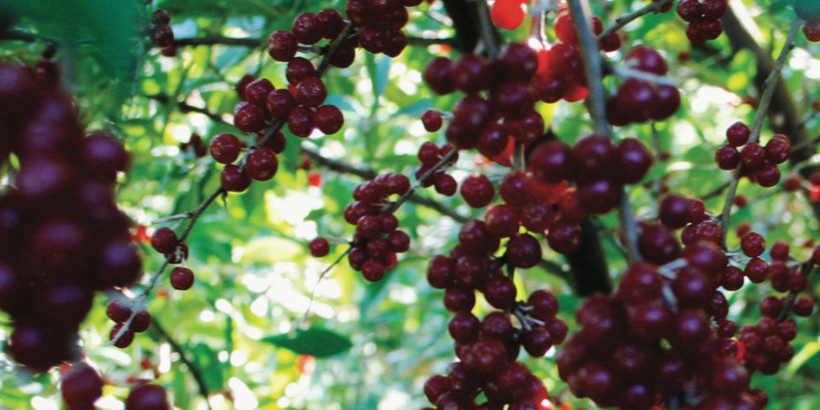
Autumn olives are quite the berry. No added sugar is required! Give it a try and keep some delicious and nourishing olive fruit leather on hand for whenever you get the craving.
The following excerpt is from Wild Flavors: One Chef’s Transformative Year Cooking from Eva’s Farm by Didi Emmons. It has been adapted for the web.
Russ Cohen’s Autumn Olive Fruit Leather
Forager, environmentalist, and teacher Russ Cohen doles out a little fruit leather to his students before they begin a foraging tour. Everyone marvels at the sweet flavor, including me! To make this leather it’s helpful to have a dehydrator, but you can also make it on top of a woodstove or in an oven warmed by the pilot light. (Traditionally, of course, fruit is dehydrated by the sun.)
Russ sees this leather as the best way to use autumn olive berries, which are quite tart when fresh, because the drying process concentrates the sugars, so much so that he need not add sugar. Which is unusual, Russ says, since he’s found that he generally needs to add at least a little sugar to all leathers, even wild grape leather.
INGREDIENTS
1 gallon or more autumn olives
PROCESS
- Place the berries in a large, heavy-bottomed pot. Add water to a depth of approximately J inch in the pot, to prevent the fruit from scorching. Heat to a low simmer, and let simmer (no boiling) for 30 minutes, stirring occasionally.
- Run the cooked fruit through a food mill. Then pass it through a sieve to get a very thick, tomato-sauce-like consistency. The pulp that’s left behind in the sieve is not a waste product—save it and add it to your morning cereal!
- Line the trays of a dehydrator with the fruit roll sheet accessory or parchment paper. Pour the fruit puree into a gravy boat or an old soy milk carton. Drizzle the puree onto the prepared trays in the thinnest layer possible.
- Dry the fruit leather at 135 degrees F, or according to the dehydrator manufacturer’s instructions, for 12 hours. Rotate the trays and dry for another 12 hours.
- Cut the leather into strips and store in ziplock bags; they’ll keep indefinitely.
Recommended Reads
The Radiant Raspberry: Foraging For and Cooking With Wild Raspberries
You may like...
-
 $29.95
 -
$25.00
-
$40.00


Recent Articles

There are reasons that miso paste has become popular around the world: it’s versatile, relatively inexpensive, and can be made in a range of flavors you’d be hard-pressed to find anywhere else. And better yet, you can even make miso at home!
Read More
Wondering where to forage for greens this spring? Look no further than hedges, which serve as natural havens for wild greens and herbs!
Read More
Homemade cheese doesn’t have to be complicated, all you really need is a handful of ingredients, time and a love of cheese.
Read More
Get ready for a comfort dish like no other! Our short ribs recipe features foraged juniper berries for a unique twist. Ever wondered how to forage your own? We’ve got you covered with expert tips!
Read More
Think twice before pulling out that lambsquarter! It is a “super weed” with many edible & medicinal uses. Discover the surprising benefits of lambsquarter!
Read More