

When to Plant: Determining When Crops Thrive
Most people know that different crops thrive in different seasons and climates and that each crop has ideal growing conditions. But, did you know that the moon also has a significant influence over the productivity and health of plants? Paying attention to the proximity, declination, and phase of the moon will help you determine when to plant.
The following is an excerpt from No-Till Intensive Vegetable Culture by Bryan O’Hara. It has been adapted for the web.
The time when a crop is grown also has dramatic influence on its productivity.
Sunlight availability and temperature among other environmental factors have a dramatic impact on crop growth. If a crop is very heat loving like eggplant, and the plants are set out too early they will not recover and yield to the extent that a later planting will.
This is true of many heat-loving crops. The same is true of cool-loving crops. Spinach seed will germinate in our soils in August, yet these early seedings do not have the vigor and yield of later seedings in September and October. So most crops have particular times of the year best suited to their growth. However, growing these crops slightly out of their season is often the most profitable avenue, due to high demand. All the more reason to have environmental and soil conditions in place that can support such off-season growth.
The amount of sunlight and warmth is the primary factor that determines the best time of year for a particular crop to grow; there is also the moon’s dramatic influence on growth to consider. In terms of seeding crops, we pay attention to three moon dynamics: the proximity, the declination, and the phase of the moon. The proximity of the moon to the earth is determined by its elliptical orbit and has a cycle of 27.5 days. When the moon is moving closer to the earth is potentially a time of benefit for seeding. 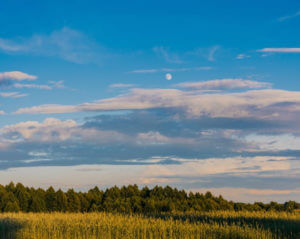
The moon’s influence on crops and many other conditions like tides is greatest when it is in closest proximity (at perigee) to the earth. The declination is the height or angle of the moon as it moves across the sky. The moon’s pattern of movement is very similar to the sun’s apparent movement in this regard, but instead of taking a year to complete a cycle, the moon completes its cycle in 27.3 days. When the moon is ascending in the sky, similar to the sun in spring, it is generally regarded as a period for seeding.
The phases of the moon are probably the most traditionally watched indicator for the seeding of a crop. The period from the new moon to full moon (waxing period) is considered best for the start of growth. If all three moon factors line up positively—waxing, ascending, and approaching perigee—then it may be best to reduce seed rate. If the moon is waning, descending, and approaching apogee (farthest distance from the earth), then it may be time to increase the seed rate.
To some degree, we try to carry out seeding during more favorable lunar conditions, but sometimes a crop will need to be seeded regardless of lunar position. There are also the celestial positions of the sun and moon as well as the other planetary bodies that are influencing conditions; here a study and understanding of astrology can be useful.
Recommended Reads
Read The Book

No-Till Intensive Vegetable Culture
Pesticide-Free Methods for Restoring Soil and Growing Nutrient-Rich, High-Yielding Crops
$32.95
You may like...
-
 $29.95
 -
$29.95
-
$34.95


Recent Articles
Having an indoor sprout garden is easier than you might think and yields a bountiful harvest. Here’s how to get started — right from your windowsill!
Read More
Growing no-till arugula is a simple way to grow your own food. These greens can be used on pizzas, salads, and as a garnish on almost any dish.
Read More
The leaves are falling, which means it’s time start figuring out what to do with them. This year, try turning your fallen leaves into mulch for your garden!
Read More
Enjoy fresh produce all year long by growing your own food! Achieving a twelve-month growing season is as simple as using the right crop protection structure.
Read More
Beets can be grown year-round and are a perfect, flavorful addition to meals. Get started on growing your own no-till beets with help from these tips!
Read More