

From the Homemade Hooch Files: How to Make Dandelion Wine
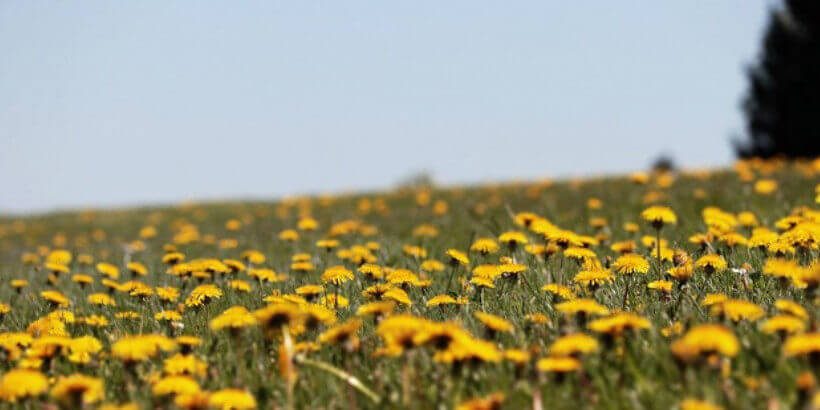
Heads up: you definitely don’t want to be spraying weed killer on your dandelions. If your lawn is a total dandelion breeding ground, you are so close to having some delicious wine! Get out there and pick some so you can get started on fermenting a batch of flower wine. This drink is not only tasty, but is said to have liver-cleansing properties as well!
The following is an excerpt from Wild Fermentation by Sandor Katz. It has been adapted for the web.
“Wine made from flowers preserves the exquisite flavors and benevolent properties of the blossoms from which it is made. It also preserves the memories of fine, clear, sunshiny days—alone or with Someone Else—in woods, meadows, and hills, picking millions of tiny flowers for hours until they become etched on the insides of the eyelids.” These wise words were written by my friend and neighbor Merril Harris, in an article, “Nipping in the Bud: How to Make Wine from Flowers,” published in Ms. Magazine nearly thirty years ago.
Dandelion wine is the classic flower wine, made with the bright yellow flowers of the plentiful and easy-to-find weed. Don’t believe the hype of the manicured lawn lobby; dandelion is not only beautiful and tasty, but potent liver-cleansing medicine. Many other flowers can transfer their delicate bouquets and distinctive essences into wines, as well, including (but certainly not limited to) rose petals, elderflowers, violets, red clover blossoms, and daylilies.
“Begin by gathering your flowers,” writes Merril, “perhaps the most pleasurable part of the winemaking process.” As a general guideline, pick about a gallon of flowers per gallon of wine you intend to make. If you cannot gather this many in a single outing, freeze what you gather until you accumulate enough. Be sure to pick flowers from places that have not been sprayed, which usually means not roadsides.
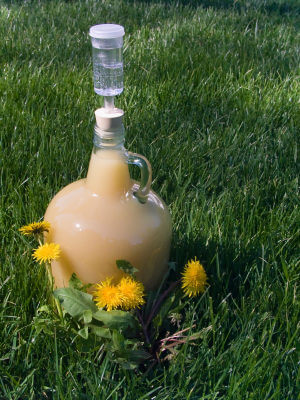 Yields 1 gallon/4 liters
Timeframe:
1 year or more
Equipment:
- Crock, bowl, or bucket of at least 1-gallon/4-liter capacity to allow for vigorous stirring
- 1-gallon/4-liter jug or carboy with air lock
Ingredients:
- 1 gallon/4 liters flowers in full bloom
- 2 pounds/1 kilogram (4 cups/1 liter) sugar
- 2 lemons (organic, because you will use the peel)
- 2 oranges (organic, because you will use the peel)
- 1 pound/500 grams raisins (golden raisins will preserve the dandelion’s light hue better than dark raisins)
- Water
- 1 ⁄ 2 cup/125 milliliters berries (for wild yeast) or 1 packet wine yeast
Process:
- As much as possible, separate flower petals from the base of the blossoms, which can impart bitter flavors. With dandelions this can be a tedious project.
- Reserving about ½ cup/125 milliliters to add later in the process, place the flower petals in a crock with the sugar, the juice and thinly peeled rinds of the lemons and oranges (to add acidity), and the raisins (to introduce astringent tannins). Then pour 1 gallon (4 liters) of boiling water over these ingredients, and stir until sugar is dissolved. Cover the crock to keep flies away, and leave to cool to body temperature.
- Once the mixture cools, add the reserved flower petals and berries to introduce wild yeasts. (Or to use commercial yeast, remove 1 cup of the cooled mixture, dissolve a packet of yeast into it, and once it starts to bubble vigorously add it to the crock.) Cover the crock, and stir as often as you think of it, for 3 to 4 days.
- Strain out the solids through a clean cheesecloth and squeeze moisture out of the flowers. Then transfer liquid to a carboy or jug with an airlock, and ferment about 3 months, until fermentation slows.
- Siphon into a clean vessel and ferment at least 6 months more before bottling.
- Age bottles at least 3 months to mellow wine; even longer is better.
Recommended Reads
Read The Book

Wild Fermentation
The Flavor, Nutrition, and Craft of Live-Culture Foods, 2nd Edition
$29.95
You may like...
-
 $29.95
 -
$39.95
-
$24.95


Recent Articles

This bright, yet delicate flavor profile is both sweet and sour – a unique taste that you’ll keep coming back to. This recipe is intended for long, slow fermentation starting at persimmon harvest time in the autumn and continuing into winter.
Read More
Growing no-till arugula is a simple way to grow your own food. These greens can be used on pizzas, salads, and as a garnish on almost any dish.
Read More
This triple apple snack cake uses applesauce, cider, and apples for a one-two-three apple punch. Don’t take our word for it though, give it a go yourself!
Read More
The leaves are falling, which means it’s time start figuring out what to do with them. This year, try turning your fallen leaves into mulch for your garden!
Read More
These small fruits are a delicious source of nutrients that you can find almost anywhere. Get started on acorn harvesting with help from these simple tips!
Read More