

The Carbon Farming Solution
A Global Toolkit of Perennial Crops and Regenerative Agriculture Practices for Climate Change Mitigation and Food Security

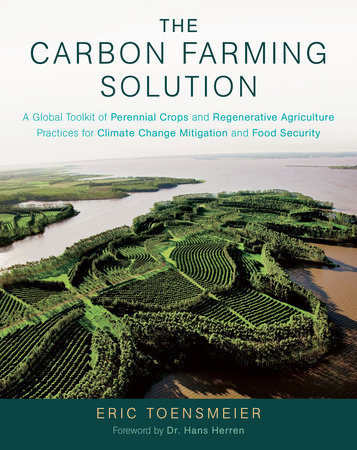
EXCERPTS
| Pages: | 512 pages |
| Book Art: | Color photos tables, charts & illustrations |
| Size: | 8-1/2 x 10-1/2 inch |
| Publisher: | Chelsea Green Publishing |
| Pub. Date: | February 8, 2016 |
| ISBN: | 9781603585712 |
The Carbon Farming Solution
A Global Toolkit of Perennial Crops and Regenerative Agriculture Practices for Climate Change Mitigation and Food Security
With carbon farming, agriculture ceases to be part of the climate problem and becomes a critical part of the solution
“This book is the toolkit for making the soil itself a sponge for carbon. It’s a powerful vision.”—Bill McKibben
“The Carbon Farming Solution is a book we will look back upon decades from now and wonder why something so critically relevant could have been so overlooked until that time. . . . [It] describes the foundation of the future of civilization.”—Paul Hawken
In this groundbreaking book, Eric Toensmeier argues that agriculture—specifically, the subset of practices known as “carbon farming”—can, and should be, a linchpin of a global climate solutions platform.
Carbon farming is a suite of agricultural practices and crops that sequester carbon in the soil and in above-ground biomass. Combined with a massive reduction in fossil fuel emissions—and in concert with adaptation strategies to our changing environment— carbon farming has the potential to bring us back from the brink of disaster and return our atmosphere to the “magic number” of 350 parts per million of carbon dioxide. Toensmeier’s book is the first to bring together these powerful strategies in one place.
Includes in-depth analysis of the available research.
Carbon farming can take many forms. The simplest practices involve modifications to annual crop production. Although many of these modifications have relatively low sequestration potential, they are widely applicable and easily adopted, and thus have excellent potential to mitigate climate change if practiced on a global scale. Likewise, grazing systems such as silvopasture are easily replicable, don’t require significant changes to human diet, and—given the amount of agricultural land worldwide that is devoted to pasture—can be important strategies in the carbon farming arsenal. But by far, agroforestry practices and perennial crops present the best opportunities for sequestration. While many of these systems are challenging to establish and manage, and would require us to change our diets to new and largely unfamiliar perennial crops, they also offer huge potential that has been almost entirely ignored by climate crusaders.
Many of these carbon farming practices are already implemented globally on a scale of millions of hectares. These are not minor or marginal efforts, but win-win solutions that provide food, fodder, and feedstocks while fostering community self-reliance, creating jobs, protecting biodiversity, and repairing degraded land—all while sequestering carbon, reducing emissions, and ultimately contributing to a climate that will remain amenable to human civilization. Just as importantly to a livable future, these crops and practices can contribute to broader social goals such as women’s empowerment, food sovereignty, and climate justice.
The Carbon Farming Solution is—at its root—a toolkit and the most complete collection of climate-friendly crops and practices currently available.
With this toolkit, farmers, communities, and governments large and small, can successfully launch carbon farming projects with the most appropriate crops and practices to their climate, locale, and socioeconomic needs.
Toensmeier’s ultimate goal is to place carbon farming firmly in the center of the climate solutions platform, alongside clean solar and wind energy. With The Carbon Farming Solution, Toensmeier wants to change the discussion, impact policy decisions, and steer mitigation funds to the research, projects, and people around the world who envision a future where agriculture becomes the protagonist in this fraught, urgent, and unprecedented drama of our time. Citizens, farmers, and funders will be inspired to use the tools presented in this important book to transform degraded lands around the world into productive carbon-storing landscapes.
Reviews & Praise
“This indispensable book needs to be put in the hands of all climate-change policy makers, agrarians, and people who eat food, drink water, and breathe air. Mr. Toensmeier’s book is not ground-breaking—it is ground-healing!”—Brock Dolman, director, Permaculture Program and WATER Institute at Occidental Arts and Ecology Center
“The Carbon Farming Solution is a book we will look back upon decades from now and wonder why something so critically relevant could have been so overlooked until that time. . . The title is accurate but humble: The Carbon Farming Solution describes the foundation of the future of civilization.”—Paul Hawken, author of Blessed Unrest
“The Carbon Farming Solution is a book whose time has come. . . [and] is of enormous importance.”—John D. Liu, founder and director, Environmental Education Media Project (EEMP)
“This book offers what governments at present spectacularly do not: hope.”—Colin Tudge, author of Good Food for Everyone Forever and Why Genes Are Not Selfish and People Are Nice
“Packed with an enormous amount of information about seven hundred plant species that have a role to play in saving the planet from land degradation and climate change, while at the same time improving the lives of millions of poor farmers, especially in the tropics and sub-tropics, . . . The Carbon Farming Solution offers a path to a bright new world!”—Professor Roger Leakey, vice chairman of the International Tree Foundation and author of Living with the Trees of Life
“Dealing with climate change requires action on many fronts, and this book is the toolkit for making the soil itself a sponge for carbon. It’s a powerful vision, one that I’ve seen playing out in enough places to make me very hopeful it can presage major changes in our species’ use of the land.”—Bill McKibben, author of Deep Economy
“In The Carbon Farming Solution, Eric Toensmeier admirably harnesses available data with traditional wisdom to propose a practical response to climate change. Toensmeier’s solution-oriented ideas combine his clear understanding of ecology, agriculture, and the magnitude of the challenge we face with a set of agriculture-based solutions that are suited to various livelihoods, communities, and systems of production. This book will surely be a benchmark in policy-relevant knowledge.”—Dr. Cheikh Mbow, senior scientist on climate change and development, World Agroforestry Centre
"Summing Up: Recommended. All library collections.”—Choice
"Toensmeier covers the science of carbon sequestration, perennial crop cultivation, and key financing tips . . . [and] provides invaluable information and inspiration to farmers and agricultural entrepreneurs as well as everyone interested in environmentally positive farming as part of the effort to protect food sources and mitigate global warming.”—Booklist
"VERDICT: Both small- and large-scale farmers will find ways to apply methods that segregate carbon and therefore lessen the deleterious effects of climate change in this comprehensive title.”—Library Journal

About Eric Toensmeier
Eric Toensmeier is the award-winning author of Paradise Lot and Perennial Vegetables, and the co-author of Edible Forest Gardens. Eric is an appointed lecturer at Yale University, a Senior Fellow with Project Drawdown, and an international trainer. He presents in English and Spanish throughout the United States, Canada, Mexico, Guatemala, and the Caribbean. Eric has studied useful perennial plants and their roles in agroforestry systems for over two decades, and cultivates about 300 species in his urban garden. His writing can be viewed online at perennialsolutions.org.
Books by Eric Toensmeier


You may also like...
-
 $29.95
 -
$90.00
-
$19.95


