

The Bio-Integrated Farm: Authors Shawn Jadrnicek and Stephanie Jadrnicek
Q: Let’s start with the title: What is a “bio-integrated farm?”
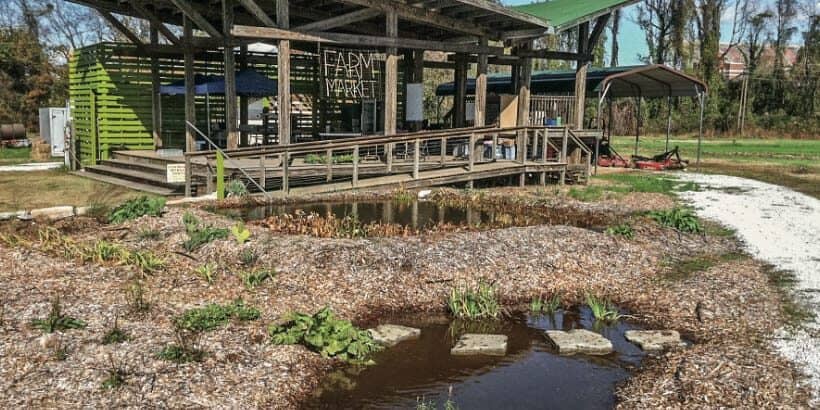
A: When a component in a farm or landscape—which could be a water garden, greenhouse, or chicken coop—performs seven functions, the component becomes alive, and I call this bio-integration. The concept is derived from Bill Mollison’s definition of permaculture design “…assembling conceptual, material and strategic components in a pattern which functions to benefit life in all its forms.” He then states: “Every component of a design should function in many ways.” I build on this definition with design components that function in at least 7 ways and some that have over 20 functions.
Q: You’re applying bio-integrated design at the Student Organic Farm at Clemson University. The projects are multi-faceted: ponds inside greenhouses, compost piles outside the greenhouse helping to heat the water in the ponds, fish in the ponds, and more. How do you come up with this kind of design? Do you start with just one system, and then find ways to add to it?
A: The design usually starts with a good backbone structure. The backbone involves buildings, rainwater harvesting, roads, animals, pathways, and parking. If the backbone structure is sound, it’s easy to build on other components as the design evolves. Of course, it’s always best if you can design as much as possible up front, drawing from a palette of proven design patterns. Christopher Alexander started this with his revolutionary book called A Pattern Language. I hope I’ve been able to build on his work with design patterns specific to farms and homesteads.
Q: Which projects in your book would you direct readers to as the best ones to try first? And can they follow your design as a blueprint, or will they need to figure out some adaptations on their own?
A: I think every farm and home can benefit from a small rainwater harvesting pond or water garden. It only takes a weekend of work to install one, and there are so many benefits, from controlling mosquitos in the neighborhood to providing a permanent place to gather food, not to mention the beauty they add to the landscape. When a pond is placed properly, it will reflect winter light through the windows of your house to help warm it. Or you can use gravity-flow piping to connect the pond to toilets for flushing. If you raise some chickens, the pond can be a source of minnows for your flock to eat, or you can channel water from the pond to flush manure from your coop into channels that irrigate and fertilize fruit trees. In dry climates you can turn a small pond into a water-storage tank by floating a cover on top to prevent evaporation, while still maintaining the living aspects of a pond with plant and animal life.
Q: Bio-integrated design is an intriguing blend of abstract thinking about stacking functions with very practical issues such as where and how to install the necessary plumbing and electric infrastructure, excavate ponds and basins, and more. Do you have to have all these skills yourself, or do you hire out some of the work involved in installing one of your projects?
A: I always like to try my hand at something first so I can learn how to do all aspects of a project before I hire help. During construction, the design usually changes because the process allows you to think about everything for a much longer time. To minimize mistakes, I’ll usually consult with as many experts in the field as possible before I start. Sometimes I’ll think about a project for over a year before I start to build it, and sometimes I’ll work with a mentor first to gain experience, then start small before ramping up. I remember I studied bees for over a year before I set up my first hive. I worked with a mentor on a few hives, then increased my hives to five. I’m planning on splitting the hives next spring now that I’m having success.
Q: You’re in South Carolina, which has moderate winters. Will your greenhouse systems function well in areas with freezing, snowy winters? How about in dry climates like California?
A: It depends on the specific system, but I think most of the design patterns in the book have wide applicability. A sloped greenhouse will take advantage of convection in any climate and will harvest more sunlight during winter. Shallow solar ponds inside greenhouses might need more insulation in cold climates, but water always makes great thermal mass, absorbing heat during the day and releasing it at night when you need it. California is interesting, because the rainfall normally occurs during the winter. This works great for solar reflecting ponds. The greenhouse channels water into a pond on the south side of the greenhouse during the winter months, and light reflects into the greenhouse when you need it most. During the summer, the pond dries up, but before the water evaporates completely, the pond produces a flush of toads or frogs to furnish the landscape with pest-eating predators.
Q: What about on a smaller scale? Which projects in the book are the best for a homesteader to try? Seems like raising chickens would be a great starting point.
A: The book includes three chapters that focus on designs I created in urban landscapes or small lots. These are usually the most fun as you try to maximize yields in a small area. The designs deal with everything from leaf-eating wicking hydroponic earthworm beds to harvesting acorns for chicken feed using special curbs to separate the leaves. Chickens are definitely a good starting point. I’ve been raising chickens for 17 years now at four different locations. The process of moving and starting over again was frustrating but gave me an opportunity to keep learning from my mistakes from the previous location and improving the systems. I’ve finally perfected the system: my chickens actually save me time and money by mowing and fertilizing my property and by providing food for the neighborhood. You have to design the system to eliminate the labor input for the daily care of the chickens: providing water and collecting eggs, for example. It’s also important to find ways to reduce the amount of feed you buy to make it profitable on a small scale. Since a kale leaf sells for the same price as an egg, it’s much easier to make money by growing veggies than by raising laying hens, but it’s a lot more fun to have a small flock of hens.
Q: Most of your projects involve moving water efficiently through the landscape and using water in creative ways to accomplish a task, whether it’s raising prawns or potted plants or shiitake mushrooms. How did you come to focus on water?
A: When I first read Bill Mollison’s book, it impressed me that water was such an integral component of the whole book, but water was lacking in all the designs of the permaculture installations I toured. I neglected rainwater harvesting and water catchment in my first designs and realized quickly that once plants are in place, it’s very difficult or impossible to move soil to create irrigation channels or install a basin or pond. Ever since, water catchment comes first in my designs and works in conjunction with roads, access, and buildings to form the backbones for everything else. Water is the limiting factor for life in most regions. By capturing, storing, and using water, we have a powerful tool to transform the landscape into food.
Q: Students are an active part of the Student Organic Farm—it’s not just a demonstration farm. You’re producing crops that are sold through a CSA. How do students respond to the concept of bio-integration? Are they excited about the concept and about permaculture design principles, or are they more interested in learning practical farming skills as part of their personal career path?
A: It’s so much fun to work with students. They have an excitement for life and aren’t afraid to take risks that scare us as we age. We definitely feed off each other. I’m constantly trying to find new projects to excite them and fuel the learning process, and they’re constantly adding to the designs and inspiring new projects. I’ve introduced a lot of students to permaculture and they’ve taken off with their learning process. I’ve only recently formalized the bio-integration concept with the publication of the book and hope this will inspire advanced designs. The practical farming skills are not as exciting as the design projects, but they are more lucrative and I’m always trying to impress upon students how to make money in farming through efficiency. Hopefully, they’ll use bio-integrated designs on their farms and homesteads when they graduate.
Q: Once you’ve designed and built a system, does it take on a life of its own? Do you continue to change and refine systems? Can you give an example of a system in the book that evolved over time?
A: Every design can be improved upon and all designs should be tailored to the users. I’ve made some mistakes creating designs for other people that were tailored to me. It’s like giving someone a sports car when they need a minivan because they have kids they need to drive to school and activities. The system will de-evolve with time in this scenario. The best designs are created by the user or for the user or simply designed to let nature take the wheel. When Stephanie and I moved away from Walterboro, I wanted to pass the house and landscape on to another landowner who would nurture the landscape, but the market wasn’t good, so we rented out the house. The landscape however continued to function, harvesting rainwater, heating the home and producing an abundance of fish, mushrooms, soil, and perennial vegetables. Most of the renters who stayed in the house became inspired by the landscape and ended up taking a deep interest in nature, nurturing the surroundings. After about six years with no maintenance, parts of the property looked better than ever, and other parts needed a chainsaw to get through it, but most of it was still producing and functioning as intended.
Read The Book
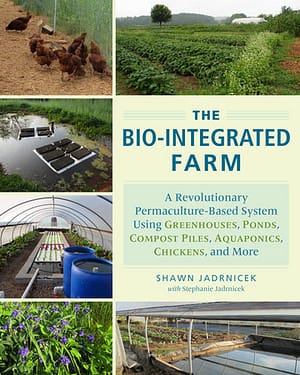
The Bio-Integrated Farm
A Revolutionary Permaculture-Based System Using Greenhouses, Ponds, Compost Piles, Aquaponics, Chickens, and More
$44.95
You may like...
-
 $44.95
 -
 $22.95
 -
 $35.00


Recent Articles
Aside from the sheer pleasure of telling your friends, straight-faced, that you maintain your garden using something called a “chicken tractor,” there are a slew of other benefits to working the land with a few of your animal friends. Getting rid of pests without chemicals, for one; letting them do the work of weeding and…
Read More
If the idea of running a vegetable farm sounds daunting, you’re not alone. What can you do to simplify techniques and reduce expenses? Where do you even begin?
Read More
When you’re walking around the grocery store looking at the vegetables, it’s probably hard to imagine that a century ago there was twice the amount of options.
Read More
If you love tomatoes, you probably already know just how many varieties of these summertime staples there are. But do you know what makes each one unique?
Read More
Adding the long game of trees to your system results in a deeper and more reliable, resilient and profound presence to your annual vegetable production.
Read More