Introduction
Untitled Document
None of us becomes an herbalist overnight. Learning
the spiritual teachings and healing qualities of the plants takes more than
a lifetime to experience. We need to discover for ourselves how to grow and
harvest the herbs we use and how to make effective preparations from them. We
need to probe a seemingly endless pool of knowledge about the body, mind, and
spirit. Learning a huge range of healing techniques and therapies enhances our
work with the herbs. Of course a truckload each of wisdom and common sense is
needed to complete the package. Wow! Try to balance all of that and find time
to raise a family and then make yourself available to people. I constantly fall
short of my ideal.
At times I am so enthralled with being an herbalist that I want to catch
up, to be as experienced and knowledgeable as my wisest teachers. I wasn’t
handed down this knowledge as a child, yet the ancestral roots are a deep part
of my being.
I have the vision of what I want to become, but I must learn to be patient
with myself and enjoy the journey. We serve and blossom when we can. We grow
and nurture our roots through all our days. A sapling doesn’t become a
big solid oak in a few years or even a decade. Yet I can begin to create some
shade and protection for others. I can drop my leaves and begin to nourish the
soil for the community around me. I can lend my branches for others to find
shelter and respite from the high winds and storms of life. I can make the world
a bit more beautiful by sharing a bright healing spark like green leaves do
in springtime. Each experience makes me stronger, more solid, more deeply rooted
in Mother Earth. My heart continually opens to the guidance of the Creator.
Increasingly I am more able to be of service to others from this strong foundation.
If your passion runs deep, and you have that strong desire to learn as
much as you can about herbs, health, and healing, and to share that wisdom with
your community, then you are on the right track. This book is intended to help
you move more quickly along the engrossing and rewarding path of becoming an
herbalist. — N.P.
DISCOVERING THAT our medicine can be found in the fields
and woods that surround us is empowering. So many of the good things in this
life are simply intended as everyday blessings. Our culture has promoted our
food, our health, at times even our spirituality, as centralized economic commodities.
Professions deliver the goods, relieving us of the responsibility for knowing
more about ourselves and our delightful place on Earth. Carried to the extreme,
this vision of health care has devolved to one where health management organizations
(HMOs) approve extremely profitable pharmaceuticals to support isolated and
failing body systems. Aren’t we missing something here? The healing process
is misunderstood by those who believe it is the doctor or drug, or both, that
makes us better. Not so. Our bodies have a natural ability to work their own
cure. A healer uses compassion, intuitive experience, restorative therapies,
and medicines to bolster another person (being the sum total of body, mind,
and spirit) in his or her recovery. We are all healers as much as we are all
in need of healing. Here to assist us on that journey is an incredibly complex,
beautifully simple, always inspiring world of healing plants.
Herbal medicine is more about a deep relationship with the plants—and
ourselves—than it is about a dusty jar of distant leaf that happens to
retain enough vitality to serve as a specified book remedy. The current infatuation
with herbal capsules and food supplements available at the nearest superstore
misses this mark on several counts. An herbalist begins with the healing plants
growing outside the door, whether grown in the garden, approaching bloom in
a wildflower meadow, or shaded in a woodland glen. Local medicine provides both
a livelihood for the healers within our communities and a direct experience
of the plants that help heal those in need. Such neighborly circles are also
our best bet for healing the impact of Homo sapien on our planet home. We left
the Garden of Eden with its promise of all we need . . .isn’t it time
we return?
We begin our journey by linking back to what was good for our communities
in the past. People who grew up intimately involved with Nature had a generational
handle on the good foods and medicines available to them. Reverence for these
great gifts filled the human heart. The village herbalist often served as a
midwife, family pharmacist, and spirit guide rolled into one. Communities honored
their healers throughout most of history. The call to serve, to be an instrument
of healing, did not lead to glory or riches. Barter and sliding scales of payment
made it possible for everyone in need to both benefit from and support those
local people who dedicated their lives to this good work. Such mutual caring
worked in days when community circles balanced individual desires with a deep
understanding of the generations to come and the sacredness of Creation.
Human ingenuity is a combination of traditional wisdom and ever expanding
consciousness and discovery. Speaking appreciatively of past medical practice
is not a call to use leeches to absorb the “ill humours” of the
body. (In truth, even the oft-despised leech has found a place in modern medicine.
Reconstructive surgeons have found blood-sucking Hirudo medicinalis most effective
at cleaning up venous congestion when replaced skin tissue needs capillary circulation
reestablished. More than 10,000 leeches were sold for medicinal purposes in
the United States in 1988. For a fascinating look at how traditional healing
knowledge continues to show merit, see Robert and Michèle Root-Bernstein,
Honey, Mud, Maggots, and Other Medical Marvels (New York: Houghton Mifflin,
1997)). Nor do we imply that modern heroic medicine should be shunned. Antibiotics,
surgery, and technology all have a place in today’s health care systems.
Our goal is to join with others in shaping a sustainable future by drawing on
what is usable and honored from the past and mixing it with the enlightened
choices of today. We are blessed to live in a time when so many healing modalities
are available. More and more people are beginning to realize that modern allopathic
medicine is not always the best choice for every situation. Yet many are in
the lemminglike habit of following the usual routine when presented with a health
concern.
Taking responsibility for family health begins with a conversant herbalist
in each home, someone who has learned the basics about eating right and tonic
herbs and healing baths and poultices. The appeal of herbs for most people lies
in this simple approach, one that embraces everyday health. We can fend off
the flu, relieve a stress headache, and nurture vitality with herbs all on our
own. Home herbalism is a basic life skill.
Today’s community herbalist fills a bigger role than the home herbalist:
teaching mothers and fathers the first principles of the herbal healing art,
suggesting healing approaches for a wide array of illnesses, having plant remedies
available, and recognizing personal limits when the advice of a more experienced
practitioner is advised. Later in this book, we’ll be taking an encompassing
look at the question of licensing or certifying herbalists. For now, suffice
it to say that people who assume responsibility for their own health, and who
exercise their own free will, will be drawn to healers who resonate with love
and community approval.
Integrating an herbal livelihood within the context of a sustainable community
is of critical importance. Learning the plants and their healing properties
comes most of all through direct experience. Weekend courses, in-depth seminars,
and apprenticing with an herbal mentor rounds out one’s knowledge base.
Practitioners can learn to network with local growers, who in turn realize the
quality considerations we’ve listed to keep medicinal herb customers returning
to the farm. The potential joys and concerns of setting up shop—be it
tips on label design for a line of tinctures or handling government regulations
in heartening fashion—are detailed for budding herbal entrepreneurs. Such
neighborhood apothecaries often serve as educational centers where the proper
use of healing herbs can be taught by local herbalists.
The drift of any book ultimately rests upon the viewpoint of its authors. Ours,
we suspect, is obvious. Unhindered by a string of letters behind our names to
indicate intellectual worth, we embrace local plant medicine and an Earth-centered
lifestyle with unwavering verve. Gut feelings and heartfelt passion matter.
We don’t speak with unquestionable authority about options you have with
your own body. Personal responsibility to discern what’s right for each
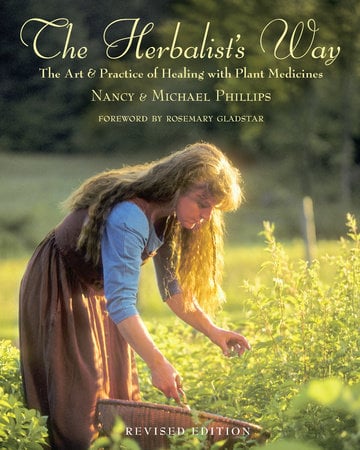
of us remains paramount throughout our time on this planet. The Herbalist’s
Way bespeaks both a personal path and a cultural journey. We wrote this book
to add medical care to the ongoing discussion of sustainability in these mad
and impetuous times. The wisdom to move forward in a direction that honors the
past, holds the present moment in awe, and leaves room for the seventh generation
to come shall guide us all to lives worth living.