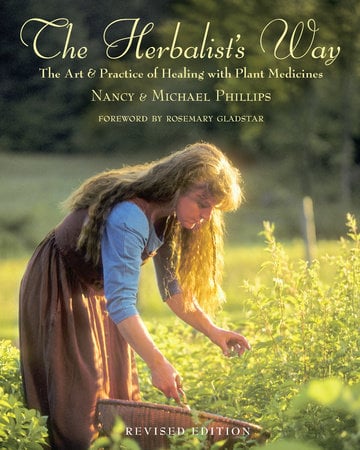
ISBN: 9781931498760 Year Added to Catalog: 2005 Book Format: Paperback Book Art: photographs, appendices, resources Number of Pages: 8 x 10, 352 pages Book Publisher: Chelsea Green Publishing Old ISBN: 1931498768 Release Date: April 30, 2005
Also By These Authors
The Herbalist's Way
The Art and Practice of Healing with Plant Medicines
A
profile of herbalist Matthew Wood from Chapter One of The Herbalist's
Way
Matthew Wood
INDIAN PEOPLE learned about certain plants for medicine and food by watching
the bear dig up roots, tear off barks, and collect berries with its claws.
The bear is a totem animal for the native healer, bringing empowerment
from the dream world. Bear medicines (osha, lomatium, and balsam root)
are the first plants the bear seeks to eat each spring. The resins in
these roots work on the lungs, heart, and liver. Native Americans believed
the bear was taking care of the people by pointing out these remedies
for the aeration, circulation, and metabolism of the body.
The herbal renaissance has a modern-day bear to similarly heed in Matthew
Wood. This Minnesota herbalist prods at the roots of healing traditions,
seeking integral understanding of body systems and plant energetics. “I
spend a lot of time going through the old books,” explains this eclectic
explorer. “I see phrases that don’t mean much today, like keeping open
the kidneys, or the condition of the skin, or keeping open
the bowels. I didn’t initially get that this was a medical system.”
Little by little Matthew has come to realize that hese expressions have
meaning that tie together seemingly different approaches to therapeutics.
An intensive teaching schedule has helped him articulate these fragments
of lost healing wisdom into a congruent whole for other herbalists.
“Remember in the movie Little Women? The mother comes back to
treat the daughter who’s sick, takes down the covers, and says, ‘We have
to get the heat down to her feet.’ She instantly knew what to do. These
simple folk-medical ideas were the common property of doctors, mothers,
grandmothers, healers, and herbalists in the nineteenth century,” notes
Matthew. “These medical sayings are still in our blood. Our ancestors
want to speak. They healed and they know things . . . we can pick up hints
from them and realize we do know about medicine after all.”
Finding a language that meshes such folkloric perception with modern
medical understanding is the challenge. “I recently made a big conceptual
shift. The nineteenth-century botanical doctors refer to five different
tissue states. Modern allopaths can get down to microscopic lesions, but
the old doctors could only see general conditions of the body. Tissue
overstimulation or irritation or heat would be one, contraction or spasm
another, then relaxation. Those three are the basic biological response
states that happen in living tissue. In addition, there’s atrophy, or
lack of nutrition, and then there’s depression. These five tissue states
correspond closely to causative agents long recognized in traditional
medicine: hot, damp, dry, cold, and wind. This has knitted it all together
for me. These five tissue states have analogies to old medical systems
as well as roots in allopathy and nineteenth-century botanical medicine.
It’s simple, yet it takes in so much. I have not been a fan of simplifying
everything to four or five elements, till I understood these tissue states.
Then, all of a sudden, boom. I began to read the nineteenth-century
botanical literature with fresh eyes. Everything they do gets defined
in terms of these five tissue states, again and again and again. If you
can define what you are looking at as one of these five states, and then
understand what organ systems are involved, then you’ve got it. My work
has gotten much more precise and clear and easy.
“I always felt from the beginning of studying herbal medicine that I
didn’t want to practice in a way that is boring, that is not uplifting
to me. I don’t want to be a doctor and just do mechanical diagnosis. Understanding
what goes on in the body energetically cultivates my senses, my observational
skills, and my mind to make deductions and put things together by intuition.
This develops my own soul and spirit so that I am growing while my patients
are growing. Otherwise it would be an imbalance.”
Matthew considers himself a clinical herbalist of the Western tradition.
This good- humored man prefers to get right down to the business at hand
in these consultations. “I take their pulses, make note of indications
in their tongue and skin, and hear what their doctor had to say. If it’s
a fairly acute, superficial condition, and I have the right remedies for
it, I figure I won’t see people again because their problem will be helped.
But for a more subacute or chronic thing, I might need to see people two
or three times over a half-year period. I don’t get as much into lifestyle
changes, eating, psychological factors, et cetera. I believe the herbs
will change people.”
Here is an herbalist renowned for low-dose recommendations— as in, one
to three drops of a specified tincture. Matthew perceives that the plants
work in our bodies on a much deeper level than the mechanical explanations
offered by phytochemistry. His homeopathic application of herbal remedies
can be puzzling, until you recognize this man’s broad grounding in spiritual
intent. “We need to understand the herbs as living beings, as personalities,
as entities in themselves,” he explains, “that we treat with respect and
that we can know and understand. I am a believer in a shamanistic interaction
between medicine plants and people.” A friend of Matthew’s had eaten a
poisonous mushroom, known as a Death Cap. When he got to her house, he
gave her a few milk thistle seeds. The staff at the emergency room were
not too hopeful for this friend’s chances. Whether it involved an atypical
antidote or spiritual trust, the woman walked home the next morning.
“Some of us arrogant types start out thinking we know it all. The herbalists
who go around speaking at conferences tend to be people who have a lot
of selfconfidence. We need these kinds of trailblazers who’ve figured
things out on their own. Speaking for myself, I can say that when I knew
a lot less, I thought I knew just about everything.”
Matthew accepts that his views may be spurious to some. Certainly, like
the native bear, he gives us much to ponder. His Book of Herbal Wisdom
rates high in our collection of herbals, providing a thorough cross-referencing
of many traditions. Physical indications and pulses are just a part of
his tool bag, as he simultaneously calls upon intuition, psychic acuity,
and past experience with plants and people to help him choose the best
remedy. Matthew always comes back to an understanding of general broad
patterns. “Say you have an upset stomach that goes on and on. You go to
the doctor, then come back again after another month. They give you a
barium enema. It turns out you don’t have cancer, so they say bye. You
either have cancer or you have nothing they want to know about or can
treat or help. The old medical books—and our herb books—say dyspepsia,
ulcer, acidity, bilious distress, flatulence, bloating. We treat all these.
Many of our simple herbs, the carminatives, like dill, fennel, angelica,
are warming, drying, and help to dispel gas and bloating. This is just
the wisdom of the ages, but it’s ignored in modern medicine.”