

The Cost of Manufactured Food: Land & Energy
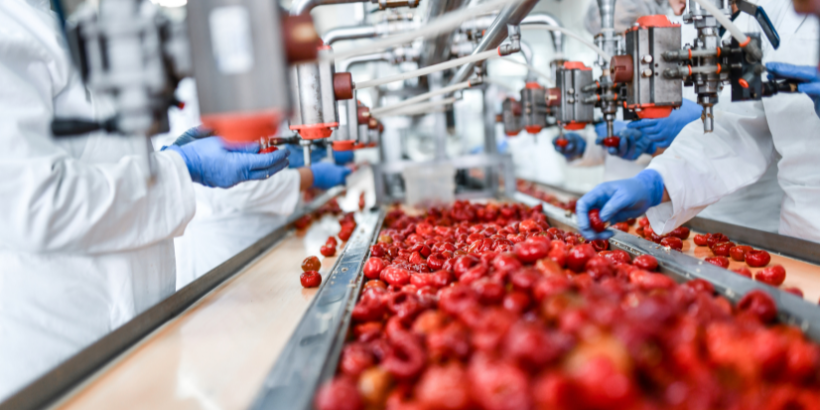
It’s no secret that overly manufactured food isn’t good for our health. The production of these foods is also extremely harmful for agriculture and the environment. The end result of manufactured foods lead to the elimination of many small farms.
We must change the way we grow and purchase food to stay healthy and keep small farms running.
The following is an excerpt from Saying NO to a Farm-Free Future by Chris Smaje. It has been adapted for the web.
The “Rationale” for Manufactured Food
An important part of the rationale for manufactured food is the cost to nature of what George Monbiot calls agricultural sprawl, suggesting the need to cut agricultural acreage. While are a few wrinkles in this land-sparing argument, there is some evidence to suggest that manufactured food might help.
For example, a detailed study published in the Proceedings of the National Academy of Sciences (PNAS) has found that a hectare of land devoted to protein-rich microbial biomass production energised by solar (photovoltaic – henceforth PV) panels could potentially produce 15 tonnes of protein per year.2 Whereas a hectare of soybeans, the authors report, only produces 1.1 tonnes of protein.
PNAS Study on Manufactured Food
It has to be said that the PNAS study makes various assumptions rather favourable to the case for manufactured food, one of which is to use figures for incoming solar energy to the panels typical of places such as Southern California (around 2,000 kilowatt-hours per square metre per year – the corresponding figure in the UK is about 1,000) and a global average figure for soy yields.
So, the 15:1.1 ratio is probably best taken as the upper limit of land-sparing possibilities for manufactured food (Monbiot claims the possibilities are greater, but on the basis of flawed figures, as I’ll suggest in a moment).3 It must also be borne in mind that no large-scale manufactured food facilities yet exist, so all these figures remain speculative.
Benefits of the Manufactured Food Study

And soybean rather than meat protein is the appropriate comparison because if the name of the game is efficient feeding of the Global Standard Consumer, then looking at the optimum product from the Global Standard Farm in comparison to the manufactured food approach is the right way to go about it.
One thing the PNAS study doesn’t do overtly is provide a figure for the amount of electrical energy required to manufacture the 15 tonnes of protein on the nominal hectare. To his credit, Monbiot does provide such a figure, although he doesn’t cite a source for it. He states that the manufacture of Solein uses 16.7 kilowatt-hours (kWh) of electrical energy to produce 1 kilogram (kg) of protein (to give an everyday sense of that, it’s the equivalent of boiling about 90 kettles filled with 2 litres of water).4
Flaws in the Figures: Issues With the PNAS Study
Monbiot estimates on that basis that the protein needs of the entire global population could be met through manufactured protein using about 11 per cent of the world’s current electricity consumption. Which sounds to me like a lot, but not entirely beyond the bounds of possibility.
However, so far as I can see, this figure is wrong – so wrong, in fact, that it’s less than the minimum energy cost of what’s even theoretically possible, a figure that stands at 17.7 kWh/kg.5 A better figure for the actual energy inputs can be calculated with a bit of number crunching from behind the scenes of the PNAS paper, to arrive at around 65 kWh/kg – nearly four times higher than Monbiot’s.6
Even this figure is unrealistically low, involving several assumptions favourable to the case for manufactured food, for example in assuming high levels of solar irradiance and in ignoring the energy costs associated with building and maintaining bioreactors, PV arrays and all the supporting infrastructure. So it shouldn’t be used as the ‘real’ figure – only as a minimum ballpark.
It’s also worth noting that the primary energy inputs for most forms of generated electrical energy other than PV, such as nuclear or fossil-fuel powered generation plants, would be two to three times higher, due to energy conversion inefficiencies.7
Which Figures Should We Use?
If we repeat Monbiot’s calculation with this minimum ballpark 65 kWh/kg figure, we find that meeting the global population’s protein needs via the manufactured route would require at least 43 per cent of the world’s electricity consumption using his own electricity consumption figures. Using figures for electricity generation in 2021, I calculate that meeting global protein needs would require at least 89 per cent of its low-carbon electricity supply (nuclear, hydro and renewables), or at least 924 per cent of its solar electricity supply.

Of course, if you grew the soy in your backyard for your own consumption you could probably do it with little more than a digging stick, and the energy inputs would be negligible.
For soybeans grown organically with broadscale mechanised methods, I estimate they require around 1.5 times the energy input (including human labour), per kilogram of protein compared to conventional soybeans, which is mainly due to lower yields per hectare without the agrochemical inputs into conventional crops.9
Food for Thought: Saving Money and Energy
So, putting all this together, with mechanised agriculture you could produce 1 kg of soy protein for the energy cost of boiling about five 2-litre kettles of water, or about eight kettles with organic methods, and much less with backyard methods. Or you could go down the manufactured food route and, even neglecting various energy costs, produce 1 kg of protein for around 20x more with 100 kettles as the absolute theoretical minimum, or more likely about 70x more with 350 kettles as a ‘real-world’ minimum ballpark figure tipped rather generously towards the manufactured route.
The Importance of Producing Protein
In this latter case, to provide for all of humanity’s protein needs, you’d have to use more than nine times the entire world’s current solar electric supply. Many other industries, such as steelmaking, are clamouring for that supply, because they have few other options for decarbonisation. But in the case of edible protein, there is one. The sun – which costs nothing. So you could say that manufactured food is a 10x innovation, but not exactly in the way that Peter Thiel intended.
Protein is, of course, only one component of the human diet. It’s not the hardest one to produce when land is tight, an honour that goes to calories, or food energy. Among the ten most widely grown arable crops worldwide, six of them are cereals like wheat that are grown predominantly for their energy (although they also contain protein). So if we want a truly farm-free future, it’s not enough only to manufacture protein. We need to manufacture calories as well (or, more strictly speaking, turn the calories in sunlight into edible calories by way of PV panels and bioreactors, rather than by way of plants).
Manufactured Food: Ignoring Energy
Compared with the fanfare over protein, the manufactured food literature has less to say about food energy. Possibly this is because of the toxicity issues mentioned in Chapter 1. Or because the industry is positioning itself primarily around proprietary manufactured vegan meat substitutes, and not the ecological concerns motivating analysts like Monbiot.10
Or a tricky combination of the first two, inasmuch as once the edible portion is extracted for vegan food, the best use for much of the residue may be as livestock fodder. Or else it’s because the energy input picture for microbial calories looks even more dismal than for protein.
On that last point, I’ve run some parallel calculations for food energy as the preceding ones for protein, based on data provided in the PNAS study. In this instance, to meet all of the global population’s calorific needs using manufactured calories (assuming they’re safe to eat) would use, at an improbably bare minimum, more than three times the world’s current electricity supply, or more than eight times its current low-carbon electricity supply, or more than ninety-one times its current solar electricity supply. (Both microbial biomass and soy contain some fat – soy proportionately more – which I haven’t considered here.)
A Simple Solution: The Power of Sunlight
Alternatively, we could just use sunlight.

What has changed is the emergence of:
(1) environmental arguments for decreasing the land take of the food system;
(2) a ‘disruptive’ tech bro 10x framing of entrepreneurship that makes an idea like ‘Food-as-Software’ sound cool rather than weird – so much so that few notice what’s really involved is a process that’s 10x (or, more likely, 70x) less energy efficient than its predecessor; and
(3) a critique of livestock agriculture and a lucrative market for vegan meat substitutes driving agribusiness corporations to hedge their bets on the meat/ vegan issue and position themselves as generic ‘protein providers’.
It seems to me that the real driving force behind manufactured food is point (3), for which points (1) and (2) function largely as PR gloss, with the likely result of non-disruptive business-as-usual for an expansionary industrial food system that will probably be detrimental to most people and most wildlife.
Recommended Reads
Read The Book

Saying NO to a Farm-Free Future
The Case For an Ecological Food System and Against Manufactured Foods
$19.95
You may like...
-
 $20.00
 -
$24.95
-
$19.95


Recent Articles

Enjoy fresh produce all year long by growing your own food! Achieving a twelve-month growing season is as simple as using the right crop protection structure.
Read More
Beets can be grown year-round and are a perfect, flavorful addition to meals. Get started on growing your own no-till beets with help from these tips!
Read More
All hail the mighty garlic clove! Become a master at garlic growing with these simple tips for growing no-till garlic from seed to harvest.
Read More
Try your hand at preserving veggies by freezing them! Freezing vegetables is a quick, simple way to preserve them for winter meals.
Read More
If you keep your hens in a stationary coop, you’re missing out on their soil building talents. Un-coop that poop by putting your flock in chicken tractors!
Read More