

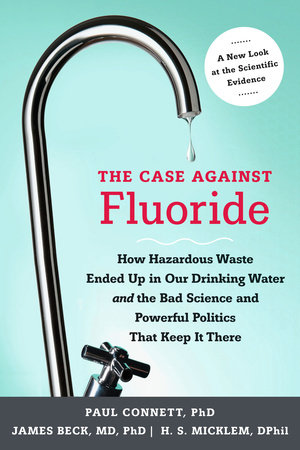
The Case against Fluoride
How Hazardous Waste Ended Up in Our Drinking Water and the Bad Science and Powerful Politics That Keep It There

EXCERPTS
| Pages: | 392 pages |
| Book Art: | Black and white illustrations tables, charts and graphs |
| Size: | 6 x 9 inch |
| Publisher: | Chelsea Green Publishing |
| Pub. Date: | September 29, 2010 |
| ISBN: | 9781603582872 |
The Case against Fluoride
How Hazardous Waste Ended Up in Our Drinking Water and the Bad Science and Powerful Politics That Keep It There
Paperback
$32.95
National Health Information Award
“At once painstakingly-documented and also highly-readable, The Case Against Fluoride brings new research to light . . . [it] explores the poor science, bizarre tactics, biased reviews, and puzzling motivations of a relatively small number of influential people who continue to push this practice on a largely ill-informed public.”—American Academy of Environmental Medicine Newsletter
When the U.S. Public Health Service endorsed water fluoridation in 1950, there was little evidence of its safety. Now, six decades later and after most countries have rejected the practice, more than 70 percent of Americans, as well as 200 million people worldwide, are drinking fluoridated water. The Center for Disease Control and the American Dental Association continue to promote it–and even mandatory statewide water fluoridation–despite increasing evidence that it is not only unnecessary, but potentially hazardous to human health.
In this timely and important book, Dr. Paul Connett, Dr. James Beck, and Dr. H. Spedding Micklem take a new look at the science behind water fluoridation and argue that just because the dental and medical establishments endorse a public health measure doesn’t mean it’s safe. In the case of water fluoridation, the chemicals that go into the drinking water that more than 180 million people drink each day are not even pharmaceutical grade, but rather a hazardous waste product of the phosphate fertilizer industry. It is illegal to dump this waste into the sea or local surface water, and yet it is allowed in our drinking water. To make matters worse, this program receives no oversight from the Food and Drug Administration, and the Environmental Protection Agency takes no responsibility for the practice. And from an ethical standpoint, say the authors, water fluoridation is a bad medical practice: individuals are being forced to take medication without their informed consent, there is no control over the dose, and no monitoring of possible side effects.
“Alfred North Whitehead said the scientific method means leaving ‘options open for revision.’ An ancient Roman adage says that ‘whatever touches all must be approved by all.’ These characterizations of science and democracy are the reasons for reading this book. Especially if you and your family are drinking administratively mandated fluoridated water.”—Ralph Nader
Reviews & Praise

About Paul Connett
Dr. Paul Connett, a retired professor of environmental chemistry and toxicology at St. Lawrence University, has given more than 2,000 presentations in forty-nine states and fifty-two countries on the issue of waste management. He holds a bachelors degree from the University of Cambridge and a Ph.D. in chemistry from Dartmouth College. He lives in Canton, New York.
Books by Paul Connett

About James Beck
Dr. Paul Connett, a retired professor of environmental chemistry and toxicology at St. Lawrence University, has given more than 2,000 presentations in forty-nine states and fifty-two countries on the issue of waste management. He holds a bachelors degree from the University of Cambridge and a Ph.D. in chemistry from Dartmouth College. He lives in Canton, New York.
Dr. James S. Beck is a Professor Emeritus of Medical Biophysics at the University of Calgary and holds doctorates in medicine from Washington University School of Medicine and biophysics from the University of California, Berkeley. He lives in Calgary, Alberta, Canada.
H. Spedding Micklem is a Professor Emeritus in the School of Biological Sciences at the University of Edinburgh. He holds a D.Phil from the University of Oxford. He lives in Edinburgh, Scotland.
Books by James Beck

About Spedding Micklem
Dr. Paul Connett, a retired professor of environmental chemistry and toxicology at St. Lawrence University, has given more than 2,000 presentations in forty-nine states and fifty-two countries on the issue of waste management. He holds a bachelors degree from the University of Cambridge and a Ph.D. in chemistry from Dartmouth College. He lives in Canton, New York.
Dr. James S. Beck is a Professor Emeritus of Medical Biophysics at the University of Calgary and holds doctorates in medicine from Washington University School of Medicine and biophysics from the University of California, Berkeley. He lives in Calgary, Alberta, Canada.
H. Spedding Micklem is a Professor Emeritus in the School of Biological Sciences at the University of Edinburgh. He holds a D.Phil from the University of Oxford. He lives in Edinburgh, Scotland.
Books by Spedding Micklem
You may also like...
-
 $34.95
 -
$29.95
-
$24.95


