

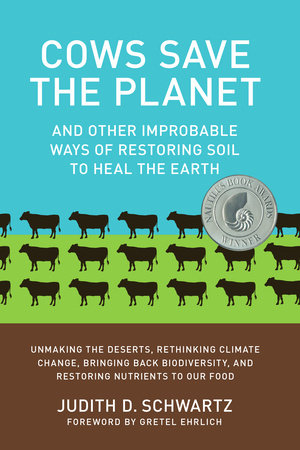
Cows Save the Planet
And Other Improbable Ways of Restoring Soil to Heal the Earth

EXCERPTS
| Pages: | 240 pages |
| Size: | 6 x 9 inch |
| Publisher: | Chelsea Green Publishing |
| Pub. Date: | April 22, 2013 |
| ISBN: | 9781603584326 |
Cows Save the Planet
And Other Improbable Ways of Restoring Soil to Heal the Earth
Paperback
$17.95
In Cows Save the Planet, journalist Judith D. Schwartz looks at soil as a crucible for our many overlapping environmental, economic, and social crises.
Schwartz reveals that for many of these problems—climate change, desertification, biodiversity loss, droughts, floods, wildfires, rural poverty, malnutrition, and obesity—there are positive, alternative scenarios to the degradation and devastation we face. In each case, our ability to turn these crises into opportunities depends on how we treat the soil.
Drawing on the work of thinkers and doers, renegade scientists and institutional whistleblowers from around the world, Schwartz challenges much of the conventional thinking about global warming and other problems. For example, land can suffer from undergrazing as well as overgrazing, since certain landscapes, such as grasslands, require the disturbance from livestock to thrive. Regarding climate, when we focus on carbon dioxide, we neglect the central role of water in soil—”green water”—in temperature regulation. And much of the carbon dioxide that burdens the atmosphere is not the result of fuel emissions, but from agriculture; returning carbon to the soil not only reduces carbon dioxide levels but also enhances soil fertility.
Cows Save the Planet is at once a primer on soil’s pivotal role in our ecology and economy, a call to action, and an antidote to the despair that environmental news so often leaves us with.
“Judith Schwartz takes a fascinating look at the world right beneath our feet. Cows Save the Planet is a surprising, informative, and ultimately hopeful book.”—Elizabeth Kolbert, Pulitzer Prize-winning author of The Sixth Extinction
Reviews & Praise

About Judith D. Schwartz
Judith D. Schwartz is a journalist whose work explores nature-based solutions to global environmental and economic challenges. She writes on this theme for numerous publications and speaks at venues around the world. She is the author of Cows Save the Planet and Water in Plain Sight. A graduate of the Columbia Journalism School and Brown University, she lives in southern Vermont.
Connect with Judith D. Schwartz
Books by Judith D. Schwartz


You may also like...
-
 $19.95
 -
$39.95
-
$40.00


