

| Pages: | 168 pages |
| Book Art: | Black-and-white illustrations |
| Size: | 6-1/2 x 9 inch |
| Publisher: | Stone Pier Press |
| Pub. Date: | October 22, 2019 |
| ISBN: | 9780998862330 |
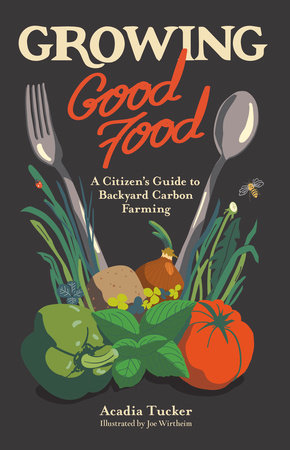
Growing Good Food
A Citizen’s Guide to Backyard Farming
Recipient of the GardenComm Emergent Communicator Award for 2023: Acadia Tucker
Growing Good Food is a beginner’s guide to growing your own herbs, fruits, and vegetables using organic and sustainable practices. It’s for home gardeners who want to raise food on their own patch of soil—all while cultivating a microbe-rich, carbon-sucking, regenerative foodscape.
Acadia Tucker, a regenerative farmer, gardener, and climate activist, invites us to think of gardening as civic action. By building organically-rich soil, even in a backyard, we can capture greenhouse gases in the very place we’re growing nutritious food.
To help us get started, Tucker drafts plans for gardeners who have a little ground or a lot of it. She offers advice on how to prep and clear land, cultivate healthy soil, plant food from seeds or starts, fend off pests and disease, and grow 21 popular perennials and annuals, including fruit trees, herbs, strawberries, peppers, tomatoes, cabbage, carrots, garlic, beans, peas, and potatoes.
Tucker also describes the climate changes taking place in our own backyards, and the various steps we can take to boost a garden’s resilience.
Growing Good Food includes calls to action and insights from leaders in the regenerative growing movement, including David Montgomery, Anne Biklé, Gabe Brown, Wendell Berry and Mary Berry, and Tim LaSalle. By the end of this book, you’ll know how to grow some really good food, and build a healthier world, too.
Reviews & Praise
“Acadia's books are wonderful, timely, and elucidate the simple and the complex beautifully. I especially love the call to action of the climate victory garden. We are at a time in human history where we all must get involved to reclaim our food supply and halt climate chaos, and these guides are an inviting how-to. Brava!”—Ave Lambert, Director of Education, CUESA
“An important read for any backyard grower who wants to make a positive impact on the climate in their own patch of dirt.”—Robyn Rosenfeldt, Pip Permaculture Magazine
“Tucker has a unique perspective on the climate crisis. Working as a farmer from Washington State to New Hampshire, she has seen radical, unpredicted shifts in climate which decimated sensitive annual crops but spared perennials. She has also seen the difference it makes to those crops when soil contains an abundance of organic material vs traditionally farmed soil which doesn’t. It’s fascinating to read.”—Todd Heft, author
“I’m obsessed with this book already, I might sell everything and buy a farm.”—Brittany Yu, Branch On Bowen Bookstore
"I love this book. Growing Good Food is great for beginning gardeners who care about the climate."—Lucy Biggers, Now This Media
"In this well-informed and educational call to action, Acadia Tucker set out to simplify regenerative gardening so that anyone can do it. She succeeded! With step-by-step instructions and chapters dedicated to your favorite veggies, readers will be inspired to grow food and save the planet, all from the comfort of your backyard."—Jes Walton, Food Campaigns Manager at Green America
"I would recommend Acadia’s new book to every gardener to learn how a person can impact the environment through one’s own garden.”—pegplant.com
"Acadia Tucker’s new book shows what it takes for beginners to throw themselves into regenerative agriculture."–Modern Farmer
"Growing Good Food is about working where we are, on a small scale, to improve the health of the land. Acadia Tucker tells us that what we do matters and if we have access to any piece of ground we can start addressing climate change. My father, Wendell Berry, says that this kind of work is radical now, when public attention is focused on global solutions. This work is what people are for."–Mary Berry, Executive Director, The Berry Center, New Castle, Kentucky
"Add this gardening book to your library. If we don’t get together and take care of the soil, our atmosphere is toast."–Tim LaSalle, Cofounder The Regenerative Agriculture Initiative, Chico State
"The book is easy to follow, entertaining, and informative. It offers hope and solutions for our climate crisis. It’s perfect for anyone with a backyard who cares about our environment."—Cheryl Spencer, Simply Smart Gardening

About Acadia Tucker
Acadia Tucker is a regenerative farmer, climate activist, and author. Her books are a call to action to citizen gardeners everywhere, and lay the groundwork for planting an organic, regenerative garden. For her, this is gardening as if our future depends on it.
Before becoming an author, Acadia started a four-season organic market garden in Washington State inspired by farming pioneers Eliot Coleman and Jean-Martin Fortier. While managing the farm, Acadia grew 200 different food crops before heading back to school at the University of British Columbia to complete a Masters in Land and Water Systems.
She lives in Maine and New Hampshire with her farm dog, Nimbus, and grows hops to support locally sourced craft beer in New England, when she isn't growing food in her backyard, or in her dining room. Acadia is an Ambassador for regenerative agriculture for The Rodale Institute.
Books by Acadia Tucker


You may also like...
-
 $24.95
 -
$27.95
-
$34.95

