

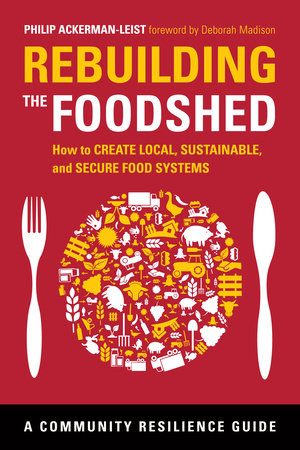
Rebuilding the Foodshed
How to Create Local, Sustainable, and Secure Food Systems

EXCERPTS
| Pages: | 360 pages |
| Book Art: | 8 pages of color illustrations |
| Size: | 6 x 9 inch |
| Publisher: | Chelsea Green Publishing |
| Pub. Date: | January 24, 2013 |
| ISBN: | 9781603584234 |
Rebuilding the Foodshed
How to Create Local, Sustainable, and Secure Food Systems
Paperback
$24.95
Droves of people have turned to local food as a way to retreat from our broken industrial food system. From rural outposts to city streets, they are sowing, growing, selling, and eating food produced close to home—and they are crying out for agricultural reform. All this has made “local food” into everything from a movement buzzword to the newest darling of food trendsters.
But now it’s time to take the conversation to the next level. That’s exactly what Philip Ackerman-Leist does in Rebuilding the Foodshed, in which he refocuses the local-food lens on the broad issue of rebuilding regional food systems that can replace the destructive aspects of industrial agriculture, meet food demands affordably and sustainably, and be resilient enough to endure potentially rough times ahead.
Changing our foodscapes raises a host of questions. How far away is local? How do you decide the size and geography of a regional foodshed? How do you tackle tough issues that plague food systems large and small—issues like inefficient transportation, high energy demands, and rampant food waste? How do you grow what you need with minimum environmental impact? And how do you create a foodshed that’s resilient enough if fuel grows scarce, weather gets more severe, and traditional supply chains are hampered?
Showcasing some of the most promising, replicable models for growing, processing, and distributing sustainably grown food, this book points the reader toward the next stages of the food revolution. It also covers the full landscape of the burgeoning local-food movement, from rural to suburban to urban, and from backyard gardens to large-scale food enterprises.
Reviews & Praise
"By now we have all learned that local food is about much more than food miles. Philip Ackerman-Leist has eloquently helped us to understand just how comprehensive the concept is: how our food system must be redesigned if it is to be reliable and resilient, how that design must be guided by principles of ecology, justice, health, and humility, and how to put such theories into practice for farmers, chefs, consumers, and communities. A practical guide for anyone interested in imagining our food systems of the future."—Frederick Kirschenmann, author of Cultivating an Ecological Conscience: Essays from a Farmer/Philosopher
"The future of food is local. But how do we transition from our current globalized, supermarket-centered food world to one that's human-scaled and ecosystem-friendly? This book shows how communities across America are reclaiming the ability to feed themselves. It's inspiring as well as informative. If you eat, you really should read it."—Richard Heinberg, author of The End of Growth and Peak Everything
"Rebuilding the Foodshed introduces readers to local food systems in all their complexities. In moving from industrial to regional food systems, communities must consider an enormous range of factors, from geographic to socioeconomic. Difficult as doing this may be, this book makes it clear that the results are well worth the effort in their benefits to farmers and farm workers as well as eaters."—Marion Nestle, professor of Nutrition, Food Studies, and Public Health at New York University and author of What to Eat
"Phillip Ackerman-Leist has been in the trenches of food-systems change for well over a decade, from farm to school. Now he has elegantly laid out the principles of how to redesign foodsheds for greater food security, justice, and energy efficiency, while engaging communities in making tangible innovations on the ground. He is undoubtedly in the best place to address these issues, since Vermont communities have accomplished more food relocalization than those in any other state."—Gary Paul Nabhan, pioneer in the food relocalization movement, author of Coming Home to Eat and Renewing America's Food Traditions
“For a somewhat wonky book about food policy, Rebuilding the Foodshed is unusually humorous and open-minded…With insight, he demonstrates how communities can bridge and transcend the ‘false divides’ he pinpoints in the local-food conversation: urban/rural, small-scale/large-scale, local/international, and all/nothing.”—Publishers Weekly
“This is a great book that will catapult readers into a highly critical understanding of the many complex issues with food and localized agriculture in the United States, as well as offer possible solutions. Ackerman-Leist writes with lively panache, an unlikely but somehow well-suited style for talk of such serious problems. This book is highly recommended for anyone who hopes to be part of the evolution.”— ForeWord Reviews-
"Much of Ackerman-Leist's argument focuses on how a locavore approach is articulated within a larger food production cycle…Ackerman-Leist's task is not simple, but his approach is stimulating and worthwhile. Summing Up: Recommended."—Choice

About Philip Ackerman-Leist
Philip Ackerman-Leist is the author of Rebuilding the Foodshed, Up Tunket Road, and A Precautionary Tale. He and his wife, Erin, farmed in the South Tyrol region of the Alps and North Carolina before beginning their nineteen-year homesteading and farming venture in Pawlet, Vermont. With more than two decades of field experience working on farms, in the classroom, and with regional food systems collaborators, Philip’s work is focused on examining and reshaping local and regional food systems from the ground up.
Vandana Shiva is a world-renowned environmental thinker and activist, a leader in the International Forum on Globalisation, and of the Slow Food Movement. Director of Navdanya and of the Research Foundation for Science, Technology and Ecology, and a tireless crusader for farmers’, peasants’, and women’s rights, she is the author and editor of a score of influential books, among them Oneness vs. the 1%; Making Peace with the Earth; Soil Not Oil; Globalization’s New Wars; Seed Sovereignty, Food Security: Women in the Vanguard; and Who Really Feeds the World?
Shiva is the recipient of over twenty international awards, including the Right Livelihood Award (1993); the Medal of the Presidency of the Italian Republic (1998); the Horizon 3000 Award (Austria, 2001); the John Lennon-Yoko Ono Grant for Peace (2008); the Save the World Award (2009); the Sydney Peace Prize (2010); the Calgary Peace Prize (2011); and the Thomas Merton Award (2011). She was the Fukuoka Grand Prize Laureate in 2012.
Connect with Philip Ackerman-Leist
Books by Philip Ackerman-Leist

You may also like...
-
 $42.95
 -
$24.95
-
$29.95


