Like this book? Digg it!

Book Data

ISBN: 9781931498920
Year Added to Catalog: 2006
Book Format: Paperback
Book Art: Glossary, Notes, Index
Number of Pages: 6 x 9, 350 pages
Book Publisher: Chelsea Green Publishing
Old ISBN: 193149892X
Release Date: November 30, 2006
Web Product ID: 214

Also By This Author


The End Of America Movie

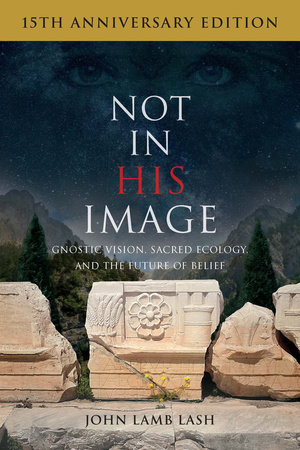
Not in His Image

Gnostic Vision, Sacred Ecology, and the Future of Belief

by John Lamb Lash

Afterword by Derrick Jensen

Q & A

Q & A with Author John Lamb Lash

Your new book, Not In His Image, contains an enormous amount of information, spanning thousands of years and several continents. Where and how did most of the research for the book take place?

The book is the result of about 40 years of questioning and research, a life-long pursuit. As I explain in the introduction, I began to challenge certain religious beliefs at 17, inspired by Nietzsche. I have studied, discussed, and experimented with religious and spiritual ideas and practices all my life. In the late 1960s I traveled around the world, visiting many places related to the subjects in my book, and in 1986 I made an extensive tour of the sacred Pagan sites of Europe. In the last ten years I have concentrated on the Dead Sea Scrolls and Nag Hammadi writings of the Gnostics. Some of the world-class libraries for such studies are in Europe.

How does our colloquial use of the term “Pagan” differ from the historically accurate use? P. 24

In everyday speech, pagan seems to be used rather facetiously to denote someone of loose morals who dances naked under the full moon. It refers to tree-huggers, or it has dubious New Age connotations. Historically, Pagan simply denotes the animistic and shamanic cultures of pre-Christian Europe. This was a vast cultural and geographic complex that lasted for thousands of years. The roots of Paganism go back well into the last Ice Age, the Paleolithic era.

Can you tell us why the story of Hypatia illustrates the overall story of the eradication of Paganism from our 21st century world?

Hypatia not only exemplifies the high spiritual and intellectual attainments of the classical world – she was a mystic, mathematician, inventor, and more; in other words, a true interdisciplinary scholar - but her murder typifies the kind of faith-based violence that opposed and brutally eradicated those attainments. Her fate makes us face the fact that the end of Pagan spiritual life was not due to a natural death but to a campaign of blind, brutal suppression – a massive act of cultural destruction. The campaign continued long after her death. In some respects, it continues today.

Could you explain further the transference of the man Jesus Christ to the savior of Christianity? Why is this concept important to understand?

Transference is my proposed term for the process in which the agenda of a small Jewish cult, the Zaddikim or Zealots, morphed into the Christian ideology of salvation. No one knows if there was a man named Jesus Christ, but there certainly numerous messianic candidates in the early Christian era, and Yeshua was a common name. The messiah of the Jews, as understood by the Zaddikim, was a national hero, a warrior, and liberator of Palestine from Roman occupation. When Paul infiltrated the Zealot movement and hijacked its ideology, he turned this flesh-and-blood messiah into the supernatural, superhuman savior Jesus Christ. The man Jesus, if he ever existed, was someone Paul never met. The “Christ” was a rip-off of the secretly anointed messiah of the Zealots, the Dead Sea sect. The transference was completed when this weird hybrid, Jesus/Christ, became the central figure of a Salvationist cult adopted by the Roman Empire.

The concept of the transference is important for two reasons: first, it shows how Christianity arose from the Zaddikim sect, not from mainstream Judaism. And second, it shows that the superhuman savior of Paul was not literally a divine being who took human form. Rather, it was the grotesque transformation of the failed Jewish messiah, the Yasar Arafat of the Zealots, not a rabbi who came out with a message of universal love and forgiveness. In short, understanding the transference totally changes our view both of the savior and the origins of the Salvationist message focused in Jesus Christ.

How does the Redeemer Complex tie in with many of the problems our society is facing today, such as global warming, war, etc? p. 16

The Redeemer Complex consists of four elements, one of which is the ending of the world, the apocalypse or last judgment. A close look at this scenario shows that it encourages “annihilation theology,” that is, the idea that the world can be destroyed, and must be destroyed, in order for the righteous to be saved. As James Watt, onetime Secretary of the Interior said about the environmental crisis, “When the last tree is gone, Jesus will return.” He said this approvingly, and righteously. The notion that nature is dispensable, and animals are soulless, is inherent to the Redeemer Complex. Also, the belief in an off-planet creator who provides the rules for living on earth implies that human survival depends on our relation to that entity, not to the earth itself.

In short, the Redeemer Complex sets us up for alienation from the earth. Once our bond to the sacredness of the earth is broken, we are at liberty exploit and destroy it. Jehovah of the Old Testament is a god who hates trees. This is clear in many passagse. Monotheism makes us superior to our habitat, rather than symbiotically bonded with it. Redeemer beliefs encourage and legitimate the domination of nature - or the illusion of domination, to be more precise - thus allowing us to turn a blind eye to environmental problems we create, such as global warming. Faith in the off-planet deity exonerates us from responsibility toward the natural world.

Domination is so pervasive today that we often don’t give it a second thought. How can individuals begin to create a world without domination?

The most powerful tool for overcoming domination is changing the beliefs we hold that make domination possible, and make us accessory to acts of genocide and ecocide. Belief drives behavior. Or to put it the other way around, we behave as we believe. We can challenge and resist domination in the world – political power-games, for instance – but the seeds of domination are in our beliefs about how the world operates. Belief-change - a profound inner commitment that requires exceptional honesty and courage - makes us more effective warriors against the domination around us.

At what point in your life did you first feel a connection with the Goddess Sophia? Did it stem from your connection with the land and with the sacred magic found within it? How could it change how we live if we believed that Sophia is the Godhead of Nature? P. 145

I would say it began in childhood, growing up in coastal Maine, where I felt close to the beauty, power, and purity of nature. Specifically, I connected to Sophia and Gnosticism through reading The Alexandria Quartet by Lawrence Durrell when I was 16, and later through theosophy. I was also drawn the divine feminine through art, sculpture, and music, and through images of the Goddess in non-Christian traditions, as well as through erotic connections (Tantricism and the Troubadours). The connection to Sophia deepened when I discovered Gnostic writings in the 1970s. Apart from my studies, this bond has been fostered by intimate experiences that left me with strong feelings of adoration and affection for nature and women.

Is your book title alluding to the masculine possessive ‘His’ versus the feminine Sophia or to the Redeemer Complex idea that we are all striving to shape ourselves in the image of a god who is separate from ourselves? P. 116

The “His” refers directly to the paternal father God and off-planet deity, Jehovah. This entity, who was exposed as a false pretender god by the Gnostics, is the key figure in the Palestinian Redeemer Complex. Without him, the Salvationist program simply cannot work. The father god is totally separate from us, yet we are made to believe we are his offspring, made in his image. Sophia, who is a divine power embodied in the earth and represents the living intelligence of the planet, is other than us, but not separate from us. She can be reached, while Jehovah cannot. People insist that their prayers connect them to God, but this is make-believe. We can really connect to the living intelligence of the planet, because part of that intelligence lives in us – the divine germ of nous. If we connect to Sophia, we realize the humility of being an animal who must find its reflection in its habitat, not in an off-planet deity. The contrast is between being made in his image, which is a delusion, the Gnostics said, and owning our humanity through a way of life that reflects our habitat, the realm of Sophia.

What are the Illuminati’s Pagan roots? What is the difference between the Gnostics and the Illuminati? P 150

In the sense that I use this term, Illuminati were members of the ancient Persian religion of Zarathustra, called Magi or Magians. Originally, this religion was animistic, and its priest were shamans and mystics living in the highlands of northwestern Iran. In a remote time, probably around 4000 BCE, the Magian order split into two groups, one of whom orchestrated the urban civilizations that arose in Mesopotamia (Sumerian, Assyrian, etc). They became the managers of the ancient theocrats, male kings who were said to be descended from gods. So, Illuminati is a name for the secret political and spiritual advisors who ran the ancient theocracies. They became deeply involved in social control, and types of initiation that use mind control and behavior modification. In short, they used mystical or parapsychological methods for political ends, just as the CIA and other state-security organization do today. The Manchurian candidate is an outgrowth of Illuminati methods.

That is half the story. Some of the Magians refused to assume such a role of social and political management. These were the Gnostics, although they preferred to call themselves telestai, “those who are aimed.” They were also mystics and shamans, but they were dedicated to developing culture, art, and science, and fostering human potential, rather than to political manipulation. They were the educators of the ancient world. The maintained their own system of secret cells in the Mysteries, and from the schools attached to the Mystery temples they directed most of the educational, artistic, and artisanal activities of the Pagan world. With the rise of Christianity, almost all evidence of their existence and activities was deliberately destroyed.

What do you hope this book will accomplish? P 121

I have two wishes for my book. First, that it will give courage and support to people who are beginning to see that there is something fundamentally wrong with Judeo-Christian religious values. My book argues that these values are not just used wrongly by some bad people, but that they are essentially wrong and cannot be embraced as genuine spiritual values. Salvationism is perpetrator religion, a cover for acts of genocide and ecocide, and those who adopt Salvationist beliefs are complicit in these acts. I know that it is extremely difficult to argue against the established notions of spirituality in Western religious traditions, so I wish that my book provides clout and evidence and legitimacy for that argument, so that those who now undertake to challenge and criticize the insanity that passes for faith, will feel strong and confident in doing so. They will know what they’re talking about.

Second, I wish that my book will provide the missing spiritual dimension for the environmental movement, by melding the Sophianic vision of the Gnostics with deep ecology. I offer an introduction of the goddess Sophia, Wisdom, whose body is the earth. This is a message about what is truly sacred, and a challenge to expose and reject what is falsely believed to be sacred.


$21.95
On Sale: $17.56!
Format: Paperback
Status: Available to Ship
Ships: Next day


Also available in: Hardcover