

EXCERPTS
| Pages: | 240 pages |
| Book Art: | Black-and-white photographs |
| Size: | 5-1/2 x 8-1/2 inch |
| Publisher: | Chelsea Green Publishing |
| Pub. Date: | September 27, 2019 |
| ISBN: | 9781603589123 |
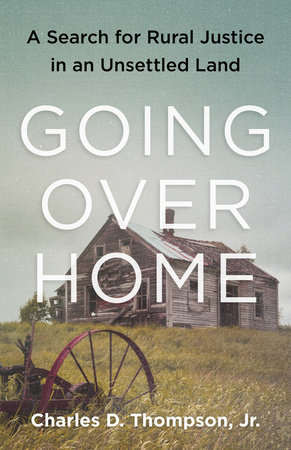
Going Over Home
A Search for Rural Justice in an Unsettled Land
“Going Over Home is a call that inspires the reader to stand shoulder to shoulder with family farmers in their daily struggle.”—Willie Nelson
An intimate portrait of the joys and hardships of rural life, as one man searches for community, equality, and tradition in Appalachia
Charles D. Thompson, Jr. was born in southwestern Virginia into an extended family of small farmers. Yet as he came of age he witnessed the demise of every farm in his family. Over the course of his own life of farming, rural education, organizing, and activism, the stories of his home place have been his constant inspiration, helping him identify with the losses of others and to fight against injustices. In Going Over Home, Thompson shares revelations and reflections, from cattle auctions with his grandfather to community gardens in the coal camps of eastern Kentucky, racial disparities of white and Black landownership in the South to recent work with migrant farm workers from Latin America. In this heartfelt first-person narrative, Thompson unpacks our country’s agricultural myths and addresses the history of racism and wealth inequality and how they have come to bear on our nation’s rural places and their people.
Booklist Editors’ Choice “Best Books of 2019”
Reviews & Praise
“This book isn’t just the story of one person’s lifelong fight for justice for family farmers and rural communities. Going Over Home is a call that inspires the reader to stand shoulder to shoulder with family farmers in their daily struggle. It puts into words why all of us at Farm Aid believe in family farmers and rural America, and why their survival matters to all of us―no matter where we live.”―Willie Nelson, president, Farm Aid
“Going Over Home bears eloquent witness to Charlie Thompson’s path toward a homegrown revolution of the heart, first illuminated by listening to many voices, then achieved by acting in solidarity with those who struggle for equality and inclusion along the wailing walls that America is building between itself and its own heart. Thompson’s exemplary memoir confronts our separate and unequal pasts and gives us a heartfelt but clear-eyed narrative of American agricultural life and a bridge toward wholeness in a broken time.”―Rev. Dr. William J. Barber, II, codirector of the Poor People’s Campaign; coauthor of The Third Reconstruction
“Told through moving stories of kinship and solidarity, Going Over Home brings much needed dimension and heart to our conversations about rural life and shows the strength of our bonds when love of place is animated by justice.”―Elizabeth Catte, author of What You Are Getting Wrong About Appalachia
“Charles D. Thompson, Jr.’s memoir isn’t just a personal snapshot of some of the most important North American agrarian movements and thinkers. It’s the history of a grateful rural educator’s education written with a deep mix of generosity, curiosity, and wit, and it deserves to be read widely.”―Raj Patel, author of Stuffed and Starved

About Charles Thompson, Jr.
Charles D. Thompson, Jr., is the author or editor of six previous books, including Border Odyssey: Travels Along the U.S./Mexico Divide. He has also directed six documentary films, all of which have focused on rural life either in the United States or Latin America. His latest film, produced by Farm Aid in 2017, is Homeplace Under Fire. It concerns the thirty-year history of farm advocacy as supported by Willie Nelson and others. Currently Thompson is at work on a new film about Appalachian small farming. Thompson is the Professor of the Practice of Cultural Anthropology and Documentary Studies at Duke University. He’s also a champion of a number of community causes that center on food, farming, and justice.
Books by Charles Thompson, Jr.

You may also like...
-
 $29.95
 -
$34.95
-
$20.00


