

How to Make and Maintain Your Own Sourdough Starter
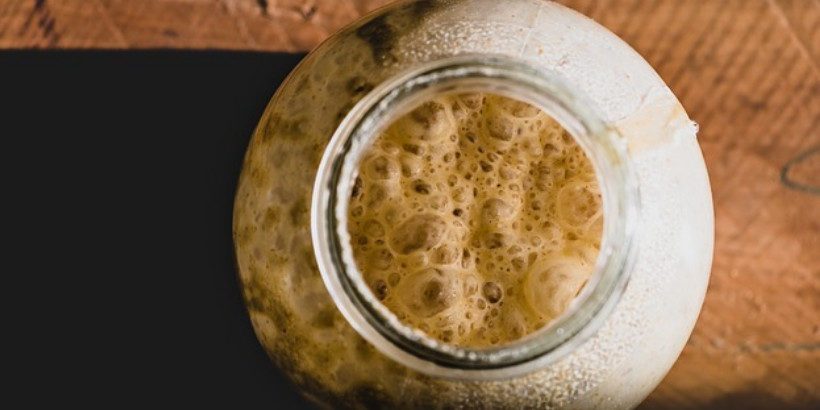
Sourdough is a simple wild ferment made from nothing but flour and water. You can start a batch today, use it in a few days, and keep it alive and bubbling … well … forever.
If you have the patience, enjoy the flavor of sourdough, and can commit to feeding your quiet new “pet” frequently, you can develop a vibrant colony of mixed yeasts and bacteria and keep it going indefinitely. There are stories of legendary, long-lived sourdough cultures — maybe yours could join their ranks. Some were smeared on handkerchiefs, dried, and brought across the sea when folks immigrated to America. Some, like San Francisco’s famous culture, are just the unique ecology of microorganisms from a certain place.
The following is an excerpt from The Art of Fermentation by Sandor Katz. It has been adapted for the web.
Over the years, I have been gifted with sourdough starters by many wonderful people. One great starter was from the Bread and Puppet Theatre Company, which incorporates the baking and sharing of sourdough bread into its performances. Their sourdough came from Germany via company founder Peter Schumann. Another very different sourdough came from my friend Merril Mushroom, who has maintained it for decades, and originally got it from a friend. Merril’s starter is very distinctive due to the fact that she replenishes it not with water, but rather milk. Readers and students have also shared their sourdoughs with me. Unable to maintain so many different starters over time, my current sourdough is one I started from flour and water years ago, to which I have added all the starters I have received. Let us celebrate mixed cultures and give up the futile quest for cultural purity.
No matter what they start as, sourdough starters are not static microbial entities. They become their environment and, to a lesser degree, what they are fed. “You can’t pick and choose your wild yeast,” writes baker Daniel Leader in his book Local Breads.
Your culture will get its unique flavor characteristics from whatever yeast is present in your flour and your air. Say you obtain a sourdough culture from a baker in San Francisco. Once you bring it home and refresh it several times, it will adapt to its new environment. New yeast from your flour and air will begin to grow in the culture. A different mix of bacteria will emerge.1
To demonstrate this, Leader took a sourdough starter from a California baker. He sent part of it to a laboratory for microbial analysis and took the rest home with him to New York State. Four days, a cross-country flight, and several replenishments later, he sent another sample to the lab:
New lab tests confirmed that the yeast now growing in the culture was different from the yeast living in it on the West Coast. It’s possible that particularly strong strains of yeast may survive a journey to a new location and continue to thrive in a culture fed with local flour and air and water. But it’s been my experience that local yeast predominates, making every loaf of sourdough bread a local product.2
There has been some fascinating research by microbiologists into the community dynamics of sourdough cultures. It turns out that in most sourdoughs, lactic acid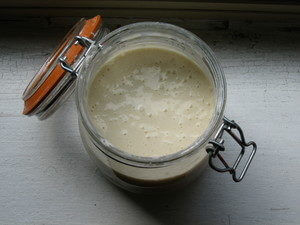 bacteria are far more plentiful in number than yeasts; the consortia they form coexist as communities with great stability over time. Ilse Scheirlinck and colleagues in Belgium analyzed sourdough samples from different bakeries around the country; in some cases, several samples came from the same bakery, of different sourdoughs made from different starters and different grains. The analysis found that the microbial “community structure” of different sour-doughs “is influenced by the bakery environment, rather than the type of flour used to produce the sourdough.”3
A year later, the team repeated the experiment, this time sampling even more different sourdoughs at the same 11 bakeries. They found that the sourdoughs “varied little over time,” and confirmed “only limited variation among the different sourdoughs from a single bakery.”4
Bear in mind that your home is not (necessarily) as microbe-rich as a bakery. While the study cited above found that the specific bakery environment was of greater importance than the flour used, still, flour is rich in microbes to get things started. You do not need to be in a bakery, or in San Francisco (or Belgium) to start a sourdough. Lactic acid bacteria and yeasts are everywhere and just need gentle coaxing and periodic attention. “Only a handful of genera of yeast and bacteria have ever been found in any sourdoughs anywhere,” reports Jessica Lee.5 “The remarkable similarities in the microbial populations of leaven from widely separated places demonstrate the effectiveness of the selection process,” concludes Keith Steinkraus.6
The way to encourage yeast in the mixed sourdough community is to repeatedly feed the bubbly starter a high proportion of fresh flour and water. This means using (or discarding) most of it (75 to 95 percent) and adding the small amount of remaining starter to fresh flour and water, in roughly the amount of what you have removed. Similarly, when using sourdough starter in breads, use a small proportion of starter, no more than 25 percent of the over- all dough, unless you wish to accentuate the sour flavor, which I sometimes enjoy, but sometimes I enjoy breads with subtler flavor or other accents. Perpetuating and using sourdough starter in limited proportions such as these is the key to making sourdough breads in which sourness is a subtle note rather than an exclamation point.
I saw instructions years ago that advised developing and maintaining a sourdough like this, discarding most of the starter with each feeding, and the thought of discarding so much food horrified me, so I completely ignored it. Now I have experienced the benefits of this technique, in terms of better, faster, lighter breads; and I have found a good use for the excess starter: savory pancakes.
I typically maintain my sourdough in a liquid state, thick but not solid. Some people prefer to maintain sourdough starters in a solid state, as a firm dough. Experiment and find the style you prefer. If you are traveling with a sourdough, or wish to leave your sourdough behind while you travel, I would recommend thickening it up into a solid state. The higher density of a solid dough slows down microbial activity. People also freeze their starters, which maintain greater viability if the dough is in a drier solid form. Drying is also used to transmit or preserve sourdough. Legend has it that many immigrants brought their sourdoughs and other cultures dried on handkerchiefs.
Feeding your sourdough daily is ideal, although every two or three days is generally adequate. Be prepared to feed it more often in a warm kitchen than in a cool one. If you use your starter only occasionally, keep it in the fridge. Take it out of the fridge once a week, let it warm up to ambient temperatures, feed, and let it sit and ferment at ambient temperature before returning to the refrigerator. When you are ready to use your refrigerated starter, let it warm up, then give it a couple of high-proportion feedings before baking with it. Similarly, with a starter “backed up” in the freezer, thaw and allow it to slowly come to ambient temperatures, then feed it, repeatedly if necessary, until it becomes vigorously active.
Notes
- Leader, 44–45.
- Ibid., 45.
- Ilse Scheirlinck et al., “Influence of Geographical Origin and Flour Type on Diversity of Lactic Acid Bacteria in Traditional Belgian Sourdoughs,” Applied and Environmental Microbiology 73(19):6268 (2007).
- Ilse Scheirlinck et al., “Taxonomic Structure and Stability of the Bacterial Community in Belgian Sourdough Ecosystems as Assessed by Culture and Population Fingerprinting,” Applied and Environmental Microbiology 74(8):2414 (2008).
- Lee, 3.
- Steinkraus, 202.
Recommended Reads
From the Garden to the Bread Basket: Rosemary Bread, Scones and Stuffing
Read The Book

The Art of Fermentation
With Practical Information on Fermenting Vegetables, Fruits, Grains, Milk, Beans, Meats, and More
$39.95
You may like...
-
 $25.00
 -
$35.00
-
$29.95


Recent Articles
Looking for something to munch on that’s both tasty and good for you? These ginger carrots are a healthy snack that are easy to make at home! The following excerpt is from The Heal Your Gut Cookbook by Hilary Boynton and Mary G. Brackett. It has been adapted for the web. Ginger Carrots Recipe…
Read More
Mead is one of the oldest fermented beverages and is made by fermenting honey with water, offering countless flavor possibilities. Let’s dive into the world of mead making!
Read More
Learn how to make the anti-inflammatory cocktail, Gates of Immortality! This is a vibrant, botanical twist on the classic Whiskey Smash.
Read More
Hot sauce fans, this one’s for you! This easy recipe for fermented hot sauce with wild greens is sure to add an extra punch of flavor to your favorite meal.
Read More
Known for their tall stature and distinctive flower heads, cattails thrive near lakes and marshes. From edible shoots and nutrient-rich roots to pollen used in baking, cattails offer a wealth of uses.
Read More