

The Process of Growing Grain: Dealing With Weeds
Want to grow grains this spring, but weeds keep getting in the way? With the right tools and practices, you can keep weeds from affecting your grains and handle them without hurting the environment.
In the passage below, farming expert Jack Lazor explains the characteristics of the weeds that might appear along the way and offers advice for managing these pesky plants.
The following is an excerpt from The Organic Grain Grower by Jack Lazor. It has been adapted for the web.
How to Deal With Weeds While Growing Grains

Spring cereals don’t have this sort of advantage. Row crops, on the other hand, are planted thirty inches apart in rows that can be mechanically cultivated.
Some experimentation, however, has been done in Denmark and Northern Europe with growing cereal grains in wider twelve- to sixteen-inch rows, and a special steerage hoe called the Schmotzer is driven through these wide rows to mechanically remove weeds.
Both the University of Maine and University of Vermont have Schmotzer hoes and are conducting trials to determine the efficacy of wide-row cereal planting in northern New England. In the meantime, the rest of us have to figure out some other sort of strategy with our six- and seven-inch rows of wheat, barley, and oats.
Yellow Mustard: “The Nightmare Weed”
My own personal nightmare weed that afflicts my spring planted cereals is common mustard. Mustard will germinate just as early as that super-early-planted wheat that I strive so hard to make happen.
My old-timer neighbors told me numerous stories about pulling kale (which is our local variety of yellow mustard). Sam Pion, who grew up on the farm where I now live, told me that his father used to spray the oats with something called “blue vitrol,” which as near as I can tell is copper sulfate, and he said it would kill the kale dead. (I wondered what kind of copper toxicity this had left behind in my soil.)
Thirty years after hearing about blue vitrol, however, I have learned that mustard is a sulfur deficiency indicator. Sulfur is certainly anecessary element for protein synthesis in plants. I have been using very trace amounts of copper, zinc, and manganese sulfates on my hay crops for years, so it may be time to try this fertilization as a foliar spray on cereal grains.
To Spray or Not to Spray?

My own brother-in-law, Ted Welch, was working for the Velsicol Chemical Company of Chicago, Illinois, at the time. Velsicol’s primary product was Banvel, a 2-4-D herbicide for use on cereal grains, and Ted kept asking us if we wanted a free five-gallon pail.
We knew that dioxin, which was one of the deadliest chemicals on the earth, was a by-product of 2-4-D, and there was no way we were having any of that stuff on our farm. This was in 1977 and 1978, and the concepts of organic farming were just beginning to be understood at the time. And so we simply learned to live with the mustard.
Good Vs. Bad Weeds: What’s the Difference?
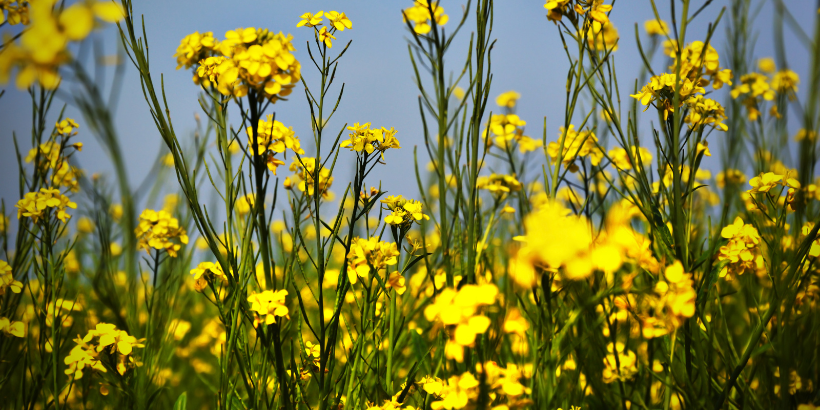
Fortunately for us, it turned out to be not such a bad weed after all. Mustard flowers quickly and ripens to make seed quite early in the season. Unsprayed grain fields will turn completely yellow with mustard flowers when the cereal crop is twelve to sixteen inches tall and still in the vegetative stage. Then all of a sudden, the yellow color is gone and grain heads begin to pop up.
The mustard is still there in the bottom of the grain crop in its reproductive state, forming and filling its tiny little seedpods. The good news is that mustard will make dry mature seed several weeks before the grain is ready to harvest. So at least the mustard seeds don’t pose a threat to the ripe kernels of grain once the crop has been through the combine.
Other later-maturing weeds like red root pigweed and lamb’s-quarters, however, are still quite moist and green at the time of the grain harvest and will impart moisture to an otherwise dry grain sample. If these soggy wet weed seeds are not removed immediately, the newly harvested grain will heat, develop mold, and spoil. Other unwanted plants like ragweed not only impart moisture into the newly harvested grain crop, but also flavor the grain with undesirable pungent smells.
A trained nose can very easily detect the sharp essence of ragweed in wheat berries even after they have been cleaned. After considering all of these possibilities for disaster, a dry mustard seed that is basically inert and stable doesn’t seem like such a bad thing to have mixed into your grain sample. It’s also quite interesting that the clean grain outlets of most older combines and threshing machines made before 1960 were all equipped with little rotary screen cleaning devices known as scourkleens.
The tiny round black mustard seeds would fall through the screen into a separate bag while clean kernels would continue on to the combine’s grain tank. Farm equipment manufacturers eventually did away with scourkleens in the 1960s because herbicide use on cereal crops became universal. But in my early days of grain growing, I was fortunate enough to have harvesting machines with these built-in cleaners.
Managing Mustard Flowers & Other Common Weeds

Weeds have evolved to survive, and this shattering process ensures that there will be plenty of mustard seed in the soil seed bank for years to come.
As I became familiar with the problems of mustard during my first few years as a small-time grain grower, I was told by numerous people that mustard seeds were viable for at least eighty years, and I found out firsthand that farmers before me on my farm must have also been plagued by the stuff.
I would plow up an old piece of pasture or field that had not been turned over for thirty or forty years, and still encounter mustard in my grain crop. As the years passed by, my mustard situation didn’t seem to improve much, and there was certainly lots of free advice to be had for the asking.
This is when my neighbor Sam Pion told me about spraying the blue vitrol on the grain fields. Several other old-timers mentioned running a roller over a recently planted field of a grain for mustard control. The strategy was to wait until the grain crop was six to eight inches tall. Early on a cool crispy morning in late May, you flatten the entire field of grain and mustard with the same roller you would use to pack a newly seeded field. Since the mustard would be stemmy and brittle and the grain, grass-like and supple, the grain crop was supposed to spring back while the mustard stems would actually break off. I must say that I have never tried this approach, either.
The one thing I did try was to cut off the mustard that towered over the grain crop with a mowing machine. This set the mustard back a bit, but it left wheel tracks in the field—and the mustard still managed to flower and seed a week or so later. Throughout this whole process, I was thankful to have the seed-cleaning machinery necessary to clean black mustard seed from my wheat, barley, and oats.
Recommended Reads
A Meditation On Garden Weeding: Reflecting On A Day In the Garden
Read The Book

The Organic Grain Grower
Small-Scale, Holistic Grain Production for the Home and Market Producer
$45
You may like...
-
 $34.95
 -
$32.95
-
$49.95


Recent Articles

Raised garden beds are a great way to utilize small space to create a bountiful garden. Discover how to create beautiful, easy-to-maintain raised garden beds!
Read More
Do you have an old, worn-out pair of jeans in your dresser? Instead of throwing them out, try to grow mushrooms on them. Follow these guidelines to get started.
Read More
If you’re planning out a forest garden, or are just looking for a plant to use as ground cover, garden strawberries are a great option.
Read More
Hot sauce fans, this one’s for you! This easy recipe for fermented hot sauce with wild greens is sure to add an extra punch of flavor to your favorite meal.
Read More
Discover the magic of oyster mushrooms! They can grow almost anywhere. Straw is a surprisingly simple way to cultivate the ever-popular oyster mushrooms.
Read More