ISBN: 9781933392271 Year Added to Catalog: 2006 Book Format: Paperback Number of Pages: 6 x 9, 391 pages Book Publisher: Chelsea Green Publishing Old ISBN: 1933392274 Release Date: September 15, 2006
Also By This Author
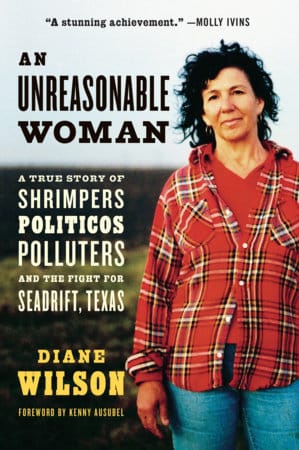
An Unreasonable Woman
A True Story of Shrimpers, Politicos, Polluters, and the Fight for Seadrift, Texas
The following excerpts from
An Unreasonable Woman: A True Story of Shrimpers,
Politicos, Polluters, and Fight for Seadrift, Texas
by Diane Wilson have been
adapted to stand alone for free use as media articles.
When reprinted, all excerpts should be attributed:
Copyright 2005 Diane Wilson, from An Unreasonable Woman: A
True Story of Shrimpers, Politicos,
Polluters, and the Fight for Seadrift, Texas.
Reprinted by permission of
Chelsea Green Publishing Company, chelseagreen.com.
p. 32:
I was leaning towards the bay. Actually the whole fish house was leaning towards
the bay, and already a crack ran through the fish house so I could never pull boxes
of shrimp out of the vault without running into that crack and throwing cold shrimp
and ice halfway down my boots. My coffee cup was sitting on my legs. The coffee was
cold. I had my hands around it like it was hot as hell.
I watched an egret land in the middle of the road, and without moving my chair I
could see it and around it and everything else through the double wood doors that
opened onto the harbor road. The fish house didn’t have screens. Even after the
state health department fella walked through the fish house and ticked off offenses
and tapped on doors and windows and said, “Screens,” and me saying,
“Will do,” (then, later, tacking my copy of the yellow offense sheet to
the bathroom wall so I wouldn’t see it) I never did screens. I liked breathing
too much. Screens got in the way of breathing and a million other things I could
name. With screenless windows, I could smell the sun on the docks. I could smell it
when the sun went down and I could smell it when it came back up again.
p. 156-7:
I was talking with Blackburn. His voice was switched off so hard I couldn’t
recognize it . . . What’s the matter? I said, and he said nothing was the
matter. What made me think something was the matter? He was having an off day. Then
Blackburn asked how my criminal prosecution petition on Formosa was doing.
“Well, it’s damn hard! We’ve got plenty of evidence. . . . Least
we think it’s evidence. Records that say Formosa doesn’t seem willing to
prevent spills, or else they don’t report them like they’re supposed to.
One inspection report told where Formosa built an earthen dam to store some acid
spill, then when the Water Commission came along, Formosa broke a hole and let it all
go. And you think the state fines Formosa for something like that? Heck, no! The
files are full of stuff like that, and that’s not even mentioning the files
those inspectors down in Corpus gave me. Where’s the enforcement on that
one?”
“Wilson! Try a little honey for a change. Sometimes you can catch a fly
better with honey than you can wielding a ten-ton sledgehammer. Stick a petition for
an environmental impact statement out there! That one isn’t near as
intimidating for people to sign, nor for the state to get involved in. Who have you
got to sign that criminal petition anyhow? Anybody?”
“Plain ole fishermen. Had to talk their legs off to do it, though. But what
else you gonna expect when Formosa’s already got millions plunked down for
construction out there? They’ve given out forty-five contracts, and God knows
how many went to the local politicians. Mayor in Port Lavaca’s got one. Justice
of the peace’s got one. That woman mayor in Point Comfort won’t talk to
me anymore. Remember her? She loved me for a while. Now she works for an ex-mayor
who’s got a contract. And remember that little reinvestment zone problem
Formosa had a month ago? The deal the city council in Point Comfort turned down?
Well, forget it. The Chairman himself flew down from New Jersey after that city hall
fiasco and gave a big shindig at the Formosa guesthouse, and before you know it
he’s telling that Point Comfort mayor he’s gonna just buy her that little
wastewater treatment system she wanted so bad. Yeah, the Chairman just walked up to
the mayor with that interpreter in tow and tells her he’s gonna build it.
’Cause wasn’t that what she wanted—a million-gallon-a-day treatment
facility? He’s gonna donate the whole shebang to the city—the water plant
and the land underneath—right after the construction on the Formosa expansion
is complete. So Point Comfort turns over the reinvestment zone deal and Formosa gets
what it wanted. Next, I guess, it’s the abatement on taxes. Another giveaway
thing.”
p. 163-5:
One raw, cold winter evening I . . . called another environmental meeting (with no
directors and no officers, only Donna Sue and the divorced Kathy), and instead of
Sanchez, I got Formosa with their stash of video cameras and tape recorders and a
stenographer carrying her machine in a black leather tote case. The men set up their
equipment in the back of the room behind all the folding chairs, and the video man
leaned back and looked at the ceiling and said, “This light isn’t
helping.” The stenographer came to the front row and unfolded her machine into
a miniature desk.
There is sometimes a silence that comes from noise you don’t recognize, and
it carries no weight and it has no name. So this new unnamed noise arrived: Jack Wu.
Jack was a wasp of a man: much smaller than me, much much smaller than my wrist. I
don’t know, he might have been cat-boned from birth.
“Excuse me,” he said. “Excuse me. We would like
you to know that we are taping your words. All that you say. Every word you say, we
will tape. And if there are lies . . . we will tape those lies. That is all. That is
what we have to say to you.”
Three trucks pulled up outside the civic center, and seven men got out and milled
around the door. They were oystermen, and I saw them through the glass doors in their
oyster clothes, hunkered down against the cold with lit cigarettes and struck matches
and nothing in their posture saying they were doing anything more than waiting for a
smoke to finish. Finally they filed into the room and sat together, and I picked up a
petition I brought with me and took it to them and showed them where to sign their
names. They looked tired—as though the wind and the cold had blown out the
light in their eyes, and when they signed their names it was slower than a schoolboy
would sign his name. When they finished, they picked at their sore hands, torn from
throwing oysters and handling heavy dredges all day.
I walked back to the front of the room and I glanced over at Formosa’s crew.
The woman with the black typing machine had her hair done in a French twist, and she
watched me closer than a lover. She mouthed the words as I said them and typed fast
on her black machine.
I said our environmental group was officially asking for an environmental impact
statement on the Formosa expansion, and we were putting out a petition to collect
signatures to send to state and federal environmental agencies and our elected
officials. An environmental impact statement was federal law. We weren’t asking
for nothing more than the law required, and we believed that the two-billion-dollar
chemical plant expansion, with its half-dozen federal projects, had the potential to
create impacts none of us could foresee . . .
Jack Wu stood, and his voice was thin and reedy and came from four rows back.
“Formosa has already submitted an independently prepared environmental document
to the EPA. It was filed last April. Another impact statement like you have suggested
will only be a tiresome repetition of our original document and could delay this
project fourteen months to two years. Is that what you want? More delays? A study
costing millions more?”
I shook my head. “There’s a big difference between what y’all
filed in April and what an environmental impact study with EPA oversight would do.
What kind of public comment was involved in your study in April? None, I bet. So who
knows what was in it or where you got your information!”
“We do not tell lies, Missus Wilson! It is all science! Facts! We get our
facts correct. It is not like you tell everywhere. ‘PVC is harmful! PVC is
harmful!’ We can tell you that PVC is, in fact, harmless! It has the
same consistency as sugar. Look! We have a little bottle here. Smell it! Pass it
around! Smell it! Do you smell an odor? No! It has no odor! It is harmless! So why do
we need to be burdened with another long study? It is silly. A waste of time. At this
very minute we build a very fine administration building. We have made many
landscaping plans that will only beautify the area. Much money has already been
spent. We have planted many, many trees! How can this be called damage?”
I could see we weren’t going to agree on anything. We might as well have
been from separate planets, with each defending a cause the other knew no words for
and wouldn’t have appreciated even if we had. I supposed it was why wars were
declared.
p. 180-1:
I walked across the harbor and sat on [oystermen’s] back decks and tried to
talk about the pollution from the plants and how the fishermen oughta get
involved.
Their argument was, How was gettin’ riled gonna help? Wasn’t nothing
gonna stop things the way they were goin’. Only thing it was gonna do was scare
folks into believin’ there was something the matter with those bays out there.
And then there go the markets. Shot straight to hell in a breadbasket.
Talk like that ran hard down some dirt road in me, and sometimes I believed them.
Sometimes I didn’t. Now I didn’t, so I got up and walked back to the fish
house. The day wasn’t fit for nothing but cleaning, so I opened the vault and
all the doors in the fish house and put sticks in the window to keep them open and
let in the salt air. I was scrubbing the fish-house floor with a hard broom when the
phone rang, and I turned my back to it and let it keep on ringing. Finally I went and
yanked it up. “Whadda you want?”
A voice said, “I’ll tell you a few things, Missus Wilson. But I
won’t say it over the phone.”
“Who is this?” I said.
“Let’s just call me Douglas,” he said.
“You’re sayin’ that like it’s not your real
name.”
“I won’t say anything over the phone, Missus Wilson. I thought I made
that clear. I’ll talk, but not here. Someplace else.”
“How about at least tellin’ me what this is all about?”
“Oh, I think you already know that.”
“Ohhh. So it’s Formosa.”
“I will not talk over the phone, Missus Wilson, but I will say that
you are correct there. You are correct.”
“So you live around here? You work over there?”
“That’s a few of the things we can discuss when we meet. Don’t
bring anybody else, though. I won’t talk to anybody else. This first time, I
want just you.”
p. 187:
Overnight I became a conduit for workers. The calls came from every direction and
from every plant in the county. A few workers came by the fish house, carrying a
photograph of a chemical spill or a rusted pipe buried deep in the ground; another
horror tale of another chemical. Cyanide. Arsenic. Acrylonitrile. Benzene. One day
after a few subtle, hush-hush telephone calls, a large, rotund superintendent from
Union Carbide brought a map to the fish house and laid it across my desk.
That’s where the contamination of the county’s source of drinking water
occurred, he said. That’s where they leaked benzene: right under the noses of
the Guadalupe–Blanco River Authority. The superintendent’s grandson was
mentally retarded, and he could no longer live with himself.
Most workers just wanted to pass on information. They didn’t trust the
company to fix it, and didn’t trust OSHA (the Occupational Safety and Health
Administration) to protect them. Every worker that walked in the fish-house door
snorted when I mentioned OSHA. They believed any information a worker delivered to
that agency would eventually wind its way back to the company, and then the worker
would be fired. “Hell, woman! There’s no job protection there!”
they said.
p. 189:
The sick man said I was gonna have to come to see him instead of the other way
around. It was getting worse and worse for him to go anywhere. He wanted to know if I
needed any directions getting there, and I said no. I had been to Point Comfort
before.
So that was one reason I found his house so easy. The other reason was he lived
right across the street from Formosa. Chairman Wang, visiting, probably could have
seen us from his office window. There was a fairly new truck sitting in a tiny
driveway, and I went around it to get to the door. The worker’s gray, calm face
stopped me. He leaned out and said, “Do you see my truck out there? It’s
for sale. You don’t need a truck, do you?”
No, I said. I didn’t believe so. Then I came in and sat down in a small
chair in a small house with wall-to-wall Christmas lights. I looked around, and he
watched as I looked. “That’s my wife’s doin’s,” he
said. “She’d never take ’em down if I left it up to her.”
I nodded my head and watched the lights smear like colored water on the ceiling.
“Once,” I said, “when it was Christmastime and I first got my
driver’s license, I drove around a big town for the first time and I ran every
traffic light, thinking it was Christmas lights.”
“I can appreciate that,” he said. “I come from a small town too.
A traffic light wasn’t in my vocabulary neither.” Now, he said, sometimes
he thought it all was just a bad dream. That somehow he would wake up and it would be
nothing but a bad dream. Be back in his own bed in a small town.
“Now, I ain’t nothing but sick all the time. I’m almost
finished. I know it. I can’t perform my craft anymore. I can’t weld. I
can’t hold my arm up to burn a rod anymore. I have to use my other arm to hold
it. My shoulders, my forearms, here. My knees. Everything. I got pains where pains
ain’t been invented yet.”
He said he had worked at Formosa for seven or eight years, and all the workers
ever thought about was the future of that plant. They knew it was getting worse every
day, and that was what worried him. They had two fellas that got hepatitis while
working out there. Formosa blamed it on family history and needles and stuff.
“Heck,” he said. “I knew those fellas. I knew they didn’t
use needles. But that’s what the Chairman would say. That’s what the
safety man over there would say. And you are fighting a losing battle trying to blame
it on Formosa. Everything is negligence on the part of the hands.
“Sometimes I got called out two or three times in the middle of the night,
and the safety man, he wouldn’t come out in the middle of the night. He would
every once in a while, but most of the time he would just okay your permit over the
phone to go do this hot work. Not even knowing if the line had been purged. If it was
ready for you.
“I would work thirty hours without a break. Go home. Rest a little bit. Go
back out and do it again. And the whole time you are doing it, you are opening up
reboilers. Exchangers. And they are never purged. As soon as you break a seal and
pull it apart, you throw up. There were lots of times I would go home and wake up in
the middle of the night and just throw up. Run chills. And just be sick. All the time
from what I did that night.
“One leak we had out there was this vessel. I couldn’t believe it.
They called me out. It was the middle of the night. I couldn’t believe it. I
just live across the street, so I got all the calls out. I am making eighty, ninety,
a hundred hours a week. Year after year. So when I go in, I seen all the lights were
flashing. I seen this cloud going north. That vessel had a real nice rust hole. Well,
not rust. It was eat out from the chemical. But they didn’t want to shut it
down. And all I had was a slicker and a face shield to go get into that. I
didn’t have any kind of face mask, you know, any kind of breathing or fresh air
or anything. I got soaked in it. It was EDC . . .
He took his time talking like there was nothing left for him but a cold, clear
morning and he had somebody’s gray mare to ride him through it, if he wanted.
He sat on the couch, his hands perfectly still over his belly, and two pink-and-white
pompom pillows tucked behind his back. Ever’ now and then he reached and pulled
out a pillow and patted the yarn balls back in place, then tucked it back.
He said he didn’t know what he wanted. Maybe make it so every man that
worked in a chemical plant was told the truth and tested on a regular basis in the
proper way. Maybe make it so a man didn’t have to die just to go to work. He
said it was probably too late for him. He thought it was. His wife couldn’t
bear to look at him. She couldn’t sleep without tranquilizers. Gave up her
sewing. Baking. He pulled the pillow out again, looked at it, then left it in his
lap. “This little thing here was the last thing she messed with. Said she
wouldn’t touch another one. Ain’t no use, so what for? About the only
thing left is those Christmas lights there.”
I never saw him again. He was in the hospital for the last three months of his
life, unable to speak and eventually getting so he couldn’t even nod his head.
His wife went to the hospital every day, and they would write on a pad. The bad dream
never quit for him; he never woke up from nothing. Then, at forty-two, he died and
left behind a wife, a truck, and a houseful of Christmas lights across the street
from Formosa. The company said his cancer was from nitrates. “Nitrates!”
his wife said. “They asked me how much barbecue he ate.”
p. 300-1:
The hunger strike had struck an eternal chord in me, and if I hadn’t known I
was a momma with five kids, I’d have believed I was a show at a movie house
that had been running for years. That was a short-lived fantasy ’cause the kid
thing and the momma thing kept coming up, and since I was a momma of five it had a
multiple factor of five. The Texas Chemical Council wondered publicly: Who is taking
care of that hunger striker’s kids? That woman starving herself to death
certainly isn’t!
I expect that if sore is something you can worm out of yourself when you’re
on a near month-old hunger strike, then I was sore. I wondered privately if the Texas
Chemical Council had ever asked Cesar Chávez or other male activists about
their kids’ whereabouts. No, I didn’t believe so. It was probably just
women that got asked that question. Still, I missed seeing the kids, but Baby said
hell would freeze over before he’d bring the kids to me. And don’t think
about coming home to see them neither, he said. Twenty-four days on a hunger strike
and twenty-four days of not being home was too much for any man to take.
Eventually that changed and so did Baby’s pale-water eyes. It happened one
early Friday morning when a helicopter flew over the dusty oak trees in the front
yard. The craft hovered, then shots were fired. Whether the shots came from a man let
out on the ground or one who simply fired from the open door of the helicopter, it
was never known. Baby’s momma had went down the road to mail some letters, and
the bullets whined past and hit the ground and sent up small dust clouds at her feet.
The dog was shot twice, one bullet exiting his neck and the other lodging in his leg.
The dog limped over to the trailer door of my momma-in-law and bled all over her
front porch.
p. 388:
I didn’t fight all the time. I went out on my little skiff in the mornings
and contemplated the birds and the fish and the elusive porpoises. Then the
corporations messed with my mind where it hurt even more: Seismograph boats hunting
for oil and gas appeared on the bays! They strung dynamite charges hither and yonder
and proceeded to blow up the bay, and when a few fish blew out of the water, more
knowledgeable heads than theirs decided that they needed airboats (the equivalent of
jet planes on the water) to chase the fish away from the dynamite. So five zipping
airboats met me every morning with their racket, and there went our fish. The fish
didn’t return to the bays for a year; the oil and gas exploration in the bays
resumed and goes on to this day. It was within this window of opportunity that the
idea for An Unreasonable Woman was born. What else to do but write and
starve—a starving writer. I didn’t invent it.