

Preserving Vegetables in Salt: Whole Tomatoes
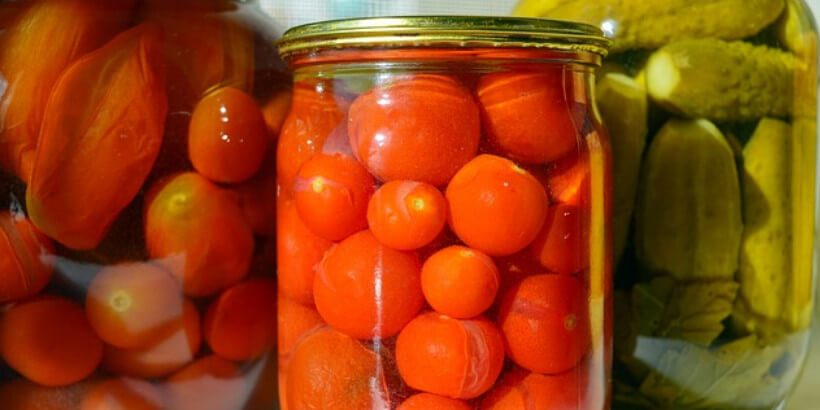
Buying fresh produce feels like a waiting game — if you blink, your food will go from ripe to rotten all too soon. Beat this game by preserving vegetables, such as tomatoes, in salt. This process will keep them fresh and ready for sauce, stock, and more.
The following is an excerpt from Preserving Food Without Freezing or Canning by The Gardeners & Farmers of Terre Vivante. It has been adapted for the web.
Preserving Vegetables in Salt
Above a certain concentration of salt in food, microorganisms cannot develop and thus the preservation of food is assured.
While preserving with salt seems a relatively ancient process, it is not as old as [other] methods…At one time, salt was mainly used for preserving meat, fish, and butter; every rural household had a salt tub. Today, salt still is used for fish, such as cod or anchovies, as well as for pork and butter. Among vegetables, we sometimes salt green beans, herbs, and vegetable mixtures for soup stock.
What to Know Before Preserving Vegetables
There are two main disadvantages to preserving food with salt:
- The salt must be removed from most foods before consuming them, which usually requires lengthy soaking and repeated rinsing that also eliminate some of the nutrients;
- If the salt is not completely removed, we risk consuming more than is considered healthy these days.
However, for preserving foods that we eat in small quantities, or that don’t need much soaking and rinsing, salt has its place. It is one of the best ways to preserve fish, for which other methods tend to be less convenient. Green beans seem to be the vegetable that best lends itself to being preserved with salt.
Preserve Mixed Vegetables In Salt
There are many versions of this method of preservation, and we have included in this chapter several of the most common ones. Yet, among all the foods preserved with salt, mixed vegetables are perhaps the most appealing: no salt need be removed; they do not cause you to eat too much salt; and they make instant stock for soup.
 Preserving Whole Tomatoes
 Preserving Whole Tomatoes
Ingredients
- Tomatoes
- Olive oil
- Salt
- A saucepan
- Glass jars and lids
Procedure
- Make a brine (one-quarter cup salt to one quart of water), and bring it to a boil.
- Allow to cool.
- Choose firm tomatoes, preferably (‘Campbell’ variety, for example), wash and dry them carefully, and put them in glass jars.
- Pour in the cooled brine, up to one and a quarter inches below the rim, and fill in the remaining space with olive oil to cover.
- Close the jars airtight and store them in a cool place.
These tomatoes will keep for nine to ten months; use them for sauces.
Recommended Reads
Read The Book

Preserving Food without Freezing or Canning
Traditional Techniques Using Salt, Oil, Sugar, Alcohol, Vinegar, Drying, Cold Storage, and Lactic Fermentation
$25
You may like...
-
$29.95
-
$25.00

Recent Articles

Eating wild food is a radical act! Look no further than the ultimate comfort dinner recipe: Juniper & Elderberry Braised Short Ribs — served up alongside tips on how to forage juniper berries.
Read More
Before yanking out the next patch of lambsquarter you find in your yard or garden, consider trying one of the many edible and medicinal uses of this “super weed.”
Read More
Looking to add another recipe to your fermenting repertoire? This recipe for kvass calls for just a few ingredients and only takes a couple days to ferment.
Read More
Having a lack of outdoor greenspace doesn’t mean you can’t enjoy homegrown food. Sprouts are a quick, simple, and healthy way to keep your appetite satisfied.
Read More
Yogurt making is having a moment! Join the fun and create your own natural yogurt at home. Try our simple recipe using kefir as a starter and taste the difference for yourself!
Read More