

Drying Herbs and Flowers
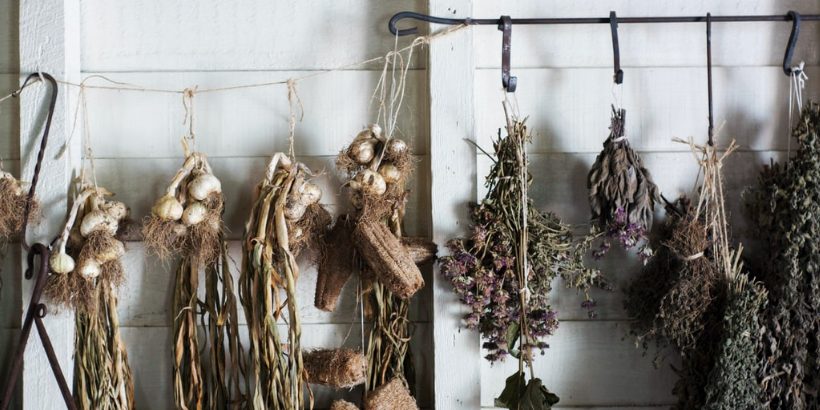
The following is an excerpt from Preserving Food Without Freezing or Canning by the Gardeners & Farmers of Terre Vivante. It has been adapted for the web.
A few guidelines:
- Pick plants in the morning, when it is dry and sunny and they are at their peak, depending on the plant and the part that you are using.
- Wash plants only when necessary (roots, for example).
- Always dry plants in the shade (outdoors) or in a dark place (indoors).
- Drying is complete when plants are dry and brittle.
- Store dried plants in glass jars, paper, or cardboard boxes, away from light. Plants can also be hung in a dry, well-ventilated place.
- Label the containers you use to hold plants.
- With every new harvest, discard plants left over from the previous year.
Farigoulade (Thyme Medley)
- 1 heaping teaspoon thyme
- 1/2 teaspoon savory
- 1/2 teaspoon oregano
- 1 heaping teaspoon thyme
- A coffee mill
Pick these plants just as they are starting to flower, and allow them to dry in the dark. Remove any very woody parts, and grind the herbs to a fine powder using a coffee mill.
Serve this medley with grilled mutton. We place a spoonful in one corner of our plates and dip pieces of meat into it. It’s a gourmet’s delight!
Anne-Marie Arrouye, Aix-en-Provence
Herbs in Bags
- Herbs with long stems (rosemary, basil, tarragon, sage, mint, etc.)
- Paper bags
This method works well for long-stemmed herbs, such as rosemary, basil, tarragon, sage, and mint. Place the heads of the herbs (separated by type) all the way inside a paper bag; gather the stems together, and tie them up along with the open end of the bag. Make holes in the bag for ventilation, and hang it in a not too cool, not too warm, well-ventilated, and preferably dark place. (Herbs lose their flavor when exposed to light.)
Ghislaine Fayolle, Larajasse
Herbs in Open-Air Bouquets
- Herbs (parsley, sage, thyme, bay leaves, tarragon, mint, marjoram)
- Glass jars
This is a particularly effective technique for parsley, sage, thyme, bay leaves, tarragon, mint, and marjoram. Make little bouquets of herbs (separated by type), and hang them in a dry, well-ventilated place, preferably in the dark. When the herbs are dry, the leaves can be separated from the stems, and stored in airtight glass jars.
M. Buisson, Riorges
Herbs on Trays
- Herbs
- Small cloth-lined crates, or trays made with screening or muslin
Place a shallow layer of plants in small crates, lined at the bottom with cloth, or on trays made with screening or muslin. Small crates, or trays with “feet,” can be stacked. Put the crates or trays in a dark, dry, well-ventilated place (such as the attic).
Jeannette Roy, Vergigny
Linden Flowers
- Linden flowers
- 2 clean dishtowels
- Tin cans or glass jars
Follow the same procedure as for rose petals (below). This way, each room will have a different scent.
You can also make a mild, soothing tea from dried linden flowers, which are highly prized in France for this purpose. The American basswood tree, widespread throughout the eastern United States, is in the linden family and produces suitable flowers.
Rose Petals
- Rose petals
- 2 clean dishtowels
- Tin cans or glass jars
To dry rose petals properly, they must be spread out in thin layers and protected from light and dust. So, on a clean dishtowel, which I’ve placed on the top of a cabinet, I spread the freshly gathered rose petals, and cover them with another dishtowel. While drying, they give the room an exquisite scent! After several weeks, I store them in tin cans or glass jars labeled with the plant’s name and the harvest year.
Lise Marie Ratier, La Ferrière
Summer Scents
- Mixed herbs (thyme, bay leaves, rosemary, wild thyme, savory, etc.)
- 3 cloves
- 1/2 teaspoon grated nutmeg
- Small piece of dried chili (optional)
- A salad bowl
- A glass jar
Gather a bouquet of mixed herbs. Set them out to dry right away in a dark, dry place. Remove the leaves from herbs with hard stems (thyme and rosemary, for example). Combine two tablespoons of each herb with three cloves, onehalf teaspoon of grated nutmeg, and a small piece of dried chili (if you like it), all together in a salad bowl. Blend small quantities of this mixture by hand, so as to obtain a coarse powder that should be stored in a glass jar.
These herbs marvelously season winter vegetables, omelets, cheeses, and the like.
M.-T. Petit, Pont-de-Cé
Recommended Reads
Read The Book

Preserving Food without Freezing or Canning
Traditional Techniques Using Salt, Oil, Sugar, Alcohol, Vinegar, Drying, Cold Storage, and Lactic Fermentation
$25
You may like...
-
 $24.95
 -
$27.95
-
$44.95


Recent Articles

These small fruits are a delicious source of nutrients that you can find almost anywhere. Get started on acorn harvesting with help from these simple tips!
Read More
Want an on-the-go snack without having to go to the grocery store? Whip up this homemade applesauce for a fresh fall snack whenever you get the craving!
Read More
The possibilities are pretty much endless with wild ingredients — use almost any fresh fruit or juice and a sweetener to create your own custom jam or syrup!
Read More
Fermenting mead is an ancient practice. With step-by-step instructions, learn how to brew fruit-based and flower meads, from foraging to fermenting.
Read More
Small But Mighty! Crab Apples are easy to find, simple to store, and incredibly flavorful. Keep reading to learn more about the unsung heroes of the apple family.
Read More