ISBN: 9781933392295 Year Added to Catalog: 2006 Book Format: Paperback Number of Pages: 6 x 9, 256 pages Book Publisher: Chelsea Green Publishing Old ISBN: 1933392290 Release Date: September 15, 2006
Reason flows from the blending of rational thought and feeling. If the two functions are torn apart, thinking deteriorates into schizoid intellectual activity and feeling deteriorates into neurotic life-damaging passions.
—Eric Fromm
Muntjac
Our world is in crisis, and, regrettably, our way of doing science in the West has inadvertently contributed to the many problems we face. I began to realise that something was seriously amiss with our mode of scientific enquiry when I was 25 years old. I had just come back to England after three years away as an ecologist and teacher in Venezuela and Colombia.
Feeling my usual urgent need to connect with nature, I had lost no time in finding a quiet wood, which to my delight, was peppered with the tracks of tiny cloven-hoofed beings. But whose tracks were these? Fascinated, I had hidden myself in a thicket overlooking a broad woodland path, waiting for the mysterious creatures to appear. As the sun settled on the horizon and dusk bathed the wood in a deep purple light, a tiny deer stepped out of the trees and stood out in the open, a creature so small that it was more like the duikers I had occasionally spied in the wild bush country of Zimbabwe than any deer native to the British Isles. The little creature exuded a deep peace and an easy elegance that totally captivated me, transforming the whole wood. In the presence of this being, a profound sense of the inexpressible beauty of nature wafted over me like subtle smoke, enveloping me in a feeling of deep peace and happiness.
The little deer was a Reeve’s muntjac deer (Muntiacus reevesi), a relatively recent addition from southern China to the fauna of the British Isles, and one of the world’s smallest deer, with a shoulder height of only 45-50 centimetres. I cycled back to the wood many times to see muntjac. It was during one of these visits that I was gripped by the idea of devoting the next few years of my life to delving into the lives of these enigmatic creatures.
Soon after, to my delight, I was given the chance to do my doctorate on muntjac ecology and behaviour at one of the world’s very best zoology departments, at the University of Oxford.
It was hard to find a good study area. For a whole year I laboured in vain in a dense thicket behind an army barracks trying to observe muntjac behaviour, but the best I could do was to take plaster casts of hundreds of muntjac footprints. Scientifically, these were almost worthless, but collecting them had at least kept me busy. Then of course, there was the inevitable collection of muntjac dung, which would at least yield some interesting information, despite the horror expressed by my housemates when they found plastic bags full of it in the fridge.
At last, in desperation, I contacted the Forestry Commission and asked them if they knew of a wood in my area which held muntjac and in which I could work. Surprisingly, they suggested that I take a look at Rushbeds Wood, a 40-hectare holding near Brill, about 14 miles north-east of Oxford. Rushbeds was a semi-natural ancient woodland which they were doing nothing with at that time—possibly there were muntjac there. I would be free to use it, if it suited my purposes.
Driving out of Oxford in the zoology department van towards Rushbeds Wood on a cold winter’s morning, I passed the newly restored tower of Magdalen College, gleaming golden in the sun. Then I drove through the wooded tunnel of Headington Hill before striking out into the quiet countryside beyond Stanton St John. I slowly approached the hill village of Brill overlooking the Vale of Aylesbury, and stopped by its old windmill to look out to the north. There below lay the wood, a lovely expanse of dark brown and grey branches gently linking with the larger lakeside woodlands of Wotton House. Would this be my new domain, a place where I could begin to unravel the intricate mysteries of muntjac ecology?
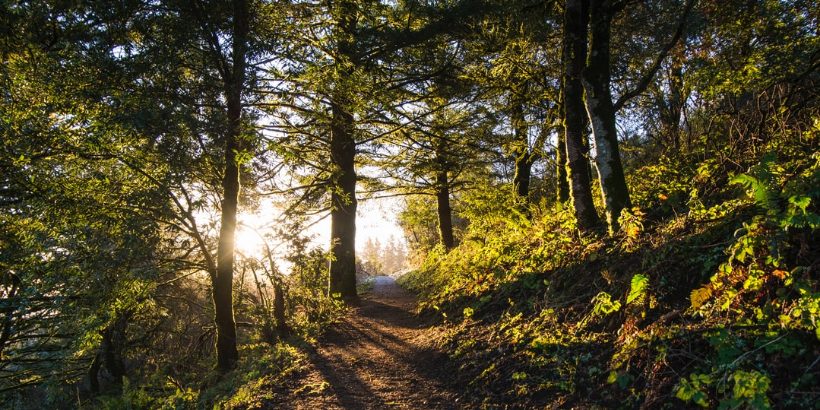
Rushbeds Wood was perfect. The abundance of fresh muntjac dung and footprints (or ‘slots’) allayed my fears that the little deer had not favoured the area. It was flat, modestly endowed with paths and rides, and apart from a dense blackthorn thicket at the western end, it was possible to walk anywhere in the wood. Virtually no one visited. It lay in quiet repose as it had done for all the centuries since it had been sliced off from the original great forest. There had been no disturbance of any kind for several decades, and the wood had a deliciously wild, unmanaged feeling that made me feel deeply relaxed and at home in its complex vegetation and its dark, overgrown tracks crossed with fallen trees and deep swampy puddles.
The work was hard. Amongst other things, I had to carry out a systematic, quantitative survey of the wood’s vegetation in order to study muntjac habitat preferences. This work took two summers and one winter, laying out hundreds of temporary 5-metre square plots with bamboo poles and string, and then estimating by eye the cover of various species of herbs and shrubs within them. Trees had to be measured using a different, time-consuming technique. The concentration needed to extract these numbers from the living world was taxing and exhausting, and it seemed unnatural.
After working on two or three plots, needing to rest my tired mind, I would lean back against a tree looking up at the sky through the wonderful wild mesh of branches, listening to the wood living its life as a vast breathing being. I became part of this being, with its swaying branches, its crisscrossing birdsongs, and its invisible muntjac carrying on with their strange lives all around me.
During these meditative moments there was a profoundly healing sense of Rushbeds Wood as an integrated living intelligence, a sense that expanded beyond the wood itself to include the living qualities of a wider world of the atmosphere, the oceans and the whole body of the turning world. Rushbeds Wood in these moments seemed to be quite clearly and obviously alive, to have its unique personality and communicative power. These periods of communion were intensely joyful and relaxing, and contrasted markedly with the stressful effort to reduce the wood to quantitative measurements in my multiplying field notebooks.
I noticed with interest that the joyful sense of union would fade into the background of my consciousness as soon as data collection began. Gathering numbers was mind numbing; being and breathing with Rushbeds Wood was liberating.
I had similar experiences whilst working at Whipsnade Zoo, where muntjac were free to wander almost anywhere within the spacious, parklike grounds. Here was a place where I could observe muntjac without the intervention of the dense, thickety vegetation of Rushbeds Wood, which afforded only fleeting glimpses of the muntjac as they crossed a clearing at dusk or dawn. The open, wooded lawns at Whipsnade made it easy to watch the little deer, many of whom I came to know as individuals. Once again, my brief was to collect numbers, this time about their movements and behaviour, so I would record on data sheets what the deer did and where they were every four minutes, for hours on end.
During my rest periods I would simply sit among the muntjac without collecting data at all. I particularly loved finding an animal that was chewing its cud. Sitting at a respectful distance, I would feel the intense, tranquil pleasure that seemed to emanate from the little animal as a bolus of food bulged along its oesophagus and into its mouth. I loved the halfclosed eyes, the meditative tranquillity, and the delicious, warm, chamoisleathery sort of feeling that exuded from them like the aroma from a richly scented flower. It was as if a gentle yellow light emanated from them into the surroundings. My own animal body gleaned something of the ease and comfort with which they lived their lives, as though they were informing my senses with a kind of contentment I had not known before.
It is now more than 20 years since I did this work, and looking back I realize that I learnt as much, and possibly more, from the simple exposure of my own sensing organism to Rushbeds Wood and the muntjac than I did from the data collection and analysis that I was engaged in to gain my doctorate. Of course, analyzing data and writing up the results were enjoyable pursuits in their own right that trained my rational mind and made it possible for me to become a card-carrying member of the scientific community. The science also allowed me to put together a fascinating and factually based account of the lives of the little deer that would have been impossible to achieve in any other way. But the learning that ultimately gave me the most valuable lessons about nature came from the unexpected qualities revealed to me by Rushbeds Wood and by the gently ruminating Whipsnade muntjac.
To my intense disappointment, there was no place for an exploration of these qualities in the fat doctoral thesis that I eventually submitted, for they were considered to be just my own subjective impressions. They were suitable for poetry perhaps, but did not belong to a way of doing science that wanted to banish me to a soulless world of bare facts devoid of inherent meaning. In an eloquent expression of this outlook, Bertrand Russell, the great 20th-century English philosopher, said that “Our origins, hopes and fears, our loves and beliefs are but the outcome of accidental collocations of atoms.” In similar vein Jaques Monod, the much respected Nobel laureate in biochemistry, thought that the science that he practised required an to “wake to his total solitude, to his fundamental isolation”, to “realize that, like a gypsy, he lives on the boundary of an alien world”.
It was only when I came to work at Schumacher College, some three years later, that I encountered the notion that the major flaw with this perspective is the belief that the whole of nature, including the Earth and all her more-than-human inhabitants, is no more than a dead machine to be exploited as we wish for our own benefit, without let or hindrance.
This idea, which has held centre court in the Western mind for about 400 years, has led us to wage an inadvertent war on nature, of gargantuan proportions. The casualties are mounting even as you read these words.
Key indicators of planetary and social ill-health are growing exponentially fast, including species extinctions, water use, the damming of rivers, urban populations, the loss of fisheries, and average surface temperatures. It is a war that we cannot possibly win, as E. F. Schumacher so drily observed when he said that “Modern man talks of the battle with nature, forgetting that if he ever won the battle he would find himself on the losing side.” We are living through a world-wide crisis of our own making: the crisis of‘ global change’.
Many green thinkers agree that this mechanistic world-view has brought us to the brink of a catastrophe so great that our very civilization is threatened, and that we urgently need to make peace with nature by rediscovering and embodying a world-view that reconnects us with a deep sense of participating in a cosmos suffused with intelligence, beauty, intrinsic value and profound meaning, as I had discovered at Rushbeds Wood. In this book we shall try to explore this participatory understanding using insights from Gaia theory, holistic science and deep ecology. In particular, we will ask to what extent it is possible to use recent scientific discoveries about the Earth to develop a deep reverence for our planet home so that we can then engage in actions consistent with this reverence, for science is a dangerous gift unless it can be brought into contact with the wisdom that resides in the sensual, intuitive and ethical aspects of our natures. As we shall see, it is only when these other ways of knowing complement our rational approach to the world that we can truly experience the living intelligence of nature.
Rediscovering Animism
The experiences of wholeness into which I had stumbled whilst living and working with muntjac were healing and full of significance, but my confidence in them had been almost totally undermined by the mechanistic views so eloquently articulated by Monod and Russell. I left the university with my doctorate, but also with a great deal of unease. Were Monod and Russell right, or was there anything of genuine value in the diverse life and intelligence that I had sensed in Rushbeds Wood and its inhabitants? And if what I had experienced was indeed real, could it ever become part of science?
For most non-Western cultures, such experiences of the living qualities of nature are a source of direct, reliable knowledge. For them, nature is truly alive, and every entity within it is endowed with agency, intelligence, and wisdom; qualities which in the West, when they are recognised at all, have commonly been referred to as ‘soul’. For traditional cultures, rocks are considered to be the elders of the Earth; they are the keepers of the oldest memories and are sought out for their tranquil, wise counsel. High mountains are the abode of powerful beings, and are climbed only at the risk of gravely offending their more-than-human inhabitants. Forests are living entities, and must be consulted before a hunt by the shamans of the tribe, who have direct, intuitive connection with the great being of the forest. The American philosopher and cultural ecologist David Abram makes the point that many traditional peoples knew their natural surroundings as so intensely alive and intelligent, as so sensitive to one’s presence, that one had to be careful not to offend or insult the very land itself. Thus, most indigenous cultures have known the Earth to be alive—a vast sentient presence honoured as a nurturing and sometimes harsh mother or grandmother. For such peoples, even the ground underfoot was a repository of divine power and intelligence.
These non-Western peoples espoused an animistic perspective, believing that the whole of nature is, in the profound words of ‘geologian’ Father Thomas Berry, “a communion of subjects rather than a collection of objects”. Animism has traditionally been considered backward and lacking in objective validity by Western scholars, but today philosophers, psychologists and scientists in our culture are beginning to realise that animistic peoples, far from being ‘primitive’, have been living a reality which holds many important insights for our own relationships with each other and with the Earth. One such insight is that animistic perception is archetypal, ancient, and primordial; that the human organism is inherently predisposed to seeing nature as alive and full of soul, and that we repress this fundamental mode of perception at the expense of our own health, and that of the natural world.
Psychologists involved in the study of child development recognise that children pass through an animistic phase in their early years, during which they relate to objects as if they had a character and as if they were alive—evidence consistent with my argument for the primacy of animism. But tragically, these same psychologists hold that this animistic phase is only appropriate to early childhood, and that one must help children to realize as quickly and painlessly as possible that they live in a dead world in which the only experiencing entities are other humans. However, not all psychologists subscribe to this view. James Hillman, a close student of Jung and the founder of Archetypal Psychology, suggests that animism is not, as is often believed, a projection of human feelings onto inanimate matter; but that the things of the world project upon us their own ‘ideas and demands’, that indeed any phenomenon has the capacity to come alive and to deeply inform us through our interaction with it, as long as we are free of an overly objectifying attitude. Hillman points to the danger of identifying interiority with only human subjective experience; a gaping construction site, for example, or a clear-cut mountainside, may communicat the genuine, objective suffering of the Earth, and one’s sensing of this is not merely a dream-like symbol of some inner process which relates only to one’s own private inner self.
This animistic perspective has a long and distinguished philosophical pedigree. For some eminent philosophers such as Spinoza and Leibniz, and more recently Alfred North Whitehead, it was inconceivable that sentience (subjective consciousness) could ever emerge or evolve from wholly insentient (objective, physical) matter, for to propose this would be to believe in a fundamental division or inconsistency within the very fabric of reality itself. Therefore each of these philosophers considered matter to be intrinsically sentient. The new animism that they espoused simply recognizes that the material world around us has always been a dimension of sensation and feelings—albeit sensations that may be very different from our own—and that each entity must be treated with respect for its own kind of experience.
But if animism is indeed such an archetypal, primordial mode of perception, how did it come to be suppressed in such an effective and pervasive way in Western culture? What drove animism underground, and what have been the effects of its loss? The story of how animism vanished is complex, intricate, and difficult to fully unravel. Some theorists, such as Paul Shepard, suggest that the separation began with the widespread adoption of agriculture during the Neolithic (new stone age) period some 5,000 years ago. Shepard argues that agriculturalists developed a fearful attitude to undomesticated nature because their crops were continuously susceptible to pests, floods, droughts and other natural misfortunes, and because these early farmers had to expend a great deal of effort to prevent wild vegetation from taking over their fields and pastures. There is evidence that this fearful attitude was linked to the worship of wrathful masculine gods who were distant from nature and who had to be constantly placated in order to keep the more-than-human world under control. It seems to me that in the Neolithic era our spontaneous animistic sensibilities gave way to a dualistic animism, in which crops, fields and domesticated livestock had to be protected from the surrounding wilderness.
According to author Roderick Fraser-Nash, the precursor of our word ‘wilderness’ comes from the concept of wildeor, from the 8thcentury Beowulf epic connoting a mixture of ‘will’—self-willed, uncontrollable nature and deor, meaning savage beast. Hence ‘wilderness’ is the place where uncontrollable dangerous beasts lurk, darkly threatening the agriculturalist’s world.
Cultural ecologist David Abram holds that the advent of formal writing systems—and, in particular, the emergence and spread of the phonetic alphabet—was a major factor in the breakdown of the animistic experience. In his book The Spell of the Sensuous he demonstrates that phonetic reading involves a displacement of our instinctively animistic style of perception away from surrounding nature to the written word, such that the printed letters on the page begin to speak to us as vividly as trees, rivers, and mountains once spoke to our more indigenous ancestors.
Writing and reading, according to Abram, involve a sublimated form of animism: while our indigenous forebears once participated, animistically, with animals, plants, and indeed every aspect of the expressive cosmos, we now participate exclusively with our own human-made signs and technologies.
Such a thesis helps explain why the richly animistic and nature-based polytheism of ancient Greece slowly transformed, in the 4th century BCE, to the more rational world-view of Plato and the philosophers. Plato himself was being educated in Athens precisely at the moment when the new alphabet was first included in the Athenian curriculum, so it was only natural that he would be one of the first to enact a new style of thought made possible by the phonetic alphabet. While the Homeric Greeks experienced surrounding nature to be filled with gods—they felt the presence of Zeus in a thunderstorm and Poseidon in the ocean waves—Plato articulated a new way of seeing and feeling, according to which the sensuous cosmos that we see around us was not the only potency in the world. For Plato, and the students in his academy, the perceived things that populate this world—the material things we see around us, which are subject to change, to growth and decay—are not the only reality. They are, rather, derivative copies of bodiless, eternal ideas that exist in some abstract realm. These archetypal ideas exist elsewhere, outside the body’s world; the rational intellect alone has the capacity to gain access to that eternal domain beyond the stars.
Plato thus inaugurated the notion of an eternal heaven hidden beyond the material world, an ideal realm where the true source of things really exists. In the hands of later philosophers, and of the Christian Church, this notion led to an increasingly dualistic way of thinking, according to which everything genuinely meaningful and wondrous about the world was assumed to exist elsewhere, in some otherworldly dimension; while the sensuous, material world of nature was viewed as an illusory, derivative, and increasingly drab world, fallen away from its divine source. But Plato himself was perhaps less of a dogmatic dualist than those who followed him, and may be best understood as a dualistic animist. In one of his richest writings, entitled the Timaeus, he articulated an idea that would have powerful repercussions during the European Renaissance almost two thousand years later. This was the notion that became known, in its Latin version, as the anima mundi—the ‘soul of the world’. In his Timaeus, Plato states that “This world is indeed a living being supplied with soul and intelligence . . . a single visible entity, containing all other living entities.” Hence the world itself was considered to have a soul—the anima mundi—which had given birth to matter and then caused it to remain in ceaseless motion. Anima mundi was feminine, and permeated every aspect of the material universe.
In the Timaeus Plato also writes of a divine Creator who had enfolded the laws of mathematics and the beautiful symmetries of geometry into every aspect of the world. Although he also suggests in this work that every being was contained in and nourished by anima mundi, he nonetheless seems to insist on the primacy of the human intellect over emotion, the body, and the rest of the material world. According to philosopher Mary Midgley, for Plato the aim of human existence was to engage in intellectual enquiry into the laws governing the motions of the stars and planets, because the celestial realm was where the divine intellect was best displayed and comprehended. The Earth, however, was the realm furthest from the divine mind, and being full of imperfections, conflicts and contradictions, could be largely disregarded and to some extent disparaged, even though anima mundi was its creator and imposed upon it an overarching harmony that prevented a descent into total disorder.
In some of his dialogues Plato proposed a seamless interconnectedness of existence within a hierarchical ordering of the cosmos. The human soul was connected to the souls of animals and plants through the anima mundi, but failed humans reincarnated as animals, which were not worthy of much respect because they “came from men who had no use for philosophy”.
For Plato, the Earth was merely a convenient place from which to carry out the contemplation of celestial bodies, but any other habitable planet would have done just as well, since not much attention needed to be paid to what was after all merely the lowly abode of the body. Plato’s most famous student was Aristotle, who, returning to a more sophisticated expression of the ancient non-dualistic animism, espoused a more immediate felt relationship with nature, in which each being was not the imperfect manifestation of a disembodied eternal idea, but displayed instead its own dynamic coming into being entirely from within itself.
A dualistic interpretation of Plato’s ideas was later incorporated into Christianity, which before the Reformation espoused a peculiar kind of hierarchical animism in which man occupied a privileged position halfway between physical matter and the spiritual world. During the Middle Ages, the common folk who had no access to reading and writing were deeply animistic, and believed that nature was sacred, despite the efforts of the
Church and its priests to impose the view that there were no spirits in trees, rocks, streams or forests. Instead, the priests attempted to convince the peasantry that these entities did not possess their own internal Godlike powers, but rather that God had intended them merely as a sign of his own divine presence, which emanated from some disembodied, invisible domain far from the world of matter. But the animism of the common folk was resilient, and defied the efforts of medieval Christianity to stamp it out. As a result the Church simply adapted and compromised by taking over many ancient sacred places and by tolerating certain kinds of animistic practice. This peculiar and complex syncretism between animism and Christianity held sway for about 1600 years, until the birth of modern science.