

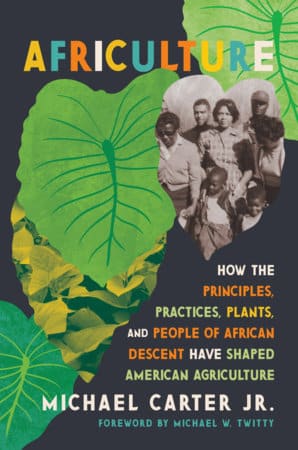
Africulture
How the Principles, Practices, Plants, and People of African Descent Have Shaped American Agriculture

| Pages: | 336 pages |
| Size: | 6 x 9 inch |
| Publisher: | Chelsea Green Publishing |
| Pub. Date: | May 19, 2026 |
| ISBN: | 9781645023012 |
Africulture
How the Principles, Practices, Plants, and People of African Descent Have Shaped American Agriculture
“Africulture is a gift and inspiration.”—Michael W. Twitty, author of the James Beard Foundation Award-winning The Cooking Gene
A bold, timely history illuminating the essential contributions to U.S. agriculture arising from the expertise and innovations of Black men and women.
In Africulture, fifth-generation family farmer Michael Carter, Jr. has blended an eclectic brew of history, culture, African-centered perspectives, and African American farm realities. Throughout, he includes inspiring stories of innovators as well as sobering facts tracking the severe decline in the number of Black farmers in the United States over the last century. Descriptions of tropical crops that Carter grows, from jute to Nigerian spinach, enliven the text, as do anecdotes from his compelling family history and profiles of contemporary Black farmers and activists. Drawing on the lifecycle of a plant as a metaphor for both individual growth and the larger story of African American farming, Carter evokes the relationship between soil health (metaphorically, society and community) and plant health (i.e., the ability of Black farmers and families to thrive).
Africulture also includes Carter’s heartfelt reflections on the cycles of progress and backsliding—what he calls “blacklash”—that are an inescapable part of the history of Black people in the United States, in agriculture and beyond. In the present moment, when the civil rights gains and progress toward economic parity for Black Americans of the past fifty years may be slipping away, Carter offers the possibility of a better future through several foundational principles of Africulture.
Destined to surprise, challenge, and enrich, Africulture lays bare the undeniable revelation that without African expertise and innovation, American agriculture—and America itself—would not exist.
“The ancestors are undoubtedly shaking their tambourines in celebration of Africulture…[it] provides a blueprint for the blossoming of an agriculture rooted in cultural memory, ecological care, and mutual thriving.”—Leah Penniman, cofounder, Soul Fire Farm; author of Farming While Black
Reviews & Praise
“In Africulture, fifth-generation Black farmer Michael Carter Jr. presents an uplifting and enlightening celebration of Black people and African crop varieties and agricultural practices that were, and are, critically important to the success of American agriculture. He educates using personal memories, cultural history, and stories of his success with African varieties like jute and Nigerian spinach.
“Throughout the book, Carter draws on the metaphors of a plant and a seed to discuss not only plant health and bounty, but also the larger issues for African Americans working to succeed in farming. Africulture points the way to using organic and sustainable practices, cooperative marketing, and community education to grow a new generation of increasingly more successful Black farmers and agriculturalists.”—Ira Wallace, Southern Exposure Seed Exchange; author of The Timber Press Guide to Vegetable Gardening in the Southeast
“The ancestors are undoubtedly shaking their tambourines in celebration of Africulture, Brother Carter’s reverent recounting of the noble, dignified, and expert contribution of Black people to American agriculture in the face of extinction-level threats. Carter elucidates the poetic kinship between the Black agrarian narrative and the botanical life cycle of the very plants we tend, interweaving his vulnerable personal memoir as a fifth-generation farmer. Africulture provides a blueprint for the blossoming of an agriculture rooted in cultural memory, ecological care, and mutual thriving.”—Leah Penniman, cofounder, Soul Fire Farm; author of Farming While Black
“As a fellow Virginian, I am honored to offer praise for Michael Carter Jr.’s Africulture. Mr. Carter reminds those of us who need reminding that without African farming experience, white immigrants like me would not have survived long in the American colonies. He does this in a lively, engaging style, including metaphors of Black history as stages of plant growth. I appreciate his descriptions of tasty African crops that we could grow in Virginia for climate change resilience. With inspiring bios of prominent Black farmers and educators, Africulture provides an uplifting message and encouragement to other farmers, especially Black farmers.”—Pam Dawling, author of Sustainable Market Farming, Second Edition and The Year-Round Hoophouse
"Africulture speaks to Michael Carter Jr.’s unique perspective on food and farming which is informed by: being a 5th generation Virginia farmer; having lived and farmed in the United States and Africa; and being a student of history, culture, and spirituality. Brother Carter challenges us to think about agriculture as a fundamental part of our work to rebuild the self-determination that was lost through colonialism and enslavement. Written to be accessible to those interested and engaged in the work of building Black Food Sovereignty, this book incorporates humor, stories, and interviews that give insight into the world of Black food and farming. Africulture makes an important contribution to the growing body of literature about Black land and agriculture."—Malik Yakini, cofounder, National Black Food and Justice Alliance

About Michael Carter Jr.
Michael Carter Jr. is an eleventh-generation farmer in the United States and is the fifth generation to farm at Carter Farms, his family’s century farm in Orange County, Virginia, where he gives workshops on how to grow and market ethnic vegetables. In addition, he runs Africulture, a nonprofit dedicated to educating and expounding upon the principles, practices, plants and people of African descent that have contributed to agriculture. He sits on the board of directors of the Montpelier Descendants Committee, Orange County African American Historical Society, Virginia Food Systems Council, American Climate Partners, and Virginia Agrarian Trust. He also serves as a fellow for the Center for Food Systems and Community Transformation. Michael was recognized as a 2020 Audubon Naturalist Society Taking Nature Black Regional Environmental Champion, the 2020 VSU Small Farm Outreach Agent of the year and Future Harvest Casa Farmer of the Foodshed for 2021. He acquired an agricultural economics degree from North Carolina A&T State University and has worked in Ghana, Kenya, and Israel as an agronomist and organic agricultural consultant. He presently consults with numerous governments, organizations, institutions, and individuals throughout the region and nation on food access, food security/insecurity, market outreach, social and economic parity/equity/evaluation programs, racial understanding, immersion, history, and cultural training, among other areas. Michael also teaches and expounds on the contributions of Africans and African Americans to agriculture worldwide and trains students, educators, and professionals in African cultural understanding, racial literacy, empathy, and implicit bias recognition. He teaches his course on Africulture at the University of Virginia in the school of Environmental Thought and Practice.
Books by Michael Carter Jr.
You may also like...
-
 $34.95
 -
$22.00
-
$29.95


