

Making Delicious Recipes on a Restrictive Diet —With Love!
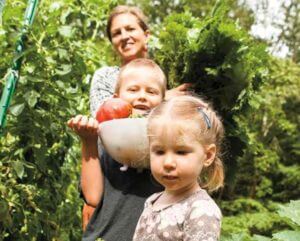
Leah M. Webb, MPH, obtained her health coach certification from the Institute for Integrative Nutrition. She has worked in nutrition and gardening education since 2009 with a focus on engaging children in healthy eating habits through experiential learning and discovery. Leah started and runs the Deep Rooted Wellness blog, on which she posts stories and tips regarding nutrition, having a restrictive diet, gardening, and healthy families.
She lives in the mountains of North Carolina with her husband, T.C., and their two children, Owen and June. Owen has a life-threatening anaphylactic allergy to wheat, and June has cystic fibrosis, a genetic disease severely impacting the lungs and pancreas. Leah’s commitment to a restrictive, nutrient-dense diet has played an important role in her children’s integrative care.
The following is an interview with Leah M. Web. It has been adapted for the web.
Your children’s severe health complications prompted your family to embark on a highly restrictive diet. What would you say to those individuals who don’t have such a compelling reason to stick to it—those who find the outside temptations too overwhelming, the preparation too arduous, the prospects too dissatisfying?
The biggest thing I always try to convey to people is that when they’re thinking about a restrictive diet, they’re often just thinking about deprivation and all of the things they’re missing out on. I think the bigger picture is that when you go on these restrictive diets, you end up making a lot of space for foods that you wouldn’t necessarily have eaten otherwise, and when you do make that space for those new foods, you start to feel really great.
The restrictive diet that my family follows is extremely nutrient dense—it’s focused on nourishment. We are a society plagued by chronic disease, and the majority of that disease has been developed through eating foods that are not supporting our healthiest version of self. So when people talk about trying to change their diet, I always tell them, Think about how you feel—how does it make you feel? It’s not about what you should be doing, or what you need to be doing, it’s about how these things make you feel and how they support a better version of you.
What is the most important tidbit of advice you would offer busy families attempting to follow a restrictive diet?
You can see the historical string of events that’s led to where we have less time to prepare healthy meals. It’s very apparent that we’re a busy society, and that we don’t have the same amount of time we used to.
I would say that if I could only give somebody one piece of advice, it would be to rethink their idea of meal planning and prep, to really think in bulk. When you are trying to prepare meals from scratch, it becomes a labor-intensive process very quickly. But a lot of foods can be frozen that people don’t necessarily realize can be frozen. If you prepare large quantities of food and eat some now, eat some for leftovers, and then have some to freeze, you’re setting yourself up for success in the long run.
What advice do you have for people with limited access to fresh, healthy produce? Are there particular foods that are perhaps more important to avoid— or to make an extra effort to consume?
My advice to these families would be to try to focus on buying as many real ingredients as you can. It doesn’t necessarily have to be organic, it doesn’t necessarily have to be grassfed, it doesn’t necessarily have to be the best. I think that good enough, sometimes, can be the best, depending on the situation you’re in. Families that are able to access frozen or canned vegetables—that’s better than nothing. Trying to find as many real foods in your realm of access is probably the best thing you can do.
What changes have you noticed in the public’s perception of nutrition during your career in the field?
I’ve been doing this type of work, in varying capacities, for a little over ten years, and I think the biggest change I’ve seen is that people are starting to think about bioindividuality. They’re challenging traditional nutritional beliefs, thinking about how their body metabolizes macronutrients and different food groups, and then using that information to heal their bodies and also help keep their families healthier. I used to get this a lot: When people heard that I was into nutrition, they assumed I was a vegetarian. And I was a vegetarian for a while because that was the trendy thing to do. But now the focus has changed to nutrient density and how foods behave, chemically, in your body. I’ve seen a change in the way people think about their macronutrients.
 Were there particular moments that gave you confidence in this diet and its impacts on your family’s health?
With kids it’s really hard to tell what’s working or not working, because they don’t have the awareness that adults have. They really just can’t communicate to you how certain things impact them. My son seems to be less sensitive than he used to be. With my daughter, I can’t really tell if the diet is what has kept her so healthy, or if it’s some of the medications she’s on, or if it’s just her genetics.
The very obvious improvement that we saw was actually with my husband. He has been on asthma medication as long as he can remember. After we had eliminated gluten and grains for about a year, my husband stopped taking his allergy meds for the first time in his entire life. That doesn’t mean that he doesn’t still have a little bit of trouble, but he is no longer on daily medications, and his norm is not to have trouble with his asthma, unless he ends up eating gluten again! So we were able to identify a major trigger for a health issue that he’s had for his entire life. And we weren’t even doing it for him! That was unexpected!
Recommended Reads
Read The Book

The Grain-Free, Sugar-Free, Dairy-Free Family Cookbook
Simple and Delicious Recipes for Cooking with Whole Foods on a Restrictive Diet
$39.95
You may like...
-
 $34.95
 -
$29.95
-
$29.95


Recent Articles
Small But Mighty! Crab Apples are easy to find, simple to store, and incredibly flavorful. Keep reading to learn more about the unsung heroes of the apple family.
Read More
Try your hand at preserving veggies by freezing them! Freezing vegetables is a quick, simple way to preserve them for winter meals.
Read More
Add a rich and robust twist to your meals with help from red wine salt! This seasoning is a perfect addition to dishes like short rib, potatoes, and more.
Read More
Raspberries: they’re sweet, flavorful, and extremely versatile. Forage for raspberries yourself and use them to create delicious dishes!
Read More
This summer vegetable tian is the perfect easy side dish. Layers of eggplant, zucchini, tomato, & red onion make this dish healthy, colorful, and delicious!
Read More