

Rethinking Pests, Invasive Species, and Other Paradigms
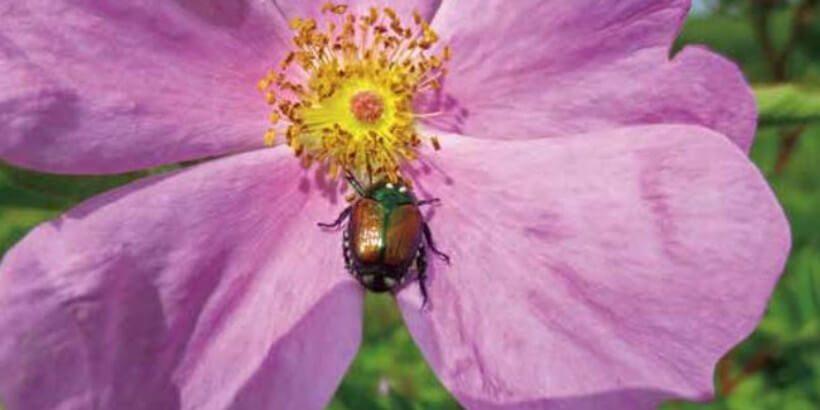
At the first sight of small chew marks on leaves or fruit mysteriously disappearing, you’ll want to get rid of the pest to protect your crop. Your first instinct might be to use pesticides or other forms of extermination. You can save yourself and your crops from using harmful methods by preparing and managing your plants early on in the growing stage.
The following is an excerpt from Farming on the Wild Side by Nancy J. Hayden & John P. Hayden. It has been adapted for the web.
As a farm that values diversity, we don’t have many biological enemies. At least we don’t think of them that way. Certain plants are allies in the places we want them, sequestering carbon, filtering water, and creating fertility, and become “weeds” only when they compete with our plantings. We do spend a fair amount of time and effort on weed management. For our crops to thrive, we need to keep the grasses and other weeds out of the propagation beds and berry bush plantings, and in check during the early years of fruit tree establishment. Weed management isn’t always easy, though.
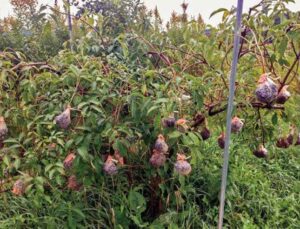
We’ve experimented with using nylon footies to exclude SWD. It works well but is labor intensive. The unprotected berries on the right have dropped early from SWD. Photograph courtesy of Alisha Utter.
Plants have a lot of life force and want to grow!
We use a variety of techniques to keep the weeds at bay, including hand weeding, landscape fabric, and sheet mulching with cardboard close to the plants. Landscape fabric is great because it can be reused year after year, but it’s not a good idea to leave it down over the winter, because it provides a safe cover for voles, which can then be a problem in themselves by girdling trees and shrubs in the winter.
There’s a pesky rodent! If we use proper vegetation management around bushes and shrubs, including vole guards on the trees, we can keep their damage to a minimum. They then become just another coinhabitant of the land. Did we mention that we like foxes?
We put nets on certain crops such as honeyberries, red currants, and blueberries before they ripen, to protect them from birds that are “pests” for only a short time in the summer. We take the nets off when we’re done with the harvest, allowing the birds to clean up the fruit. This strategy helps reduce other pest problems, like spotted wing drosophila, in our early berry crops.
Our diversity of crops allows us to withstand occasional pest outbreaks and potential crop losses by leaning on the income from other crops until a balance is reestablished. We depend mostly on biodiversity and ecological intensification practices to limit insect pests. We should differentiate here between pests and pest outbreaks. You sometimes hear or read in alternative agriculture circles that pests on a plant reflect an unhealthy plant or soil conditions. We don’t think that is correct.
We consider having a diversity of insects, including those that eat crop plants, as part of the natural balance. A pest outbreak occurs when the population of an insect increases to the point where it can cause high economic damage to a crop. A low level of pests keeps the predators and parasites fed and happy and working. Wiping everyone out with insecticides causes wild fluctuations in pest populations, as their populations tend to grow faster than predators’ populations.
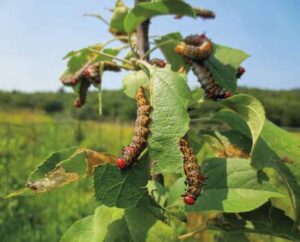
Red-humped caterpillars, just before we knocked them off, can cause serious defoliation in a newly planted or young tree but likely would not be a problem in a mature tree.
If we grew only one crop, with clean fields and field margins, we, too, would be anxious about pests and potential losses; so we can understand why monoculture farmers turn to pesticides for insurance and assurance. But it is a treadmill, and we don’t understand why they keep insisting on monocultures.
Of course, the chemical companies know how to exploit fear with their marketing. Many of the pesticide advertisements in the trade magazines look like horror movie billboards, with giant caterpillars and their gaping fangs coming to get you.
Pesticide companies are not necessarily the farmer’s friend.
They are more like parasites themselves, making their living off farmers. A good parasite doesn’t kill its host, though.
The goals of efficiency and economy of scale (which is purely about maximizing profits) are still part of the mainstream cultural mentality in our society. We’ve shown that a small-scale diverse farm has certain ecological and economic advantages. We try to be efficient in our labor and harvests, but it’s not critical to our bottom line to wring every last berry from the land. We can afford to share a little with our coinhabitants. As regenerative farmers, we’re trying to find the right balance for us and the so-called pests to coexist.
This isn’t to say that it’s all unicorns and rainbows at The Farm Between. Pest outbreaks occur because of things beyond our control— like the weather or newly introduced pests such as SWD. There’s this idea floating around that if you have a biodiverse organic farm with good soils and good management that everything will be pest resistant and in perfect balance all the time. No way. Species populations are cyclic; outbreaks and subsequent crashes occur. That’s often how an overall balance is maintained. It’s good to remember.
Recommended Reads
Read The Book

Farming on the Wild Side
The Evolution of a Regenerative Organic Farm and Nursery
$29.95
You may like...
-
 $39.95
 -
$29.95
-
$19.95


Recent Articles
Having an indoor sprout garden is easier than you might think and yields a bountiful harvest. Here’s how to get started — right from your windowsill!
Read More
Growing no-till arugula is a simple way to grow your own food. These greens can be used on pizzas, salads, and as a garnish on almost any dish.
Read More
The leaves are falling, which means it’s time start figuring out what to do with them. This year, try turning your fallen leaves into mulch for your garden!
Read More
Enjoy fresh produce all year long by growing your own food! Achieving a twelve-month growing season is as simple as using the right crop protection structure.
Read More
Beets can be grown year-round and are a perfect, flavorful addition to meals. Get started on growing your own no-till beets with help from these tips!
Read More