
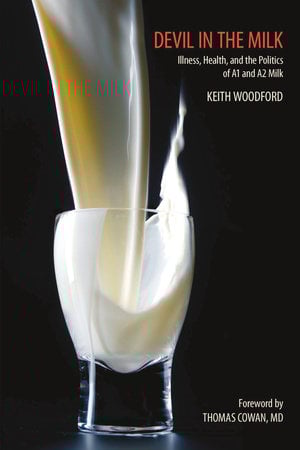
The Milk Devil: A Protein in Most Milk Linked to Autism, Schizophrenia
|
Tweet this story! Support our efforts for a sustainable world.
|
|

The following is an excerpt from the upcoming Devil in the Milk: Illness, Health, and the Politics of A1 and A2 Milk by Keith Woodford. It has been adapted for the Web.
This book is about the effects on human health of a tiny protein fragment called beta-casomorphin-7, or BCM7 for short.
BCM7 is unquestionably a powerful opioid and hence a narcotic. It is also an oxidant. It is formed by digestion of a particular type of milk protein produced by some cows. This milk protein is called A1 beta-casein.
The BCM7 that is released from A1 beta-casein has been implicated in many illnesses, including heart disease, Type 1 diabetes and autism. And there is increasing evidence that it is associated with milk intolerance and an additional range of auto-immune diseases. Metaphorically, it is ‘the devil in the milk.’
—From the Prologue
Autism is a brain disorder that begins in early childhood and persists throughout adulthood. It affects communication and social interaction. People with severe cases may have very poor speech, exhibit temper tantrums and be unable to manage their own toileting. Asperger’s syndrome is a relatively mild but common form of autism and many individuals can still operate at a high level. The incidence of autism is debated by experts, with most but not all seeming to agree that the rate has increased greatly in recent decades and that it may be about one child in every 150.
According to the World Health Organisation (WHO) website, schizophrenia is a severe disorder that typically begins in late adolescence or early adulthood. It is characterised by profound disruptions in thinking, affecting language, perception and sense of self. It often includes psychotic experiences such as hearing voices or delusions. It can impair function through the loss of livelihood or the disruption of studies. According to the WHO, there are 24 million suffers of schizophrenia.
Predominantly, this next part of the story involves a totally new set of scientists working in three different countries. The three groups have been led by Professor Robert Cade and Dr Zhongjie Sun from the University of Florida, Paul Shattock from the Autism Research Unit at University of Sunderland, and Dr Kalle Reichelt from the Pediatrics Research Institute at the University of Oslo, Norway. All three groups have interacted with each other and their work is intertwined. Much of it has been published in the journal of Nutritional Neuroscience. Other papers have been published in the journals Brain Dysfunction, Autism and Peptides. […]
The key concept underpinning the work of Reichelt, Shattock and Cade, together with co-workers such as Zhongjie Sun and Ann-Mari Knivsberg, is that many of the symptoms of neurological conditions, i.e. poor mental health, are related to what we eat and how we metabolise that food. Specifically, the symptoms of autism and schizophrenia show some remarkable similarities to the known symptoms caused by opioids which can be formed from the digestion of certain foods, in particular those containing gluten and casein. The particular genetic makeup of an individual, combined with diverse but possibly unrecognised environmental events to which that individual is exposed, determines whether or not that person is susceptible to these conditions. These scientists have been able to show that many autistic children have high levels of BCM7 and other casomorphins derived from BCM7 in their blood and urine. They have also been able to report remarkable success with diets that are free of casein and gluten, in reducing both the level of BCM7 in the urine and the level of autistic symptoms.
The idea that mental health is affected by what we eat has taken a long time to gain acceptance in some medical circles. It has therefore been a difficult journey for Cade, Shattock, Reichelt, Sun, Knivsberg and colleagues. To some extent they were probably ahead of their time, and their contributions to science will be fully recognised only with hindsight.
Until recently these scientists did not realise that BCM7 was released only from A1 beta-casein and not from A2 beta-casein. This is understandable because, as neuroscientists, they did not read the literature on dairy genetics and the ways in which some cows differ from others. So their advice has been, at least until recently, that autistics should consider a diet free of milk. However, there are now at least three different groups of biochemists (including Fonterra’s own scientists) who have found that BCM7 is released because of a biochemical feature of A1 beta-casein that is different to A2 beta-casein. So the argument in favour of A2 milk for autistic children comes from linking these separate strands of research.
To the best of my knowledge there have been no trials specifically investigating A2 milk and autism apart from an abandoned trial by Fonterra (and about which I will say more later in this chapter). Instead, research has been focusing directly on the milk devil, BCM7, and similar peptides derived from gluten. However, many parents of autistic children, particularly in Australia where A2 milk has become widely available, are saying that their children’s autistic symptoms diminish when their milk intake is restricted to A2. In Britain it is not possible to get certified A2 milk but some parents have been using Guernsey milk, which is very low in A1 beta-casein.
There is also some epidemiological evidence that provides interesting support. Intriguingly, this evidence comes from a patent application by Fonterra, in which they claimed that deaths from mental-health problems were much higher in countries that had high intakes of A1 beta-casein. Subsequently Fonterra abandoned the patent application. This in itself is intriguing and provides a story that I will outline later in this chapter.
The first person to suggest that autism might be linked to opioids was the scientist J.A. Panksepp in a paper published in 1979 in the journal Trends in Neuroscience. Then in 1981 Kalle Reichelt and colleagues proposed that these opioids were coming from the incomplete breakdown of certain foods, in particular those containing gluten and casein. Subsequently, the evidence has slowly accumulated that many autistic people do indeed have large quantities of opioids in their blood and urine. There is also evidence that a high proportion of children with autism suffer from increased permeability of the gut wall, and this is a key to explaining what is going on.


April 7th, 2009 at 2:28 am
I’m sure there is a staggering amount of variables to consider. Correlation does not necessarily equal causation. I’m waiting for definitive proof.
April 13th, 2009 at 1:27 pm
DPACHECO,
Interesting article, thanks for raising attention to it.
Although I have no direct relatives faced with the challenged of autism/asperger’s (knocking
on wood) I do have friends with this cross to bear in their lives. I have done a bit of
reading (sorry, I seem to have disconnected the TV!) and find that several interesting
connections have been made to autism, to wit:
1) Mercury (always toxic). This could come from mercury fillings in routine dental work.
This leaks through placental barrier and comes in breast milk, too. This is also found
in High Fructose Corn Sugar found in….nearly everything, thanks to Uncle Sam’s
financial and trade help, and in vaccines. Oh, and in fish, due to dispersal by coal
plants and bioaccumulation in predator/prey chains.
2) Vaccines (which contain mercury, and/or a boatload of other toxins, by design)
Big story, see http://www.nvic.org, e.g.
3) Excitotoxins including MSG and its many sisters (See http://www.russellblaylockmd.com, and
his book by the same title.)
4) Early umbilical cord cuts (brain oxygen starvation, e.g.)
5) Pure Genetics (doesn’t explain 4x prevalence of autism in boys, in my lay opinion)
and now,
6) certain milk proteins (through a neurotoxic connection….)
Lots of paths to brain damage in the modern society, it appears!
…..
Hope these articles and pointers are a help to some!
( oh, and for Joel: See this: http://www.xkcd.com/552/ )
April 16th, 2009 at 4:39 pm
[…] Week’s Popular News Spring Has Sprung: Now Get Off Your Fat Ass and Bike To Work The Milk Devil: A Protein in Most Milk Linked to Autism, Schizophrenia Weekend Project: How to Build Your Own Cheap, Simple Solar Oven April is “Give In To Your Sweet, […]
April 17th, 2009 at 3:56 pm
I remember reading something about this (AcresUSA?). Is there more information yet about which cows produce the A1 vs A2 ? From what I read, they all have to be tested, and it isn’t specific to breeds…
April 17th, 2009 at 4:22 pm
Dan, that’s right. Any breed of cattle includes individual cows that produce either A1 or A2 protein; some cows produce both types. So yes, to know what you’ve got, you either have to test the milk, or test each individual cow–that is, unless you know the genetics of the parent cow and bull. If both the cow and bull parents are pure A2 genotypes, then all their offspring will be as well, and so those offspring don’t need independent testing.
August 4th, 2009 at 5:36 am
Found your blog while browsing Google. Bookmarked. Looking forward to more nutrition tips.
August 30th, 2009 at 4:35 pm
you ALL need to FIND and watch at least these three (4 are mentioned here) DVD videos about ALL our food products:
“The World According to Monsanto” -
get it NOW while its not BANNED material. Already has been banned and subjected to banning on a few websites and removed by force.
“The Future of Food” -
its as if it were the second installment to the previous
“Life Running out of Control” - this could be the second or third.
There is also a DVD about Monsanto threatening FOX news and Fox News FIRING two GOOD employees for NOT putting the story to rest. FOX LOVESMONEY MORE THAN THEIR OWN LIVES.
DVD is called - “OutFoxed”
its MUCH worse than you might think and no, im not being paranoid.