

| Pages: | 304 pages |
| Book Art: | Black & white photos |
| Size: | 6 x 9 inch |
| Publisher: | Chelsea Green Publishing |
| Pub. Date: | June 10, 2025 |
| ISBN: | 9781645023203 |
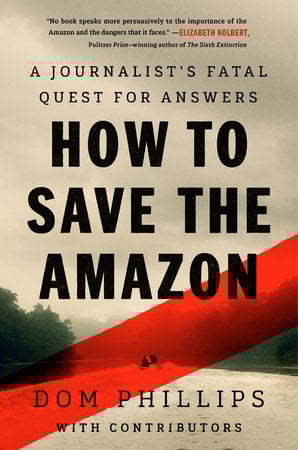
How to Save the Amazon
A journalist’s fatal quest for answers
Hardcover
$27.95
“A book both brilliant and broken, [and] one that is ultimately as inspiring and devastating as the Amazon itself.”
—The Guardian
“The book nearly died with him in the Amazon. But the story endured. . . [Chapters are] rooted in conflict, but searching for solutions.”
—The New York Times
2025 Foreword Reviews INDIES Award HONORABLE Mention for Political and Social Sciences
Journalist Dom Phillips traveled deep into the Amazon rainforest searching for solutions to the problem of deforestation, a threat to the local ecosystem, native tribes, and the global climate. When he was murdered in the Javari Valley by a group of environmental criminals, a cohort of journalists and activists took up his work to finish his book and share his important message.
During the dark days of the Bolsonaro administration, British journalist Dom Phillips set out to accomplish an ambitious goal: through research, interviews, and site visits deep in the rainforest, he would emerge with a book answering the question—how can we save the Amazon? Traveling with his companion Indigenous expert Bruno Pereira, Dom’s adventure includes trekking through Amazonia to see where ranching, fires, illegal fishing, mining, the drug trade, and urbanization have deforested and degraded millions of acres of important forest, degraded ecosystems, and created dangerous conditions for the Indigenous tribes who have called the Amazon home for thousands of years.
Jair Bolsonaro came into power on a platform of anti-environmental exploitation and deregulation. During his term, deforestation in the Amazon, the “lungs of Planet Earth,” increased exponentially as environmental criminals took advantage of lax rules, advantageous land use policy, and the difficulty of enforcing laws in a remote area of immense size. Lawlessness reigned and environmental activists found themselves in danger. With the intention of discovering strategies to protect both the land and the people who inhabit it, Dom connected with politicians, farmers, and Indigenous activists to study the benefits and pitfalls of solutions like agroforestry, tourism, and the bioeconomy. While traveling by boat in the Javari Valley, Dom and Bruno were brutally murdered. Unwilling to see her late husband’s work be for naught, Dom’s widow, Ale, and his literary agent assembled a team of expert writers, journalists, and activists to complete his work, with each tackling one unfinished chapter and grappling with the challenge of interpreting his field notes and discovering his conclusions. How to Save the Amazon, therefore, is a book both by and about Dom Phillips, his quest for answers, and his search for hope.
“A work of courage interrupted by tragedy. . . No book speaks more persuasively to the importance of the Amazon and the dangers that it faces.”
—Elizabeth Kolbert, Pulitzer Prize-winning author of The Sixth Extinction
“We can’t let life on this earth be snuffed out; this powerful book will help us rise to this challenge.”—Bill McKibben, author of The End of Nature
Reviews & Praise
“This book is the best possible tribute to a martyred colleague—these writers have helped finish the work he couldn’t, offering a picture of this crucial place and suggesting some of the ways we might still help it to survive. We can’t let life on this Earth be snuffed out; this powerful book will help us to rise to this challenge.”—Bill McKibben, author of The Flag, the Cross, and the Station Wagon
"A fascinating, multilayered work that captures Phillips’s quixotic quest. . . The hope is that, despite the horrific violence that cut short Phillips’s investigations, some of the messages he was trying to convey will resonate in Brazil and beyond."—Literary Review
“Bold, pacy, bursting with optimism and filled with vivid descriptions and deft pen-portraits, this is the work of an indomitable soul – and a tribute to how much Dom Phillips was clearly loved by his friends and colleagues. How to Save the Amazon is a beauty of a book. Let Dom and Bruno’s legacy be that we finally listen to the Indigenous defenders of the Amazon who have guarded it for so long.”—Guy Shrubsole, author of The Lost Rainforests of Britain
“This book bleeds with the passion, tenacity and eloquence of a man who gave his life for the Amazon. Dom’s intense life, cut short, will inspire and unite environmental defenders the world over.”—Yuvan Aves, author of Intertidal
“This is an important book which we should all read. Heartbreaking, devastating, yet also somehow hopeful. How to Save the Amazon records the relentless destruction of nature and its brutal effect on communities, but it’s also a rallying call to listen to those who know: the Indigenous people who have lived in and protected this magnificent part of our planet for centuries.”—Andrea Wulf, author of The Invention of Nature
“A defiant triumph of a book that roars forth from the frontlines of this deadly war against our life-support systems. By turns shocking, heartbreaking and deeply inspiring, this book – this act of solidarity – makes my heart leap. For there in the deeply researched intricacies and complexities of a forest torn apart are the seeds of hope: the courageous people fighting back, and they will not be silenced thanks to Dom and his brilliant pen-mates.”—Gaia Vince, author of Adventures in the Anthropocene
“An important dispatch from one of the burning centers of the world.”—Michael Malay, author of Late Night, winner of the 2024 Wainwright Prize for Nature Writing

About Dom Phillips
Dom Phillips was a British journalist working for publications like The Guardian and The Washington Post. An unconventional career path (he got his start as a journalist covering techno clubs for Mixmag and authoring Superstar DJs, Here We Go!) took him to Brazil, where he became passionate about the issues affecting the Amazon rainforest and its Indigenous populations. In 2022, while researching this topic and working on How to Save the Amazon, Dom and his travel companion Bruno Pereira went missing in the Javari Valley in a remote part of the Amazon. Intense public interest and pressure fomented via social media, and Brazilian police eventually found the bodies of the two men and made arrests in connection to their murders. Dom was awarded an Alicia Patterson Foundation Fellowship in 2021 and was also the 2021 Cissy Patterson Environmental Fellow. In 2019, he was nominated for a Gabo Prize (Latin America’s premier journalism award) for his coverage of the Amazon “Fire Day” for Reporter Brasil.
Books by Dom Phillips


You may also like...
-
 $19.95
 -
$19.95
-
$22.95


