

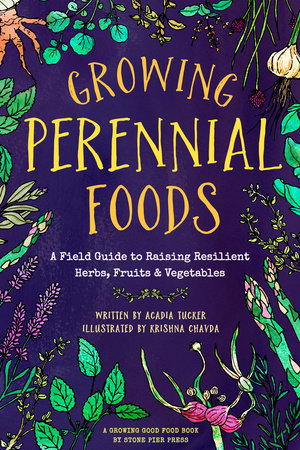
Growing Perennial Foods
A Field Guide to Raising Resilient Herbs, Fruits, and Vegetables

EXCERPTS
| Pages: | 280 pages |
| Book Art: | Black-and-white illustrations |
| Size: | 6 x 9 inch |
| Publisher: | Stone Pier Press |
| Pub. Date: | February 26, 2019 |
| ISBN: | 9780998862354 |
Growing Perennial Foods
A Field Guide to Raising Resilient Herbs, Fruits, and Vegetables
Recipient of the GardenComm Emergent Communicator Award for 2023: Acadia Tucker
Acadia Tucker’s long love affair with perennial foods has produced this easy-to-understand guide to growing, harvesting, and eating them.
A regenerative farmer and gardener deeply concerned about global warming, Acadia Tucker believes there may be no better time to plant perennials. Sturdy and deep-rooted, perennials can weather climate extremes more easily than annuals. They can thrive without chemical fertilizers and pesticides. And they don’t need as much water, either.
These long-lived plants also help build healthy soil, turning the very ground we stand on into a carbon sponge.
In this book, Tucker lays the groundwork for tending an organic, sustainable garden. She includes practical growing guides for 34 popular perennials, among them, basil, blueberries, grapes, strawberries, artichokes, asparagus, garlic, radicchio, spinach, and sweet potatoes, and wraps in a recipe for each of the plants profiled.
Growing Perennial Foods is for gardeners who want more resilient plants. It’s for people who want to do something about climate change, and the environment. It’s for anyone who has ever wanted to grow food, and is ready to begin.
Reviews & Praise
“I have every intention of referring back to the sections on individual plants as the season develops. The advice can likely be best internalized as you mull over your plants as you prepare the ground, seed them, and watch them develop. It is a book that should have lots of dirty fingerprints on it by the end of a growing season. There are plenty of gardening advice books, but the focus here on perennials and on carbon capture gardening sets this one apart.”–Ivan Emke, Book on the Coffee Table
"Great for new and experienced gardeners alike, Growing Perennial Foods is worth the purchase for the recipes alone. The book provides a short primer on general gardening topics, including composting and organic pest control, along with individual plant profiles for a wide variety of herbs, vegetables, and fruit. But, more than the academic knowledge, you will experience the love and passion Acadia Tucker has for the earth and making it a better place for all to enjoy."–Gardening Products Review
"Right from the beginning of the book, you really get the idea that not only does Acadia know what she's talking about, she is passionate about it. This book isn't technical, but also doesn't talk down to readers. Acadia is right there with you, explaining everything, encouraging you, and giving you all the info you need on growing various perennial foods. My favorite part is the section on the challenges you might face. As anyone who has ever grown a plant can tell you, one cannot simply plant and expect to have a successful harvest. I found it very refreshing to have an author write about pests, diseases, and growing problems. I also appreciate that she covered tips on how to overcome them. Acadia approaches gardening much the way we do at the National Gardening Association -- organically, and with an eye toward working with nature rather than against it. We are very impressed and excited to see more of Acadia's work."–Trish Whitinger, COO, National Gardening Association
"Beautifully written and illustrated, Growing Perennial Foods will be a well-thumbed addition to your gardening library."–The Northern Light
"In North America, we tend to think of perennials as primarily ornamental rather than food-producing. Regenerative farmer Acadia Tucker believes that taking cues from how plants grow in the wild will allow for cultivated gardens that produce bountiful harvests while addressing concerns about global climate change. This guide to creating a regenerative food garden starts with addressing the existing soil and moves through all the steps needed to create a healthy, nurturing bed. Tucker then recommends a variety of perennial herbs, fruits, and vegetables, including information for how to plant, grow, and harvest each, along with potential challenges specific to each plant. One recipe is included for each plant, with most of the recipes vegan or vegetarian. While the majority of these plants are able to survive winter in many parts of North America, some are tender and will need to be moved inside during cold months. A FAQ section and glossary are appended."—Anne Heidemann, Booklist, American Library Association
"Right from the beginning of the book, you really get the idea that not only does Acadia know what she's talking about, she is passionate about it. This book isn't technical, but also doesn't talk down to readers. Acadia is right there with you, explaining everything, encouraging you, and giving you all the info you need on growing various perennial foods. My favorite part is the section on the challenges you might face. As anyone who has ever grown a plant can tell you, one cannot simply plant and expect to have a successful harvest. I found it very refreshing to have an author write about pests, diseases, and growing problems. I also appreciated that she covered tips on how to overcome them. Acadia approaches gardening much the way we do at the National Gardening Association – organically, and with an eye toward working with nature rather than against it. We are very impressed and excited to see more of Acadia's work."–Trish Whitinger, COO, National Gardening Association
"Acadia Tucker’s Growing Perennial Foods is a must-have resource for home gardeners looking to take their conservation efforts to the next level. With hard-earned knowledge and conversational clarity, Tucker demystifies the concepts of regenerative agriculture, translates them to the garden level, and guides the reader both philosophically and practically. Her focus on perennial plants provides an exciting and useful method of enacting the principles of regenerative agriculture, one that any sustainable gardener will appreciate."–Stephanie Anderson, author of One Size Fits None: A Farm Girl’s Search for the Promise of Regenerative Agriculture
"Growing Perennial Foods is a down-in-the-dirt guide to growing food in a way that's good for the planet. It's also the account of one woman's transformation into climate activist and regenerative farmer. Acadia Tucker is on a mission to get more of us thinking about the power of regenerative agriculture. By the end of the book, you'll feel inspired enough to start your own Climate Victory Garden."–Jes Walton, Green America
"Read this book! If we don’t get together and take care of the soil, our atmosphere is toast.”—Tim LaSalle, Cofounder, Regenerative Agriculture Initiative, Chico State
"I love this book. An easy-to-read, down-to-earth guide to regenerative gardening, Growing Perennial Foods provides a blueprint, and the inspiration, to start planting your own."–Virginia Aronson, R.D., M.S., Director, Food and Nutrition Resources Foundation
"Tucker helps us tap into the deeper meaning of gardening and grow good food at the same time.”—Anne Biklé, co-author of The Hidden Half of Nature: The Microbial Roots of Life and Health

About Acadia Tucker
Acadia Tucker is a regenerative farmer, climate activist, and author. Her books are a call to action to citizen gardeners everywhere, and lay the groundwork for planting an organic, regenerative garden. For her, this is gardening as if our future depends on it.
Before becoming an author, Acadia started a four-season organic market garden in Washington State inspired by farming pioneers Eliot Coleman and Jean-Martin Fortier. While managing the farm, Acadia grew 200 different food crops before heading back to school at the University of British Columbia to complete a Masters in Land and Water Systems.
She lives in Maine and New Hampshire with her farm dog, Nimbus, and grows hops to support locally sourced craft beer in New England, when she isn't growing food in her backyard, or in her dining room. Acadia is an Ambassador for regenerative agriculture for The Rodale Institute.
Books by Acadia Tucker


You may also like...
-
 $39.95
 -
$29.95
-
$35.00


