
What’s Making Our Children Sick?
How Industrial Food Is Causing an Epidemic of Chronic Illness, and What Parents (and Doctors) Can Do About It

EXCERPTS
| Pages: | 272 pages |
| Size: | 6 x 9 inch |
| Publisher: | Chelsea Green Publishing |
| Pub. Date: | November 21, 2017 |
| ISBN: | 9781603587570 |
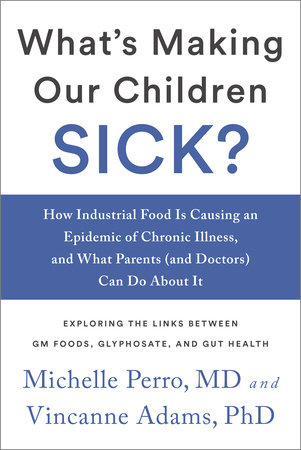
What’s Making Our Children Sick?
How Industrial Food Is Causing an Epidemic of Chronic Illness, and What Parents (and Doctors) Can Do About It
Exploring the links between GM foods, glyphosate, and gut health
With chronic disorders among American children reaching epidemic levels, hundreds of thousands of parents are desperately seeking solutions to their children’s declining health, often with little medical guidance from the experts. What’s Making Our Children Sick? convincingly explains how agrochemical industrial production and genetic modification of foods is a culprit in this epidemic. Is it the only culprit? No. Most chronic health disorders have multiple causes and require careful disentanglement and complex treatments. But what if toxicants in our foods are a major culprit, one that, if corrected, could lead to tangible results and increased health? Using patient accounts of their clinical experiences and new medical insights about pathogenesis of chronic pediatric disorders—taking us into gut dysfunction and the microbiome, as well as the politics of food science—this book connects the dots to explain our kids’ ailing health.
What’s Making Our Children Sick? explores the frightening links between our efforts to create higher-yield, cost-efficient foods and an explosion of childhood morbidity, but it also offers hope and a path to effecting change. The predicament we now face is simple. Agroindustrial “innovation” in a previous era hoped to prevent the ecosystem disaster of DDT predicted in Rachel Carson’s seminal book in 1962, Silent Spring. However, this industrial agriculture movement has created a worse disaster: a toxic environment and, consequently, a toxic food supply. Pesticide use is at an all-time high, despite the fact that biotechnologies aimed to reduce the need for them in the first place. Today these chemicals find their way into our livestock and food crop industries and ultimately onto our plates. Many of these pesticides are the modern day equivalent of DDT. However, scant research exists on the chemical soup of poisons that our children consume on a daily basis. As our food supply environment reels under the pressures of industrialization via agrochemicals, our kids have become the walking evidence of this failed experiment. What’s Making Our Children Sick? exposes our current predicament and offers insight on the medical responses that are available, both to heal our kids and to reverse the compromised health of our food supply.
“Perro and Adams’ book is an alarming, eye-opening read that documents more clearly than ever the devastating consequences that pervasive pesticide use in food production is having on our health, and the urgent need to protect our children from a system that prefers we treat illness and disease with pills rather than prevention.”—Carey Gillam, journalist, author of Whitewash
Reviews & Praise
"In their demand for a revolution in our food production system, as well as in our medical approach to chronic disorders, the authors acknowledge the need for scientists, educators, politicians, health professionals, and farmers to become involved, but they single out mothers as powerful agents of change. An accessible read with . . . a message that will be vigorously challenged by a host of agribusiness and pharmaceutical industry spokespeople and segments of the medical profession."—Kirkus Reviews
“It would be difficult for anyone to read this powerful book with even a halfway open mind and not conclude that our industrialized system of food production is in urgent need of major reform. The routine claim that genetically engineered foods are well-regulated, well-tested, and wholesome crumples in the face of the facts that are skillfully woven together in this monumental work.”—Steven M. Druker, author of Altered Genes, Twisted Truth: How the Venture to Genetically Engineer Our Food Has Subverted Science, Corrupted Government, and Systematically Deceived the Public
“Chronic diseases that were once rare are now plaguing children and adults alike in industrialized nations such as the United States. The patient case histories that Dr. Perro and Dr. Adams describe in What’s Making Our Children Sick? provide compelling evidence for advocating lifestyle changes, especially dietary medicine intervention, for overcoming these chronic ailments. And science increasingly provides explanations for such success. We now know that the balance of our gut bacteria (microbiome) is crucial to health and that imbalance, causing gut dysbiosis, is at least a contributing factor to a vast range of chronic illnesses, both physical and mental. Poor diet is no doubt a major contributory factor in causing gut dysbiosis. By eliminating pesticide and GMO-laden food from the diet and replacing it with organic wholefoods as part of her lifestyle medicine approach, Dr. Perro succeeds where standard pharmaceuticals fail. This should be enough for all to take note and follow suit.”—Michael Antoniou, molecular geneticist, King’s College London; coauthor of GMO Myths and Truths
“The sharp rise of severe allergies, brain disorders, and other chronic illnesses among America’s children has left many doctors stumped, finding themselves unable to offer lasting cures or even successfully manage sometimes devastating symptoms. Enter Dr. Michelle Perro, an integrative food-forward family physician who has had excellent results helping children and adults overcome chronic disease. Even if you’re already familiar with the controversies surrounding genetically modified foods and healthy eating, you will learn a lot from Perro and Adams’s carefully researched, science-oriented book. A compelling and important read. Highly recommended.”—Jennifer Margulis, PhD, author of Your Baby, Your Way: Taking Charge of Your Pregnancy, Childbirth, and Parenting Decisions for a Happier, Healthier Family
“With her extensive experience as a director and attending in Pediatric Emergency Medicine and her current integrative practice and health advocacy, Dr. Michelle Perro has teamed up with coauthor Vincanne Adams, whose expertise from medical anthropology is a perfect complement to the clinical perspective; together they have produced a powerful book. Their analysis carefully examines the scientific evidence and patient responses to the disruptive effects of chemicals contaminating our food, water, and the environment, and their damaging effects on our children. What’s Making Our Children Sick? exposes the hype of genetic engineering, both its flawed science and failed promises that have wreaked havoc on our health. Using their medical experience and case studies, Perro and Adams offer welcome alternatives to restore our health and hope for our future.”—Don M. Huber, emeritus professor, Purdue University
“Having seen firsthand how Dr. Michelle Perro works miracles with children in her clinical practice, I am delighted to see that she has made her insights and approach widely accessible in this groundbreaking book. What’s Making Our Children Sick? combines the latest research on gut health and the microbiome with concerning evidence about the dangers of genetically modified and industrial foods to elucidate the perfect storm that is damaging our children’s health today. Most importantly, it offers practical and actionable solutions for both parents and practitioners to help children recover their health.”—Akil Palanisamy, MD, Harvard-trained physician; author of The Paleovedic Diet
“Doctors Perro and Adams have made the complex topic of the interrelationship between the gut, brain, and the food our kids eat accessible to all. In my own experience, autism recovery is rarely possible without a dietary overhaul and a focus on whole, organic, and natural foods. This book is a welcome resource for parents struggling with their children’s chronic health conditions.”—J. B. Handley, cofounder, Generation Rescue
“What’s Making Our Children Sick? is a true clarion call to parents, physicians, and policymakers everywhere to change the way we grow the food we eat. Unless we move away from industrialized food sources that are created for the lowest short-term costs, we and our children will continue to experience increased chronic disease, immune dysfunction, and mental health problems. The transformation of our nutrition is not simply for our children and us, but also for future generations and our dear planet. It is almost as though we are all Romans drinking wine out of lead-lined bottles. Future generations will wonder why we have been so blind, deaf, and dumb.”—Dana Ullman, MPH, CCH, author of Homeopathic Medicine for Children and Infants and The Homeopathic Revolution
“Industrial medicine and agriculture, with wholesale government approval, have caused an epidemic of chronic childhood illness largely traceable to ubiquitous poisons and alien DNA in our food supply. A clinical argument for organic foods, What’s Making Our Children Sick? is a stop-look-listen book for parents, doctors, teachers, and grocery shoppers everywhere.”—Carol Van Strum, author of A Bitter Fog: Herbicides and Human Rights
“Dr. Perro was one of the first American pediatricians to connect the dots from GMOs to intestinal permeability, suffering children, and overwhelmed parents. Over the years her knowledge base for solutions has increased exponentially, as has the health of her young patients. Food-focused medicine, as she and Vincanne Adams detail in What’s Making Our Children Sick?, is a clarion call to us all.”—Samm Simpson, cohost, The Power Hour Radio Broadcast; associate producer, Genetic Roulette
“Perro and Adams’ book is an alarming, eye-opening read that documents more clearly than ever the devastating consequences that pervasive pesticide use in food production is having on our health, and the urgent need to protect our children from a system that prefers we treat illness and disease with pills rather than prevention.”—Carey Gillam, journalist, author; research director, consumer advocacy group U.S. Right to Know
“With a deep understanding of the multiple sources of health and illness, Perro and Adams have collaborated to investigate the conundrum of children’s complex ailments. Their clear-eyed cry for a food-focused ecomedicine urges a rethinking of clinical care and a reorganization of our food industries. Comprehensive and original, this book offers insights for all concerned with our children, our families, and our health.”—Sharon R. Kaufman, PhD, chair, Department of Anthropology, History and Social Medicine, University of California, San Francisco
“Children in the United States are sick and getting sicker. Food allergies and sensitivities, digestive problems, and serious behavioral issues are driving parents to distraction. In this important book, pediatrician Michelle Perro and medical anthropologist Vincanne Adams explore Dr. Perro’s clinical case histories and the scientific literature to find out what’s at the root of the problem. They are convinced that our industrialized food is a chief culprit. Pesticides and genetically modified (GM) foods have introduced known and potential toxins into the food supply, turning it into a “slow poison.” Time and again, seemingly intractable health problems in Dr. Perro’s young patients respond well, sometimes almost miraculously, when chemically grown and GM foods are eliminated from the diet and replaced with organic foods. No matter how many of the agrichemical industry’s lobbyists and PR people bombard us with claims that pesticide residues and GMOs in our foods are safe, the experiences of Dr. Perro’s patients are hard to deny and tell a different story. The book is a must-read for health practitioners and parents alike.”—Claire Robinson, editor, GMWatch; coauthor of GMO Myths and Truths
“Perro and Adams offer a unique analysis regarding the role industrialized food plays in the decline of our children’s health. What’s Making our Children Sick? provides an uncommon but extraordinary blend of clinical medicine and medical anthropology via an expert, in-depth analysis as to the root cause of this health epidemic, beginning with the gut. Filled with both knowledge and compassion, the authors, on a step-by-step readable journey, reveal how our children have become toxic from the very foods that are purportedly nutritious. This book will have wide readership from those who want to improve their own children’s health to the medical clinics of healthcare providers.”—Dr. Richard Horowitz, bestselling author of How Can I Get Better? An Action Plan for Treating Resistant Lyme and Chronic Disease
“A powerful exposé of the science and clinical evidence pointing to our food production system as a key cause of the chronic illnesses affecting so many children. Most importantly, What’s Making Our Children Sick? offers hope and a path forward for how food-focused medicine can heal our bodies and help our families.”—Stacy Malkan, author of Not Just a Pretty Face: The Ugly Side of the Beauty Industry
“In a world where we are overexposed to thousands of dangerous toxic chemicals, education is key. This book’s clear, comprehensive information is a godsend for parents with sick children, and clinicians in the dark about the cause of the epidemic of chronically ill kids. Bravo to Drs. Perro and Adams for opening our eyes to what’s really going on.”—Beth Greer, bestselling author of Super Natural Home
“In this timely book, Perro and Adams explain the powerful role of the gut-brain connection in the crisis we face today with rising rates of autoimmune and neurological diseases among children. Michelle Perro is a clinician who has witnessed firsthand the dramatic recovery patients achieve after they reduce their toxic burden from chemically laden industrial food.”—Stephanie Seneff, PhD, senior research scientist, MIT Computer Science and Artificial Intelligence Laboratory
“What role might the techniques and chemicals of industrial agriculture play in the escalating rates of chronic ailments in American children? This vital new book steps the reader through the medicine, policy, and science with the clarity and reasoned insight that scholars of science and medicine have come to expect from Vincanne Adams.”—Julie Livingston, MPH, PhD, professor, New York University; MacArthur Fellow
“In this novel work of public scholarship, Vincanne Adams and Michelle Perro instruct us on the devastating embodied cost of industrial food production: complex chronic illness in children. What’s Making Our Children Sick? is an investigation into an urgent public health crisis and an ethnography of the parents and practitioners fighting to change modern medicine.”—Emma Shaw Crane, coeditor of Territories of Poverty: Rethinking North and South

About Vincanne Adams
Vincanne Adams, PhD, is a professor and vice-chair of Medical Anthropology, in the Department of Anthropology, History, and Social Medicine at the University of California, San Francisco. Dr. Adams has previously published six books on the social dynamics of health, scientific knowledge and politics, including most recently, Markets of Sorrow, Labors of Faith: New Orleans in the Wake of Katrina (2013), and Metrics: What Counts in Global Health (2016). She is currently editor for Medical Anthropology Quarterly, the flagship journal for the Society for Medical Anthropology of the American Anthropological Association.
Books by Vincanne Adams

About Michelle Perro
Michelle Perro, MD, is a veteran pediatrician with over thirty-five years of experience in acute and integrative medicine. More than ten years ago, Dr. Perro transformed her clinical practice to include pesticide and health advocacy. She has both directed and worked as attending physician from New York’s Metropolitan Hospital to UCSF Benioff Children’s Hospital Oakland. Dr. Perro has managed her own business, Down to Earth Pediatrics. She is currently lecturing and consulting as well as working with Gordon Medical Associates, an integrative health center in Northern California.
Books by Michelle Perro
You may also like...
-
 $24.95
 -
$29.95
-
$19.95


