

The Community Food Forest Handbook
How to Plan, Organize, and Nurture Edible Gathering Places

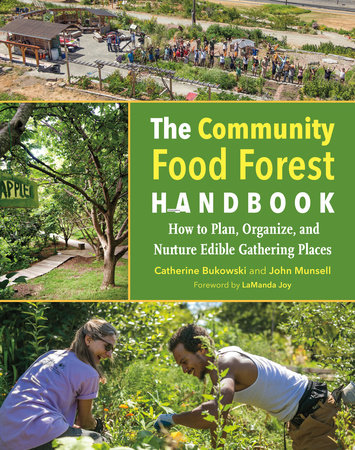
| Pages: | 272 pages |
| Book Art: | Black-and-white illustrations 16-page color insert |
| Size: | 7-1/2 x 9-1/2 inch |
| Publisher: | Chelsea Green Publishing |
| Pub. Date: | July 12, 2018 |
| ISBN: | 9781603586443 |
The Community Food Forest Handbook
How to Plan, Organize, and Nurture Edible Gathering Places
Paperback
$29.95
Collaboration and leadership strategies for long-term success
Fueled by the popularity of permaculture and agroecology, community food forests are capturing the imaginations of people in neighborhoods, towns, and cities across the United States. Along with community gardens and farmers markets, community food forests are an avenue toward creating access to nutritious food and promoting environmental sustainability where we live. Interest in installing them in public spaces is on the rise. People are the most vital component of community food forests, but while we know more than ever about how to design food forests, the ways in which to best organize and lead groups of people involved with these projects has received relatively little attention.
In The Community Food Forest Handbook, Catherine Bukowski and John Munsell dive into the civic aspects of community food forests, drawing on observations, group meetings, and interviews at over 20 projects across the country and their own experience creating and managing a food forest. They combine the stories and strategies gathered during their research with concepts of community development and project management to outline steps for creating lasting public food forests that positively impact communities.
Rather than rehash food forest design, which classic books such as Forest Gardening and Edible Forest Gardens address in great detail, The Community Food Forest Handbook uses systems thinking and draws on social change theory to focus on how to work with diverse groups of people when conceiving of, designing, and implementing a community food forest. To find practical ground, the authors use management phases to highlight the ebb and flow of community capitals from a project’s inception to its completion. They also explore examples of positive feedbacks that are often unexpected but offer avenues for enhancing the success of a community food forest.
The Community Food Forest Handbook provides readers with helpful ideas for building and sustaining momentum, working with diverse public and private stakeholders, integrating assorted civic interests and visions within one project, creating safe and attractive sites, navigating community policies, positively affecting public perception, and managing site evolution and adaptation. Its concepts and examples showcase the complexities of community food forests, highlighting the human resilience of those who learn and experience what is possible when they collaborate on a shared vision for their community.
“A highly useful guide based on the collective wisdom of people and communities who are defining this practice as they develop it on the ground. The thoughtful analysis of planning strategies and numerous case studies of active projects help us all understand what community food forests are and can be for the future.”—Steve Gabriel, author of Silvopasture and coauthor of Farming the Woods
Reviews & Praise

About Catherine Bukowski
Catherine Bukowski is a PhD candidate in the College of Natural Resources and the Environment at Virginia Tech, where she co-taught an agroforestry and whole-farm-planning course that incorporated permaculture principles. She has also earned a graduate certificate in Collaborative Community Leadership from the College of Agriculture and Life Sciences. Catherine previously co-coordinated a forest farming virtual community for the online Cooperative Extension network. She is on the Board of Directors for the Association of Temperate Agroforestry. She also served as a Peace Corps volunteer in Honduras, where she worked with farmers and as a change agent for the Lancetilla Botanical Garden and Research Center.
Connect with Catherine Bukowski
Books by Catherine Bukowski

About John Munsell
John Munsell is an associate professor and forest management extension specialist at Virginia Tech. His background is in sociology and natural resource management. He also is associate editor of the journal Agroforestry Systems and has served as a reviewer for New York City Museum of Natural History, Routledge, Taylor & Francis Group, and the Social Sciences and Humanities Research Council of Canada. John teaches agroforestry and permaculture at Virginia Tech. He has worked with communities from Appalachia to Cameroon to study agroforestry implementation and associated environmental, social, and economic impacts. He has helped design whole-farm plans incorporating permaculture and agroforestry for properties across the United States.
Books by John Munsell

You may also like...
-
 $29.95
 -
$34.95
-
$75.00


