

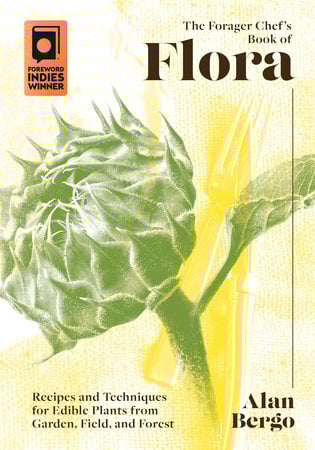
The Forager Chef’s Book of Flora
Recipes and Techniques for Edible Plants from Garden, Field, and Forest

EXCERPTS
| Pages: | 288 pages |
| Book Art: | 347 color photos |
| Size: | 7 x 10 inch |
| Publisher: | Chelsea Green Publishing |
| Pub. Date: | December 22, 2020 |
| ISBN: | 9781603589482 |
The Forager Chef’s Book of Flora
Recipes and Techniques for Edible Plants from Garden, Field, and Forest
Explore edible plants from the exotic to the familiar with the Forager Chef, including 180 recipes and 230 of the author’s own beautiful photographs
“Follow his guidance from the rediscovered culinary amusement park that surrounds you all the way to your kitchen.”—Sam Thayer, author of The Forager’s Harvest, Nature’s Garden, and Incredible Wild Edibles
Minnesota chef Alan Bergo—the Forager Chef—has become one of America’s most exciting and resourceful culinary voices, with millions seeking his guidance online. Bergo’s holistic approach is to cook with all parts of the plant—his inventive culinary style is defined by his encyclopedic curiosity and his abiding, root-to-flower passion for both wild and cultivated plants.
In this excellent, informative guide, Bergo demonstrates how understanding the different properties and growing phases of roots, stems, leaves, and seeds can inform your preparation of something like the head of an immature sunflower—as well as the lesser-used parts of common vegetables, like broccoli or eggplant. Includes sections on:
• Greens, bitter and sweet
• Vegetables, wild and tame
• Herbs, flowers, and alliums
• Nuts, grains, and starches
The Forager Chef’s Book of Flora contains valuable old-school knowledge, including many brilliant culinary techniques that were borne of thrift and necessity. For our own sake, and that of our planet, it’s time we remembered. And in the process, we can unlock new flavors from the abundant landscape around us.
Alan Bergo is the 2022 James Beard Foundation Award Winner for Instructional Visual Media
*As Seen on NBC’s The Today Show!
Reviews & Praise
“You haven’t tasted most of the vegetables your ancestors ate. Today, everything is disdained that is too small or too green or doesn’t keep for long on the produce shelf. We’ve been beguiled through generations into The Great Food Forgetting. But big, cheap, and easy have a profound cost: boring food, bad teeth, diabetes, and loss of the primal pleasure of interacting with the green world like a biologically normal human. How do we recover the birthright of perfect eating? By making forgotten food unforgettable. That’s the dream that makes Alan Bergo’s eyes sparkle, and sets his hands to work. As you’ll see in these pages, his eyes and hands work very well together. Follow his guidance from the rediscovered culinary amusement park that surrounds you all the way to your kitchen, and your mouth will confirm everything that your heart suspected. This real, good food is worth remembering.”—Sam Thayer, author of The Forager’s Harvest, Nature’s Garden, and Incredible Wild Edibles
“This is so much more than a cookbook. Of course there are tantalizing recipes, but there are also walks in the woods, explorations of plant families, revelations of unusual flavors, well-crafted plant profiles, and explanations of why things work the way they do. In The Forager Chef’s Book of Flora, Alan shares his philosophical and practical approach to making wonderful food, with exquisitely detailed flavor combinations and useful tips that could only come from a consummate pro. His passion for these wild and cultivated flavors is inspiring and will undoubtedly change the way you cook.”—Ellen Zachos, author of Backyard Foraging
“The joy and delight in Alan’s writing are contagious. After reading just the introduction, I wanted to escape to the countryside to start foraging so I could cook his inspiring recipes. This book has so many layers. Not only does it contain an abundance of recipes and information about the plants, it provides us with a history from all over the world where people commonly cooked with these ingredients. His passion and enthusiasm are endless. I was instantly engrossed and keep going back for more. I feel like this book will continue to educate me every time I pick it up! I can’t wait to start cooking from it.”—Laura Jackson, chef; coauthor of Towpath
“There’s magic afoot! Edible green growing things we’d mistaken for weeds; everyday vegetables capable of far more than we’d give them credit for; and a most companionable, knowledgeable, and encouraging guide to help us see, cook, taste, and delight in it all.”—Lori De Mori, coauthor of Towpath
“There are a lot of reasons to love this book, but chief among them is its accessibility: Alan’s recipes are approachable, and rooted in the various cultures that invented them. No pinkie-in-the-air foams or molecular whatnot here, just beautiful renditions of beloved dishes that hinge on the edible, wild world that lives all around us.”—Hank Shaw, cookbook author; owner of the James Beard Award–winning website Hunter Angler Gardener Cook
“Alan Bergo is one of the most talented and knowledgeable foragers and chefs of my generation. I’ve followed his adventures for many years now and am delighted to see all of his delectable food in this vastly inspiring and creative tome. Alan’s journeys from the garden bed to the heart of the wilderness and back to your kitchen will instill in you the urge to forage for your food and the desire to learn about all the wonderful ways that you can use nearly any vegetable, wild or cultivated. The Forager Chef’s Book of Flora is an indispensable guide to all the wondrous flavors, tastes, textures, smells, and sights of the wild foods of our world.”—Jeremy Umansky, chef/owner, Larder Delicatessen & Bakery; coauthor of Koji Alchemy
“Alan Bergo is one of the most important contemporary voices in the food of the Great Lakes North, and one of the most completely skilled wild-food chefs in America. He combines scholarship, science, vast curiosity, and a deep respect for the indigenous origins of American food. Through his efforts to reteach us how delicious our own food is, he is doing us an enormous and long-overdue favor. He is reintroducing us to our true native cuisine—a cuisine with breadth, flavor, and subtlety to rival the traditional cuisine of any other region on Earth.”—Steve Hoffman, James Beard MFK Fisher Distinguished Writing Award Winner
“I am wild about this book. I now carry a bag wherever I walk for gathering dandelions and purslane. I pick up acorns and hickory nuts, and am now thinking of so many new ways to make use of the immense larder that is nature. The sensibilities of the forager combined with that of the chef, truly inspiring.”—Ken Albala, PhD, professor of history at the University of the Pacific; author of food histories, cookbooks, translations and reference works, and video courses Food: A Cultural Culinary History and Cooking across the Ages
“This tome of a book, packed with a globally inspired fusion of playful recipes that have been gleaned during Alan’s journey as a chef and forager, is loaded with practical tips for seeking out, storing, and serving your foraged greens. The book will serve the professional chef and home cook in equal measure. It is mind expanding, experimental and utilizes a magnificent diversity of plants.”—Ben MacKinnon, founder and codirector, E5 Bakehouse
“If you find wild foods as delightful as I do, and the act of foraging as empowering as Alan Bergo does, you will be charmed by the slew of wild recipes and unusual edibles in the pages of his much-anticipated The Forager Chef’s Book of Flora. Even familiar garden plants like lilies, hyacinths, and hostas will begin to look distinctly appealing in terms of dinner. Dive in!”—Marie Viljoen, author of Forage, Harvest, Feast and 66 Square Feet
"[An] excellent debut. . . . Advocating that plants are edible in their entirety is one thing, but this [book] delivers the delectable means to prove it."—Publishers Weekly
"The Forager Chef’s Book of Flora invites wild food to the table with creative, low-stress recipes using plants that can be found outside one’s front door."—Foreword Reviews
"[A] remarkable new cookbook, Bergo provides stories, photographs and inventive recipes."—Star Tribune

About Alan Bergo
Chef Alan Bergo is one of America’s leading culinary authorities on mushroom hunting and foraging. A veteran of the restaurant industry, he spent nearly two decades as a professional chef specializing in local and wild foods at St. Paul’s fabled Heartland Restaurant, The Salt Cellar, and Lucia’s Restaurant in Minneapolis. He’s best known for his blogs, recipes, and photography, all featured at his site, foragerchef.com—the web’s largest resource on wild-mushroom cookery. In 2022, Bergo was the James Beard Foundation Award Winner for Instructional Visual Media for his work on The Wild Harvest with Alan Bergo.
Connect with Alan Bergo
Books by Alan Bergo
You may also like...
-
 $40.00
 -
$29.95
-
$29.95


