

Herbal Formularies for Health Professionals, Volume 3
Endocrinology, including the Adrenal and Thyroid Systems, Metabolic Endocrinology, and the Reproductive Systems

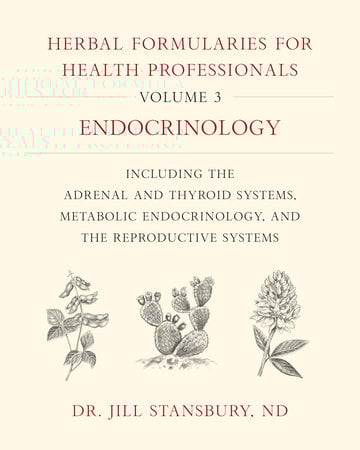
| Pages: | 272 pages |
| Book Art: | Black-and-white illustrations |
| Size: | 8 x 10 inch |
| Publisher: | Chelsea Green Publishing |
| Pub. Date: | May 16, 2019 |
| ISBN: | 9781603588553 |
Herbal Formularies for Health Professionals, Volume 3
Endocrinology, including the Adrenal and Thyroid Systems, Metabolic Endocrinology, and the Reproductive Systems
Herbal Formularies for Health Professionals is a five-volume set that serves as a comprehensive, practical reference manual for herbalists, physicians, nurses, and allied health professionals. Dr. Jill Stansbury draws on her decades of clinical experience and her extensive research to provide an unparalleled range of herbal formulas.
Organized by body system, each volume includes hundreds of formulas to treat common health conditions, as well as formulas that address specific energetic or symptomatic presentations. For each formula, Dr. Stansbury briefly explains how the selected herbs address the specific condition. Sidebars and user-friendly lists help readers quickly choose which herbs are best for specific presentations and detail traditional uses of both Western and traditional Asian formulas and herbs that are readily available in the United States.
Volume 3 focuses on endocrine systems, offering formulas and supporting information for treating thyroid disease, adrenal disorders, diabetes, and metabolic syndrome. This volume also covers the female and male reproductive systems including conditions related to menstruation and PMS, fertility and pregnancy, and the prostate. Reproductive endocrinology is one of Dr. Stansbury’s specialties, and she provides herbal formulas and therapies for pelvic inflammatory disease, genital herpes, ovarian cysts, endometriosis, PCOS, uterine fibroids, low libido, erectile dysfunction, and more. She also discusses the role of herbal medicine in prevention and treatment of reproductive cancers.
Each chapter includes a materia medica section that describes individual herbs with tips on their properties, modes of action, and the specific symptoms each plant best addresses.
These formularies are also a tutorial for budding herbalists on the sophisticated art of fine-tuning an herbal formula for the constitution and overall health condition of an individual patient, rather than prescribing a one-size-fits-all treatment for a basic diagnosis. The text aims to teach by example, helping clinicians develop their own intuition and ability to create effective herbal formulas.
Volume 1 focuses on digestion and elimination and Volume 2 covers circulation and respiration. Volumes 4 (Neurology, Psychiatry, and Pain Management) and 5 (Immunology, Orthopedics, and Otolaryngology) will be published in 2020.
Browse all five volumes of Herbal Formularies for Health Professionals.
Download and browse the cumulative index to the complete five-volume set of Herbal Formularies for Health Professionals
Reviews & Praise
“Herbal Formularies For Health Professionals is a gift to all healthcare practitioners seeking to heal their patients through a natural medicine approach. The expertise of Dr. Stansbury is extraordinary. This text is not a simple guide; it is a fascinating educational read and treatment formulary that is practical and evidence-based.”—Mimi Guarneri, MD, president, Academy of Integrative Health and Medicine
“There are many herb books, but few address the fine points of clinical herbal prescribing. To remedy this deficiency, Dr. Jill Stansbury, ND, has written perhaps the best herbal formulary since the days of the renowned Eclectic physicians. Her first book in this set of five volumes covers the digestive and eliminatory systems including the liver and gallbladder, urinary system, and skin. Each section and page clearly shows the skill, experience, and expertise of the author and will help even the seasoned naturopathic physician or herbalist improve their clinical practice and success in treating their patients.”—David Winston, RH (AHG), dean of David Winston’s Center for Herbal Studies; founder of Herbal Therapeutics Research Library
“Herbal Formularies for Health Professionals, Volume I is simply the best text available for the modern clinical practice of Western herbal medicine. It’s likely to become an instant classic and essential book for any student of herbal medicine, as well as seasoned practitioners. Dr. Stansbury includes copious examples from her extensive clinical work with many kinds of patients to help students and practitioners alike find healing solutions to common ailments and symptoms.”—Christopher Hobbs, PhD, LAc, fourth-generation herbalist
“Fabulous! This book is an outstanding resource. Dr. Jill Stansbury, one of the most respected herbalists and naturopathic doctors of our time, has created an up-to-date formulary that combines the best of traditional formulas with modern research and her own extensive clinical experience. This impeccably researched volume, the first in a set of five, is a master reference tool for herbalists, doctors, and other health care professionals seeking to create precise formulas based on the individual, not on the diagnosis.”—Rosemary Gladstar, herbalist; founder of Sage Mountain Herbal Retreat Center
“Esteemed clinical herbalist and naturopathic physician Jill Stansbury shares thirty years of experience with botanical medicines from all over the globe in this incredibly helpful text, which is part guidebook, part materia medica, and part recipe-based formulary, laced with an enthusiastic appreciation of all things herbal. In short, Herbal Formularies for Health Professionals, Volume 1 is a well-researched and beautifully presented herbal resource. Because of its easy readability, logical organization, and wealth of information, it is an asset for students, newly graduated herbalists and doctors, and seasoned practitioners alike. It will no doubt be a frequently referenced text in the library of any herbal practitioner.”—Timothy Miller, ND, MAc, LAc, RA, founder of Naturopathic CE
“Accomplished naturopathic physician Dr. Jill Stansbury brings her vast clinical experience, deep knowledge, commitment, and passion for herbs to this exciting modern-day formulary. Herbal Formularies for Health Professionals, Volume 1 is an extensive reference guide to the creation of classic herbal formulas using traditional herbal healing wisdom as well as modern science. This text should be a foundational part of herbal education. There is no other formulary as comprehensive or as accessible to the clinician; this book truly fills an empty space in the list of current herbal clinical education publications.”—Dr. Mary Bove, ND, author of Encyclopedia of Natural Healing for Children and Infants
“Herbal Formularies for Health Professionals, Volume 1 delves deeply into herbal formulas for digestive, liver, urinary, and skin problems, along with descriptions and, where known, causes of these problems. In a chapter on the art of formulation, Jill Stansbury outlines example cases and provides appropriate formulas for each. Her considerations are fascinating. This refreshing work will be highly useful for both serious students and practitioners.”—Henriette Kress, herbalist; founder of Henriette’s Herbal Homepage
“Dr. Jill Stansbury’s Herbal Formularies for Health Professionals, Volume 1 is a formidable accomplishment and historic contribution to the rapidly developing field of botanical medicine. In the tradition of the great pharmacopeias of the Eclectic and naturopathic physicians, this comprehensive manual contains a wealth of concisely detailed herbal formulations and easily readable contemporary research that address both the widespread illnesses of our time as well as specialized and less common conditions.
“Herbal Formularies is practical and immediately usable for anyone interested in the applications of herbal medicine. Its depth will satisfy senior clinicians, academic researchers, and medical educators, while its accessibility will greatly further the education of students and the serious lay person.”—David Crow, LAc, founder of Floracopeia Aromatic Treasures
“Reading Dr. Stansbury’s formulary has quickly supported us in updating and filling in gaps in our dispensary stock to better serve our customers. I believe this book will similarly inform the dispensing practices of practitioners of all experience levels looking to glean insight from one of the most experienced herbalist physicians in the United States.
“I’m thrilled to see this first of five volumes of herbal internal medical formularies being released to a wide audience. Previous efforts have been predominately geared toward licensed acupuncturists or naturopathic physicians, but these volumes will speak to a broader, dynamic audience. Clinicians will be surprised to discover how much groundwork has already been laid for future generations of health care professionals. This book offers mature templates for improvisation to treat a myriad of complex health conditions with botanical medicines.”—Benjamin Zappin, LAc, herbalist; cofounder of Five Flavors Herbs
“Formulation is one of the key elements of a clinical herbalist’s practice. It is also an aspect that intimidates many practitioners, especially those newer to herbal medicine. Jill Stansbury’s book is a valuable guide to formulation that will lend a strong guiding hand for herbalists of all skill levels. Her language is clear, instructive, and easy to read. She gives multiple examples drawn from her extensive practice, and her explanations offer direction for working with individual patients. Herbal Formularies for Health Professionals, Volume 1 is a comprehensive and practical book that I will recommend to my herbal students.”—7Song, director of Northeast School of Botanical Medicine; Director of Holistic Medicine, Ithaca Free Clinic

About Jill Stansbury
Dr. Jill Stansbury is a naturopathic physician with over 30 years of clinical experience. She served as the chair of the Botanical Medicine Department of the National University of Natural Medicine for more than 20 years. She remains on the faculty, teaching and leading ethnobotany field courses in the Amazon. She is the author of Herbal Formularies for Health Professionals, Volume 1 through Volume 5, and is the co-author of The PCOS Health and Nutrition Guide. Dr. Stansbury lives in Battle Ground, Washington, and is the medical director of Battle Ground Healing Arts. She also runs an herbal apothecary featuring many of her own custom formulas.
Connect with Jill Stansbury
Books by Jill Stansbury


You may also like...
-
 $34.95
 -
$34.95
-
$44.95


