Like this book? Digg it!

Book Data

ISBN: 9781933392271
Year Added to Catalog: 2006
Book Format: Paperback
Number of Pages: 6 x 9, 391 pages
Book Publisher: Chelsea Green Publishing
Old ISBN: 1933392274
Release Date: September 15, 2006

Also By This Author

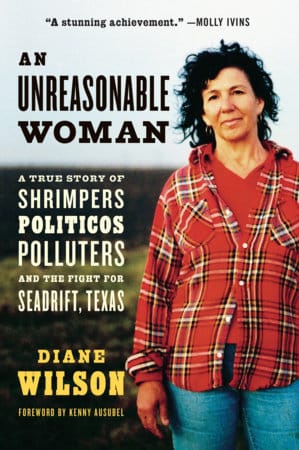
An Unreasonable Woman

A True Story of Shrimpers, Politicos, Polluters, and the Fight for Seadrift, Texas

by Diane Wilson

Foreword by Kenny Ausubel

Associated Articles 2

For Immediate Release

FORMOSA PLASTICS RECOGNIZED WITH INTERNATIONAL "HITTER AWARD" FOR TRAMPLING HUMAN RIGHTS

December 23, 2005

The Taiwan Association for Human Rights (TAHR) recognized Formosa Plastics among its winners of the 2005 Hitter Award for human rights violations. A non-governmental organization committed to securing human rights, TAHR awarded several companies with the dishonorable Hitter Award yesterday; Taiwan-based Formosa Plastics (with US headquarters in New Jersey) was among them. The award aims to underscore each company’s records in trampling the human rights of its workers.

The Taiwanese newspaper Taipei Times reported that Formosa Plastics was “given the ‘award’ for their role in violating foreign workers' human rights.” The Times recounted the story of Filipino worker Gil Lebria, who was employed at a Formosa Plastics plant in Taiwan’s Yunlin County. “After he was beaten by the factory's security guards, the management did not send him to hospital. Instead, he and 15 other maltreated co-workers were sent back to their home countries.” With funds donated by civic groups, Lebria was later able to file a lawsuit against the security guards who had hit him.

A major Formosa Plastics manufacturing plant was driven out of Taiwan decades ago because of the company’s poor record on corporate pollution. Formosa eventually built the plant, which produces petrochemicals required in manufacturing PVC plastics, in Point Comfort, Texas, and Formosa Plastics USA now operates US manufacturing plants in Delaware, Illinois, Louisiana, and Texas, with raw materials operations overseas. A self-described “growing manufacturer of plastic resins and petrochemicals,” Formosa Plastics employs more than 2700 people worldwide.

Diane Wilson, environmental activist and author of An Unreasonable Woman, has been battling Formosa’s pollution and corporate corruption since the late1980s. When Formosa announced its plan to build a $1.5 billion manufacturing plant in her neighboring town, Wilson began investigating its history and exposing a chain of illegal contamination, cover-ups, mal-treatment of workers, and political and regulatory corruption. Wilson is currently serving 120 days at the Victoria County jail for her activism against corporate crime, and could not be reached to comment on Formosa’s award.

Pollution looms over Delaware indiscriminately

National study finds black neighborhoods most at risk, but in state, it's everywhere
By JEFF MONTGOMERY
The News Journal
December 14, 2005

This is an excerpt from an article about air pollution in Delaware. One of the polluters mentioned is Formosa Plastics, the same company against which Diane is fighting in her book. Read the entire article at Delaware Online.

Longtime problems in Delaware

As long ago as 2000, EPA records clearly showed northern Delaware's air contains some of the nation's highest concentrations of toxic pollutants from all sources. Officials laid much of the blame on Delaware's location along the densely settled, highly industrialized I-95 corridor.

Some Delaware problems stood out in 2000, including emissions of toxic, cancer-causing vinyl chloride from the Formosa Plastics plant near Delaware City and releases of toxic vapors from a factory in Cheswold that supplies the plastics industry.

Department of Natural Resources and Environmental Control considered the problem serious enough to launch a $1 million, statewide analysis of both toxic and hazardous pollution levels.

DNREC Deputy Secretary David Small said Delaware has attempted to identify problems and public health concerns based on long-term, direct air sampling, which, he said, takes into account pollution from traffic and other sources rather than computer calculations based on industry reports.

"We think the EPA information is somewhat limited in its utility and application," Small said. "It's not the complete picture."

Results of the DNREC study, released earlier this year, showed pollution on Wilmington's Martin Luther King Boulevard near the Wilmington Amtrak station could cause more than four extra cancer cases than would be expected per 100,000 residents.

Inhumane situation

In Wilmington, City Councilman Charles Potter Jr. said he was pleased to see public attention on pollution problems in urban areas. Some Wilmington neighborhoods have complained for years about odors and unseen pollutants drifting across homes from industrial sites and landfills to the east.

"I totally agree with what they're saying. You have people being inundated with pollution who are the least likely to be able to speak up for themselves," Potter said.

"It's really an inhumane situation," he said. "It causes a lot of respiratory problems, and it's up to elected and community officials to rid the community of unhealthy situations as well as nuisances."

Ocean View resident Stephen E. Callanen, a Sierra Club Delaware Chapter member, said he would have reconsidered a permanent move to Delaware in 1997 had he been aware of the nearby NRG Indian River power plant "spewing out this stuff."

"I'm very uncomfortable with the attention that air pollution has received in this state," Callanen said. "I don't know enough, but what I do know is that at full capacity the power plant consumes 72 coal cars per day, which is 7,200 tons of coal, and that's an old plant that doesn't meet current pollution control standards. It's a very uneasy feeling."

Air pollution "works with many other factors, genetics and environment, to heighten one's risk of developing asthma and chronic lung disease, and if you have it, it will make it worse," said Dr. John Brofman, director of respiratory intensive care at MacNeal Hospital in the suburban Chicago town of Berwyn.

"Evidence suggests that not only do people get hospitalized but they die at higher rates in areas with significant air pollution," he said.

Environmental experts say most pollution inequities result from historical land-use decisions and local development policies. Also, regulators too often focus on one plant or one pollutant without regard to the cumulative impact, they say.


Chelsea Author Keeps Touring, Avoids Jail

by Raya Kuzyk
Publishers Weekly Daily
October 12, 2005

In a recent review of shrimper-cum-activist Diane Wilson's September hardcover, An Unreasonable Woman: A True Story of Shrimpers, Politicos, Polluters and the Fight for Seadrift, Texas, the San Diego Union Tribune noted that the book "couldn't have come at a better time." And that was before they'd heard about the jail sentence threatening to concur with the author's book tour or the South Texas Formosa industrial plant explosion October 6 that Wilson had as much predicted in her book.

Unreasonable is the 400-page account of Wilson's battle to expose and immobilize Formosa Plastics, Dow/Union Carbide, and what she sees as other toxic Texas-based industrial plants that have been threatening the health of her town's residents and sea life. Just five days after promoting the book in a Sept. 28 Diane Rehm Show appearance and following a series of strong reviews from the Christian Science Monitor, Booklist and Library Journal (see also PW review, July 18), Wilson learned that a Texas court wanted her to immediately begin serving the six-month jail sentence she’d incurred for protesting at one of its plants in 2002. She originally was to begin serving the sentence in 2006. According to her lawyer, if Wilson enters Texas, something she intended to do as part of her book tour, she'll be arrested.

Since the book tour would have been snaking toward Texas right about now, Wilson's publisher Margo Baldwin of Chelsea Green, is extending the tour, having most recently scheduled Wilson as a keynote speaker at San Rafael, Calif.'s annual Bioneers Conference on Oct. 14.

Otherwise, Baldwin is addressing the interest generated by the jail threat, the chemical plant explosion, and an NPR interview, by ordering a 10,000-copy second printing. Baldwin also ordered a 5,000-copy printing of Molly Bang's YA graphic art title Nobody in Particular, which illustrates Wilson's fight, and arranged for the two to be presented in tandem at future events. Baldwin says she intends to "keep her [Wilson] on the road as long as possible and…press for Dow to drop the charges and/or the governor of Texas to pardon her."


The Power of One

Library Journal
by Wilda Williams

It is not often that a publisher has to worry about scheduling a book tour around an author's jail term, but then Diane Wilson is no ordinary writer. In 2002, the then 52-year-old former shrimp boat captain–turned–environmental/political activist jumped the fence at a Dow Chemical plant in her hometown of Seadrift, TX, climbed a 70' tower, and chained herself there for eight hours to protest Union Carbide's denial of responsibility for the 1984 chemical plant explosion in Bhopal, India, that left thousands dead. (Dow, which now owns Union Carbide, has refused to clean up the site.)

"At the trial, the district attorney said I was a very dangerous woman," says Wilson, who is appealing her four-month jail sentence but expects to lose. "Believe me, I was not like this when I first started my activism." Her memoir, An Unreasonable Woman, traces the remarkable transformation of an ordinary working-class mother of five, who in 1989 read a newspaper article that identified her impoverished Calhoun County as the most polluted in the country.

"There are pivotal points in people's lives, and if they don't move on it, their lives are lacking for it," Wilson tells LJ. In her case, she chose to launch a grass-roots campaign to stop Formosa Plastics and other chemical companies from further dumping their toxic waste into the fragile bays along Texas's Gulf Coast. When town meetings, letter-writing, and lawsuits had little effect, Wilson undertook more drastic acts of civil disobedience, including staging several hunger strikes, until finally in 1994 she won "zero discharge" agreements (meaning no liquid effluent discharge into the environment) from Formosa and Alcoa.

"This is the story of the power of one individual to effect change," remarks Chelsea Green publisher and cofounder Margo Baldwin. With Wilson's book, Baldwin explains, the Vermont-based publisher of books on sustainable living is returning to its original intent of doing "exciting, important titles that would inspire as well as address practical aspects." Baldwin had stepped out of the day-to-day running of the company but returned in late 2002 out of concern that its focus had grown too narrow. "We didn't drop the how-to," says Baldwin, "but we felt we had to publish broader-visioned books that would reach a wider audience."

At the same time, Chelsea Green is making another departure, reissuing Molly Bang's pictorial biography, Nobody Particular: One Woman's Fight To Save the Bays (Sept. ISBN 1-931498-94-6. pap. $10), which Holt published in 2000 as a children's picture book. Bang's striking black-and-white story panels set against a backdrop of color illustrations, Baldwin thought, hadn't found its right audience the first time. She decided it would be interesting to promote the book as a young adult graphic novel to accompany Wilson's memoir.

This past June, Wilson attended BookExpo America in New York City, but further book promotion plans depend upon the outcome of her appeal and the ruling's timing. Chelsea Green is working on a contingency plan, including videotaping Wilson for a virtual tour and having her do some podcasting from jail. "If worst comes to worst," says Baldwin, "we may sell books outside the jailhouse to help publicize her plight and raise money for her legal defense fund. I'm sure we can find a lot of 'unreasonable women' to participate!"


Diane Wilson: an interivew by Gayle Brandeis

From CODEPINK
by Gayle Brandeis
August 11, 2005

Diane Wilson, commercial fisherwoman, environmentalist, and co-founder of CODEPINK: Women For Peace, launched a hunger strike August 7, 2005 to support Cindy Sheehan's roadside vigil at President Bush's Crawford, Texas ranch (or, as she likes to call it, "White House West.") Sheehan has said she won't leave the fire ant infested, 100 degree temperature site until Bush speaks to her about why her son was killed in Iraq. Members of CODEPINK are launching vigilant fasts around the world to express their solidarity.

Wilson knows how powerful hunger strikes can be. In 2002, her hunger strike against DOW chemical resulted in criminal charges in Bhopal. Her longest fast lasted 31 days. "A hunger strike is a very powerful action," she said by phone. "It creates soul-power, as Gandhi says. It creates change." She said even a one day fast of solidarity can solidify intent.

"I believe Cindy is going to be able to talk to Bush," said Wilson, who drove for seven hours to get to Crawford. "The time is coming that he is going to have to relate to the common American people. During Vietnam, most of the protestors were students. Now mothers are protesting, families are protesting. People are showing up on his doorstep saying, 'Hey George, where are those family values that you've been talking about?'"

Wilson noted that at first the authorities didn't understand the seriousness of the situation, but, she laughed, "it's starting to dawn on them." Over 20 Secret Service and law enforcement cars have patrolled the protest site. Steve Hadley, national security adviser, and Joe Hagin, deputy chief of staff, met with Sheehan, and even sat on the dirt with her, but they continued to feed her the party line. Wilson said Sheehan told her "I may be a grieving mother, but I'm not stupid." And she's not leaving until she speaks to Bush, himself. Wilson has promised to stay and fast with her for the entire length of the vigil.

Wilson is the mother of five children, including an autistic son who has been approached by military recruiters. "This isn't just about Cindy's son," she said. "This is for every new death, both US and Iraqi. We're here to say 'No more. No more.'"

Wilson is committed to the transformative power of civil disobedience, on both a personal and cultural level. She has been pleased by the support and amount of press attention the protest has received. "You know?" she said, taking a deep breath. "We are a lot stronger than we think."

Gayle Brandeis is the author of The Book of Dead Birds, which won Barbara Kingsolver's Bellwether Prize for Fiction in Support of a Literature of Social Change. She was named a "Writer Who Makes a Difference" by the Writer Magazine.


Texas Environmental Attorney Paid $200,000 by Formosa Plastics

Corporate Crime Reporter
July 14, 2005

A Texas environmental attorney was paid about $200,000 by Formosa Plastics over ten years while he was fighting on behalf of the environment and the public interest to get the petrochemical giant to stop polluting Lavaca Bay – which sits mid-way between Corpus Christi and Galveston on the Texas Gulf Coast.

Houston attorney James Blackburn is one of a handful of attorneys that Texas activists can turn to fight off big polluters.

In the early 1990s, shrimper Diane Wilson called Blackburn for help.

Wilson, a mother of five who lives in Seadrift, Texas on Lavaca Bay, was interested in putting a halt to the petrochemical pollution of her bay and her community.

Throughout the 1990s, Wilson battled the multinational petrochemical company with lawsuits, press releases, hunger strikes, civil disobedience – she’s been to jail 13 times – and an attempt to sink her own shrimp boat.

In 1992, following one of her hunger strikes against the Taiwan-based company, and with Blackburn at her side, Wilson and Formosa agreed to what she believed would be a pathbreaking settlement with Formosa – an agreement that would allow activists to name monitors at the facility and that would allow workers at the facility to organize unions free of corporate intimidation.

But only a few days after shaking hands over this agreement with Formosa, the company reneged.

And as a result, Blackburn and Wilson had a falling out.

But instead of dropping the case, Blackburn decided to negotiate a deal between himself and Formosa.

And he did.

Wilson said that the deal was signed in Austin Texas in 1992, in front of television cameras.

What was generally not known at the time about the fight between the environmentalists and Formosa was that Blackburn was being paid by Formosa.

Also not generally known at the time was that Wilson was so distraught by the deal, that she tried to kill herself by downing two bottles of sleeping pills.

The sleeping pills made it hard for her to breath, but they didn’t kill her.

The historic fight over Lavaca Bay is detailed by Wilson in her new book – An Unreasonable Woman: The True Story of Shrimpers, Politicos, Polluters and the Fight for Seadrift, Texas (Chelsea Green, 2005).

The book is scheduled to hit bookstores in late August.

In an interview with Corporate Crime Reporter, Wilson said that she has sold film rights to her story to filmmaker Robert Greenwald.

Andie MacDowell is penciled in to play Wilson.

Who will play Blackburn?

“I don’t know. I’ve always told him it’s going to be Danny DeVito.” (For a complete transcript of the interview with Wilson, see 19 Corporate Crime Reporter 29(1) pages 8 to 16, July 18, 2005, print edition only).

Blackburn told Corporate Crime Reporter this week that he was never paid by Formosa while he was representing Wilson – that he negotiated the payments only after he had severed his relationship with her and other environmental groups.

Blackburn said that about half of the payments were filtered through environmental groups – like the Galveston Bay Conservation and Preservation Association.

“Rather than bill Formosa, I made pro bono donations to Formosa,” Blackburn said. “In exchange, Formosa made donations to environmental groups, for which I had done pro bono work. And the environmental groups would then pay me.”

The other half of the payments went directly from Formosa to Blackburn for his work as the “public interest” member of Formosa’s technical review commission – a commission that grew out of one of the agreements that Blackburn negotiated with Formosa.

When asked why he didn’t just do all of the work pro bono, Blackburn responded – “I was broke.”

“There are limits to pro bono,” Blackburn said. “That was the whole reason.”

Blackburn and Wilson still consider each other friends, although they have differing views of the net effect of the agreements with Formosa.

Wilson generally sees the battle as lost, with Formosa still using the bay as its private dumping ground.

Blackburn says that much progress has been made in cleaning up Formosa’s operations.

He says that the agreements are among the best he has been involved in and have led to 35 to 40 percent reduction in wastewater from the facility.

He hopes that the agreements will eventually lead to zero discharge from the facility.

In the interview with Corporate Crime Reporter, Wilson said that Formosa officials liked Blackburn more than they liked her.

Wilson wanted to fight and win.

Blackburn wanted to compromise, she said.

“Formosa was real friendly with him,” Wilson said. “They liked him. I used to get furious. They always went through Blackburn. They never went through me. And this is one of my big gripes. It’s not just an environmental thing. It’s not just about people’s lifestyles. It had to do with just being a working class woman out there. Formosa did not like going through me at all.”

Wilson’s fall book tour might have to be postponed.

She was convicted last year of criminal trespass for climbing a fence outside of a Union Carbide facility in Seadrift to protest the company’s activities in Bhopal, India.

If an appellate court doesn’t overturn the ruling, she is scheduled to serve four to six months in prison – perhaps beginning as soon as this month.


The Loneliness of a Lonestar Liberal

By Rose Aguilar
Posted on AlterNet.
Posted June 20, 2005.

Progressive activists in Texas face strong and often hostile opposition. But they say they're going to fight to turn Texas blue again.

It's not easy being a progressive activist in Texas. Not only are the state's progressives up against a conservative majority and completely ignored by national politicians, they're also stuck with the media's label of "red state voters" who have completely different values from "blue state voters."

"I'm a redneck. I was raised Pentecostal and listen to country music. So what?" says Diane Wilson, 51, a member of Code Pink and author of the forthcoming book, An Unreasonable Woman, about her battle to save her hometown from industrial chemicals. "Redneck progressives are capable of a lot more than the media would have you think."

The repetitive use of the term "red state voter" makes it easy for the country at large, including progressives living in Democratic cities, to lose sight of the fact that Texas is a diverse state full of activists.

Wilson, a fourth-generation shrimp-boat captain, has been an environmental activist since 1989. She was born and raised in Seadrift, a small fishing town in East Texas, where chemical plants dominate and protesters are considered whackos. Shortly after Wilson learned that Seadrift was the most polluted region in the nation, she began staging solo hunger strikes. "People would say, 'Women don't do hunger strikes in Texas! Especially solo hunger strikes.'"

At the time, Wilson says she had no idea what it was like to have a support network and connections in the activist community. "A lot of activists are really good at networking. Because I was a fisherman, I was solitary anyway, so for a very long time, I would do actions by myself."

Wilson's actions eventually forced Formosa Plastics, a manufacturer of petrochemicals, to stop pumping discharge into Seadrift's waters. Since then, Wilson has been traveling around the country talking about her victories and encouraging influential progressives to reach out to working-class folks like herself. "The movement will continue to die if that doesn't happen," she says. "I still feel like I'm kind of an outsider looking in, but I do what I need to. I don't count on the Democratic or progressive parties to save me. I don't have time to wait on that. I've got chemical plants dumping daily."

Texas activists in small towns like Seadrift are making an impact; the problem is, they rarely receive the attention and press they deserve. Activists in and around Crawford, President Bush's adopted hometown, worked tirelessly to reelect Democrat Chet Edwards to the U.S. House of Representatives in November, making him Bush's congressman. Still, expressing opposition to Bush and his policies is frowned upon in Crawford. The locals make it very clear: if you're not a Bush supporter, you're not welcome. Life-sized cutouts of Bush and his family stared at me as I ate French fries at the only cafe in town. Shop and restaurant windows are plastered with W stickers and receipts say, "Home of President George W. Bush."

That's the climate Crawford Peace House activists face on a daily basis. In March 2003, John Wolf made national headlines when he announced plans to buy the house and convert it into a resource center and meeting place for those who oppose the Bush administration. On the highway leading to Crawford, just past the sign saying "Home of President George W. Bush," the Peace House is the first structure you see.

"We the People Say No to the Bush Agenda" and "Veterans for Peace" banners hang in the window, while information about everything from the war and military spending to Israel/Palestine and social justice can be found inside.

Kay Lucas, an activist who drives 25 miles to maintain and care for the Crawford Peace House, says the few locals who've expressed support for the Peace House are brave. During our interview, two men stopped by to say hello and check out the house. One agreed to answer a few questions, but didn't want to give his name for fear his neighbors would find out he voted for John Kerry (but preferred Ralph Nader).

I asked if he thought the Peace House has any impact on the locals. "I know it does. It gets some people to look deeper, but not very many. This is Bush country after all." Lucas tells me that when locals stop by the Peace House, they don't want passersby to see their cars in the driveway.

Crawford activists are trying to ease those fears by changing the dialogue. "We no longer protest," Lucas says. "We now have parades. Lots of parades." Have they made an impact? "If it weren't for us, there would be no alternative voice. I hope we've made some sort of a difference."

Even progressive activists in large Texas cities like Houston face many challenges and often work in small groups. "Houston is hard to organize because there is no mass transit and no commons area," says Theresa Keefe, who, along with her husband Keith Koski, brought a large cash cow to a Halliburton shareholder action in Houston last month. Keefe says the most effective activism in Texas involves visuals. "People in Texas won't listen if you scream," she says. "Big silly props reach more people, especially those who don't agree with us."

In addition to attending actions, Lee Loe, a 77-year-old member of Houston Code Pink, uses newspapers to spread her message. In 1996, when Loe learned about the impact sanctions were having on Iraqis, she started Iraq Notebook, a newspaper about the history of and current happenings in Iraq. Today, Loe selects stories with Houston's low-income Latino community in mind. The latest edition of Iraq Notebook includes eyewitness accounts from soldiers serving in Iraq and information on military recruiting efforts.

"The Latin American community is being heavily drafted here," Loe says. "The only people reaching out to the Latin American population are the ROTC. They were at the Cesar Chavez parade."

Loe distributed 12,000 issues of her last paper at local Latino festivals, including that parade. "It's such a drop in the bucket, but it spreads," she says. "One woman picked one up at a conference and gave it to her friend. She read it and used it in an exam for her students, so the information is getting out there."

Loe's paper doesn't have an accompanying Web site; she believes the progressive community often forgets that not everyone owns a computer. "I get mad when an event is posted and they put a web address with no telephone number. Are you kidding? That's elitist," she says. "I always hear, 'People can go to the library.' Yeah, right, with their five kids on the bus?" Loe is currently working on a new edition with the help of volunteers, donations and grants from the Green Party and Resist Illegitimate Authority.

The activists I've met over the past month and a half in Texas are dedicated and determined. Unlike progressive-leaning places like San Francisco, New York and Washington DC, activists here face strong and often hostile opposition. When Texas Governor Perry signed anti-gay and anti-abortion legislation at a church in Forth Worth last month, a few hundred activists stood in the hot sun waving signs and chanting slogans to 1,000 Perry supporters as they drove by in air-conditioned cars.

"We are beginning to learn that we have to speak out," says Mike Herrington, a sixth-generation Texan and member of Soulforce, an organization devoted to changing the minds of religious leaders who engage in anti-gay campaigns. "I'm also standing up for my own rights and I didn't used to do that. I think we're beginning to spread the message here in Texas. We have to be willing to take risks."

Lanore Dixon, an activist who drove 55 miles to attend the event, says openly talking about politics in social situations is taboo. "That has handcuffed us as activists. We're gonna have to face the uneasiness in our families. We're gonna have to risk being the black sheep that dares to open their mouth at Thanksgiving or Christmas or birthday parties. If we don't, we really are going to lose democracy," she says. "My goal is to turn Texas blue again. We need pointers on how to organize and how to inspire each other."

It's easy for progressives and national politicians to ignore Texas, especially since Bush got 61 percent of the state's vote. But local activists who break down the numbers remain somewhat hopeful. In Dallas County, Bush won by just under 10,000 votes. "If a national Democrat came here and talked to the people, I'm sure Kerry would have won Dallas," says activist Lynn Walters. "We also would have won more local races."

Texas activists say support from national politicians and progressive activists living in liberal cities would give them more power and influence. "It's pretty scary down here. We're sitting in one of the most conservative Bible Belt areas in the country," says Madeline Crozat-Williams, a Code Pink organizer in Houston. "We feel like we hear shreds of the conversation about where to go from here, but we're struggling. We could use all the help we could get."

Rose Aguilar is a San Francisco-based journalist gathering stories from people living in states that voted overwhelmingly for George W. Bush. Track her journey at Stories in America.


With Little Fanfare, a New Effort to Prosecute Employers That Flout Safety Laws

By DAVID BARSTOW and LOWELL BERGMAN
New York Times
May 2, 2005

For decades, the most egregious workplace safety violations have routinely escaped prosecution, even when they led directly to deaths or grievous injuries. Safety inspectors hardly ever called in the Justice Department. Congress repeatedly declined to toughen criminal laws for workplace deaths. Employers with extensive records of safety violations often paid insignificant fines and continued to ignore basic safety rules.

Inside the Bush administration, though, a novel effort to end this pattern of leniency has begun to take root.

With little fanfare and some adept bureaucratic maneuvering, a partnership between the Occupational Safety and Health Administration, the Environmental Protection Agency and a select group of Justice Department prosecutors has been forged to identify and single out for prosecution the nation's most flagrant workplace safety violators.

The initiative does not entail new legislation or regulation. Instead, it seeks to marshal a spectrum of existing laws that carry considerably stiffer penalties than those governing workplace safety alone. They include environmental laws, criminal statutes more commonly used in racketeering and white-collar crime cases, and even some provisions of the Sarbanes-Oxley Act, a corporate reform law.

The result, those involved say, should be to increase significantly the number of prosecutions brought against dangerous employers, particularly in cases involving death or injury.

This new approach addresses a chronic weakness in the regulatory system - the failure of federal agencies to take a coordinated approach toward corporations that repeatedly violate the same safety and environmental regulations. The E.P.A. and OSHA in particular have a history of behaving like estranged relatives. Yet the central premise of this unfolding strategy is that shoddy workplace safety often goes hand in hand with shoddy environmental practices.

"If you don't care about protecting your workers, it probably stands to reason that you don't care about protecting the environment either," said David M. Uhlmann, chief of the Justice Department's environmental crimes section, which is charged with bringing these new prosecutions.

The effort is noteworthy in an administration that has generally resisted efforts to increase penalties for safety and environmental violations. It has declined to support such steps as making it a felony for employers to commit willful safety violations that cause a worker's death. Such violations are currently misdemeanors, punishable by up to six months in jail. Instead, the administration has emphasized a more collaborative approach, offering companies increased technical assistance, for instance, on how to comply with regulations.

The new initiative is already at an advanced stage of planning. Hundreds of senior OSHA compliance officers have attended training sessions led by Justice Department prosecutors and criminal investigators from the E.P.A. In several regions of the country, OSHA managers have begun making lists of the worst workplaces and sharing them with E.P.A. investigators and prosecutors, who select the most promising cases for investigation. Several criminal inquiries and prosecutions are under way.

In March, for example, Motiva Enterprises, an oil refining company partly owned by Shell Oil, pleaded guilty to endangering workers negligently and committing environmental crimes in Delaware. The company was ordered to pay a $10 million fine and sentenced to three years' probation.

Even so, it is difficult to gauge the degree of political support for more prosecutions. The initial planning won the blessing of John Ashcroft, then the attorney general. His successor, Alberto R. Gonzales, has been briefed on the initiative and is said to be supportive.

But in March, a news conference to announce the initiative was canceled. The name of the program was also changed. What was to have been called the Worker Endangerment Initiative is now described as a "policy decision" - not an "initiative" - aimed at achieving "environmental protection in the workplace."

Neither Jonathan L. Snare, the acting OSHA administrator, nor Howard Radzely, the Labor Department's top lawyer, would agree to be interviewed about it. But Richard E. Fairfax, OSHA's director of enforcement programs, described the initiative as part of a broader effort by the agency to crack down on companies that persistently flout workplace safety rules.

"This is important to the agency," he said.

If some hesitation exists at the political level, enthusiasm is high in the trenches of OSHA and the E.P.A. Andrew D. Goldsmith, assistant chief of the environmental crimes section, has led most of the OSHA training sessions, in which he describes the many ways criminal and environmental statutes can be brought to bear. It has been a revelation of sorts, he says, to watch agency compliance officers grasp the chance at last to seek significant criminal penalties against defiant employers.

"You see a glint in these people's eyes, and you see them getting very enthusiastic," Mr. Goldsmith said. "You see hands start shooting up. They view us like the cavalry coming over the hill."

If sustained, the enthusiasm would represent an important cultural shift inside OSHA, which has traditionally shied away from referring even the most deliberate of safety violations to prosecutors.

From 1982 to 2002, for example, the agency investigated 1,242 cases in which it concluded that workers died because an employer committed willful safety violations. OSHA declined to seek any prosecution in 93 percent of those cases, The New York Times reported in a 2003 series that described a bureaucracy in which aggressive enforcement was thwarted at every level. But as the series also demonstrated, OSHA's reluctance to seek prosecution had also been fed by an assumption inside the agency that federal prosecutors have little interest in cases that have rarely resulted in prison sentences.

By fusing the technical skills and regulatory powers of the E.P.A. and OSHA with the Justice Department's environmental crimes section, the administration has created a potentially potent means of changing that dynamic.

All federal environmental crimes carry potential prison sentences, including up to 15 years for knowingly endangering workers. And unlike OSHA, the E.P.A. has some 200 criminal investigators with extensive experience building cases for federal prosecutors. In 2001 alone, the agency obtained prison sentences totaling 256 years.

OSHA, meanwhile, has wide jurisdiction over American workplaces, and its inspectors routinely wander the floors of the nation's dirtiest and most dangerous manufacturing operations. Unlike E.P.A. inspectors, they also investigate hundreds of workplace deaths and injuries each year. In short, they are well positioned to spot potential environmental crimes, particularly those that harm workers.

With nearly 40 prosecutors, the environmental crimes section of the Justice Department has a long record of bringing complex criminal cases against major employers. By contrast, before this initiative, only one prosecutor at the Justice Department focused full time on workplace safety crimes. Now, after identifying promising cases from the lists sent by OSHA, prosecutors are also checking for significant records of environmental infractions. If a plant is part of a larger conglomerate, they are checking the records of sister plants, too.

"We can see all the pieces," Mr. Goldsmith said. "We can coordinate."

The value of that coordination became obvious, he and other officials said, during a recent federal investigation into a New Jersey foundry owned by McWane Inc., the nation's largest manufacturer of cast-iron pipe. The investigation was prompted by articles in The Times and a companion documentary on the PBS television program "Frontline" that described McWane as one of the most dangerous employers in America.

Senior officials at OSHA, the E.P.A. and the Justice Department saw a way to produce an indictment that would "tell the whole picture" of how a company could put profit ahead of all other considerations, said Mr. Uhlmann, the chief of the environmental crimes section.

In December 2003, several senior managers at the New Jersey foundry were indicted on charges of conspiring to violate safety and environmental laws and repeatedly obstructing government inquiries by lying and altering accident scenes. The case is pending, but Justice Department officials called it a "pioneering indictment."

The partnership was cemented in a meeting last summer between Thomas L. Sansonetti, then an assistant attorney general, Mr. Radzely, the chief Labor Department lawyer, and John L. Henshaw, then the administrator of OSHA.

In a recent interview before he left the Justice Department to return to private practice, Mr. Sansonetti said he made it clear at the meeting that the Justice Department was prepared to offer training nationwide and a firm commitment to go after the worst cases as a way to send a message of deterrence to other employers. Mr. Henshaw and Mr. Radzely, he said, responded enthusiastically.

"That's where we agreed to take off on this," Mr. Sansonetti said.

An UnReasonable Woman for the Earth - An Interview with Diane Wilson

From Gaian Voices
November 2002

Diane Wilson is an inspiring powerhouse of a woman. A mother of five and fourth generation shrimper, Diane grew up in Seadrift, Texas, a small fishing town on San Antonio Bay in Calhoun County — which has the dubious distinction of being the number one county in the nation for toxic disposal. Diane has been battling huge chemical corporations — Union Carbide/Dow, Aloca, BP Chemical, Dupont, Formosa Plastics, Carbon Graphite — since 1989, the first year corporations were required by law to report toxic emissions. As a fisher, she knew something was terribly wrong before 1989 but no information was available. Once she found out what was going on, she became determined to change things. She has been on several hunger strikes, some over 30 days, and attempted to sink her own 42 foot shrimp boat on top of an illegal discharge. In August 2002, Diane climbed a 90 foot tower inside a Dow/Union Carbide facility in Seadrift and unfurled a banner that read: “Dow/Union Carbide Responsible for Bhopal” to protest the company’s refusal to take responsibility for the disaster in Bhopal, India. (See update). In 1995, she won “zero discharge” agreements with Alcoa Aluminum and Formosa Plastics, one of the world’s largest producers of PVC. She is the inspiration behind UnReasonable Women for the Earth, founded in 2002, and co-founded Code Pink in response to the war in Iraq. She has won numerous environmental awards and been featured on 48 Hours and Lifetime TV. A children’s book, Nobody Particular by Molly Bangs, tells her story.

I spoke with Diane shortly before Thanksgiving as she prepared to go to jail in Austin for disrupting the Texas legislature as they passed their resolution supporting George Bush and the war in Iraq. (She hung a banner and screamed “No more killing!” as the police dragged her out.) Nothing deters Diane’s invincible spirit and commitment. Not jail (she was jailed six times in 2002 and has two trials coming up in January 2004), not risk to herself, and certainly not threats from the powers-that-be.

Talking with Diane was a real treat. She’s easy to talk to and has a great sense of humor. I felt as though we were close friends sitting on the back porch, drinking tea, sharing our concerns and our passion for the Earth. Our conversation was punctuated with laughter — and more than a few cackles. As she would put it, Diane is on our side. And I, for one, am extremely grateful.

GV: You started taking action in 1989. At around that time, until 1992 or so, I was researching what I called “the worst corporate destroyers of the Earth”. How had I not heard of you?

DW: Well, for a long time it was just a Texas thing. And especially around here, they just thought I was a nut. Now they say I’m a persistent nut. (Laughs)

GV: Well there has to be something a little off in order to do what you’ve been doing. (Both of us laugh). No, really, because most people can’t imagine it.

DW: I’m a firm believer in commitment. I think most folks just don’t understand what that word means. It’s not writing a check to Greenpeace. It’s about putting yourself into it. You make your commitment and things happen. It’s like a miracle. You create action, you create events.

GV: And the energy builds up around you.

DW: That’s right. What people don’t understand is I don’t plan a thing. My actions come from a spontaneous, intuitive place. When you’re a fisherman on the bay you’re very instinctive about where you go. You feel the moon and the water and the wind. You imagine where the shrimp or the fish are going. You have to think like them. When I do my actions, it’s the same thing. I just put the intent out there. Some of the most miraculous actions are completely spontaneous.

GV: Relying on your intuition comes naturally to you.

DW: Oh yes. Matter of fact, I consider myself a mystic.

GV: Can you talk about that a little bit?

DW: I’ve been on the water my whole life. When I was about five I can remember going to the bay and the bay was a woman. I could see her. She had gray hair. I felt like she was my grandmother. The thing is, it was visual. It was emotional. I felt her. I saw her. When I would come to the bay I felt so welcomed. She was like, “Why Diane!” It was like coming to see your grandmother who adored you. And it was real. It wasn’t airy-fairy or pie-in-the-sky. It was a real, physical thing. There was never a boundary between me and the water or the wind. It moved into my boundaries. There was no place where I could say I was different from it.

GV: I know exactly what you mean. I feel the same way about the mountains here. So did the bay tell you what was going on?

DW: Being a fisherman I knew something was wrong. We were having brown tides and green tides, and the red tide which was like a carpet. Fish were coming out of the water trying to get air, and we had a huge dolphin die-off. The shrimping had gotten so bad I tied up my boat and was running a fish house. The resource wasn’t there anymore. So I knew things were happening but I didn’t have any information about why. Then one day in 1989 a shrimper — who had three different kinds of cancer and huge lumps all over his arms — gave me a newspaper article about the Toxic Release Inventory (TRI). This was the first time industry had to report the toxins they were dumping into the air, water, and land. And it was the first time I had seen anything in the paper about what the chemical plants in the county were doing to the environment. The article said we were the number one county in the nation for toxic disposal! I was totally flabbergasted! I couldn’t just sit on that kind of information.

GV: I remember when the TRI first came out. It was such a shock to learn that millions of pounds of toxins were being spewed into the environment every year.

DW: People still cannot believe it. And it’s a big myth government agencies are taking care of it for you. At one point I went to get some information from the district office of the Texas Environmental Agency in Corpus Christi. Come to find out that the executive director, who was up for retirement, had an application in to the company I was fighting. Two inspectors pulled me aside, went to a file room, gave me information about contamination, and said, “You do something because it’s going nowhere here”. And that’s the way it is. It’s a revolving door.

GV: So what did you do after the TRI came out?

DW: First thing I did was call a meeting at the fish house. I was inexperienced and naive. All I knew was what I read in the paper. I had the meeting and was promptly attacked by mayors, chambers of commerce, business people who believed that questioning the corporations was asking for economic trouble. I was unprepared for all the hate that was directed at me. Why did they care? I was just a woman in Seadrift who called a meeting. But they wanted me to be a good citizen and stop causing problems. After about a year of writing letters, starting petitions, calling politicians, making Freedom of Information Act requests, talking to the EPA and other state agencies, I found out that corporations are all self-monitoring. I learned that corporations and federal agencies can violate laws and it doesn’t matter. It’s business, it’s money. I had politicians actually say that they’re not going to commit political suicide by getting involved. So I knew I had to do something out of the ordinary. That’s when I did my first hunger strike.

GV: A hunger strike — now to me that would be a very difficult thing to do.

DW: It is. I remember the day I decided I was going to do it. I knew I had to tell the press right away. Because if you think on your outrageous ideas you start getting nervous and you start backing down. So I had to put it out there. The idea blew my mind so much that I almost felt like I was moving out of my body. It was a tremendously expanding idea in my head when I did that.

GV: So you just took it one day at a time?

DW: Absolutely. Because I had no idea how to do it. Except that you didn’t eat. I did that hunger strike on my shrimp boat and didn’t even have a telephone, that’s how dumb I was. A fellow from an environmental group in Houston told me, “Oh Diane, this is the stupidest thing. You can’t do it.” And I kept saying, “I’m going to do it.” So he said, “Well you know it’s going to take at least a week before anyone takes you seriously”. So I was sitting on a boat for a solid week by myself. My husband was so irritated with me he wouldn’t bring down any of the kids. The only people who came to see me were the chemical plant executive and some of the staff. Every morning they came down to the bay and said, “Well, there she is, just look at her.” There’d be about seven men in their business suits and they’d look at me and say, “Isn’t she doing a stupid thing?”

GV: They just wanted you to go away.

DW: Yeah. The hunger strike rattled them. They couldn’t control me. They had no idea what I might do next. Being spontaneous is real important because the whole thing about corporations is control. They want to control everything, they want to control the activists so they know what we’re doing. They want to obliterate our voices. When you’re spontaneous you get them off guard. And they get nervous.

GV: It’s like they don’t really know what’s at stake. They’re like kids. They have no idea that they’re play-ng with the ultimate thing here.

DW: (Laughs) No they don’t. Or they refuse to think that far.

GV: I have to believe that’s it, that they’re not all totally evil.

DW: Definitely not. When I see someone in a corporation on a personal basis I can’t get mad at them. I’m friendly as the dickens. But when I see it as a faceless thing — this (growls) corporation — oh, I can get real energetic about it.

GV: So tell me about UnReasonable Women for the Earth.

DW: (Laughs) I had been asked to give a plenary speech at the 2001 Bioneers Conference. Now I’m not the type to write a speech and give it. I just rely on inspiration. At the end of my speech, I paraphrased something George Bernard Shaw had said, that a reasonable man adapts to the world and an unreasonable man makes the world adapt to what he wants. I turned it around and said that the Earth needs unreasonable women. We need to get out there and turn the world into what we believe it’s capable of instead of going with the status quo. And the women went bananas. I had women coming up to me who were crying. I was just totally overwhelmed with this idea — and I really believe this — that women have the key to what can change things. We have the energy, we see how the world could be.

After the speech I called Nina Simonds and Kenny Ausable (producers of Bioneers) and said, “I just got a vision of a group of unreasonable women who do outrageous things, and I know we can make an impact.” So in May 2002, Nina put together a retreat of 34 of some of the most unreasonable women she knew from across the United States. We discussed what an unreasonable group of women would be like, how to get a movement like that going. We were real cautious about putting an established form around what we wanted to do. We wanted it to be more organic and see what happened. When I went home to Texas one of the first things I did was spontaneously tell some Bhopal women who were on a hunger strike that I would support them in the United States. Bhopal, India, as you know, was the site of the worst industrial accident ever. 8,000 people died overnight and almost 20 years later people are still dying. Even so the Indian government was getting pressure from U.S. interests to drop all charges against Union Carbide (now owned by Dow). The women were so outraged that they went on the hunger strike.

GV: Have you been to Bhopal?

DW: I was there in 1992. My life as a fisherwoman has taught me one thing, that there are no seas with lines and divisions. So similarly if there is a border that separates me as an American from the anguish and sorrow of my sisters and brothers in Bhopal and their fight for justice, then that line is a false and lying one. I told them that I would do the hunger strike in the United States. I contacted the UnReasonable Women, explained what I was doing, and asked for their help. That was one of the most successful hunger strikes. Over 1,000 people participated from eight different countries. And what came out of that hunger strike was that the Indian government reversed their decision and instead intensified their efforts to bring Union Carbide to court. And the Bhopal Network gave the credit for the success of the U.S. hunger strike to the UnReasonable Women.

GV: Tell me about Code Pink.

DW: At the 2002 Bioneers conference the UnReasonable Women had a workshop and one of the women in the back asked, “What are you going to do about the war in Iraq?” I was so excited I jumped up and said, “Why I can just envision all of these women on a hunger strike right in front of the capitol.” And so we decided right then and there that we were going to do it. We met the very next day and spontaneously decided to launch a hunger strike vigil in front of the White House. We were there for about three months. The government was in Code Orange or Code Red, so we called ourselves Code Pink. It was an alert for women to increase their awareness.

GV: I remember that. It really captured people’s imaginations. Code Pink. How can anything that’s pink be threatening?

DW: One of the funniest actions we did was in Iraq right before the war. All the media, there must have been about two hundred, were in one building with all the satellites on the roof. There was only one TV so everyone was downstairs watching Colin Powell talking about weapons of mass destruction and how they were fixing to possibly invade. So we knew all the reporters were going to go up on the roof and do their little speech about war in Iraq. There were three of us from Code Pink there and we decided to take over the broadcast and get out a message of peace. So we went to the roof where technicians were arranging things, placing the mikes, and all. It was so funny because they looked at us as if we were supposed to be there. They even offered me a seat. So we sat down to wait for the reporter to come and make his speech. And when he got there we grabbed the mike and shoved him off. (laughs) We took over for about five seconds. I think on CNN they saw a flurry of pink-shirted women and heard something about no more killing. It was a hoot.

GV: That’s so cool. And it was just three of you. I guess sometimes that makes it easier.

DW: It does. You just look like you belong and melt right in and then do it. A lot of times the only thing that stops people is the doing. It was either Cesar Chavez or Ghandi who said the most important thing to remember in any action is just do it. People are not alert for the outrageous.

GV: And then you have to be willingto pay the consequences.

DW: That’s right. I feel that’s part of the whole package. It’s not just a cause or an action, it’s your life, your integrity. You know how Joseph Campbell talked about myths and the hero’s journey? I see life as a mythical journey and everything that you do tells your story. When you’re jailed, it’s a part of that story.

GV: You’ve made an incredible impact for one person. It’s amazing, really. Why do you think that is?

DW: I credit it to being unreasonable. Being rational, logical, and linear, working for more regulations isn’t going to cut it. Corporations have made the playing field. If we play by their rules we’re not going to get anywhere. I believe you have to be unreasonable and go out for what you believe is possible — and expect miracles. I totally do. I expect miracles. I expect things to turn around. And people just look at me in amazement. People are so disillusioned. They don’t believe you can win anything. They say, “You’re just wasting your time, making a fool of yourself. You can’t change City Hall.”

GV: And of course if that’s your attitude, you’re not going to.

DW: That’s right. So when I speak it’s not so much to convince people on zero discharge but to inspire them to take their passion and create miracles with it, create change.

GV: I agree. And I know it’s possible. I don’t know that we’ll do it but it is possible. And it can happen very quickly. To me the Earth has a lot to do with it. The Earth is a participant. That’s where the magic comes in and that’s where the possibility for miracles comes in. It’s not just us humans making it happen.

DW: Definitely. I’m a big believer in magic. I have a sense of awe and delight and it’s just like Christmas every day. I just get this bubbling excitement. I have the mind of a beginner. All things are possible. It’s whatever you can dream up. You have to be willing to put yourself out there. I guarantee you do it a few times and it’s like, “Oh well, I did that”. One thing leads to another and it frees something in your head. I have never felt so free and powerful in my life. Most people my age are thinking about sitting back, taking it easy. But no way! At this age your heart catches up with what you probably always knew. Don’t waste it. Do something with it.

Update: On January 29, Diane was found guilty by a Texas court on charges of criminal trespass and resisting arrest and sentenced to four months in jail. The judge refused to allow her to make “any direct or indirect reference . . . to Bhopal, India, the plant explosion in 1984, or any other environmental crimes . . . of Dow Chemical or Union Carbide” effectively preventing Diane from defending her actions. To find out more: www.bhopal.net, www.codepinkalert.org; or wwwunreasonablewoman.org.


$18.00
On Sale: $14.40!
Format: Paperback
Status: Available to Ship
Ships: Next day

Also available in: Hardcover

On ChelseaGreenTV


Watch the larger version on ChelseaGreenTV >>

Related News

Diane Wilson's Upcoming Events