

The Holy Trinity of Sheep’s Milk Cheeses: Pecorino Siciliano, Vastedda & Ricotta
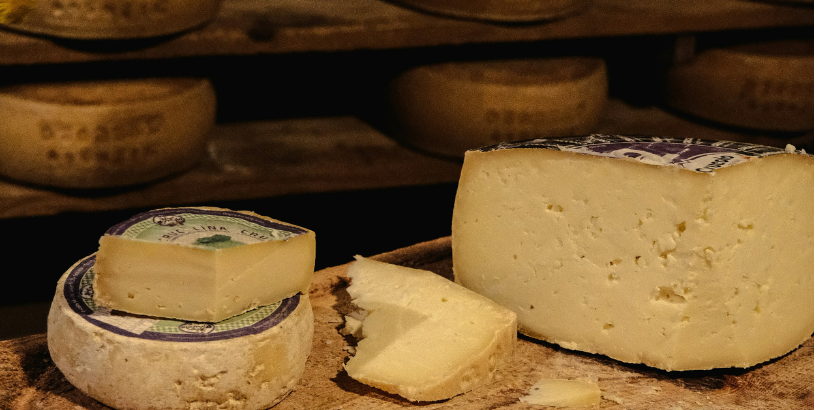
In the coastal hills of Sicily, the Cangemi family continues a rich tradition of sheep herding and cheesemaking. Guiding their flock of Valle del Belice sheep, they celebrate centuries of agricultural heritage. From the robust Pecorino Siciliano to the rare Vastedda del Belice, these cheeses showcase the unique flavors that arise from this sustainable way of life.
Join us as we delve into three favorite sheep’s milk cheeses as crafted by ancestral cheesemakers in Sicily.
The following excerpt is from Cheese Trekking by Trevor Warmedahl. It has been adapted for the web.
It Starts With the Sheep
The sheep were tinged yellow by dust mixing with the lanolin wax of their wool. They moved like a slow-motion flock of birds across a grassy hill in a hopscotching formation. Some walked slowly in a phalanx with their heads close to the ground as they nibbled and fell behind, then ran to catch up and become the new front line. We kept our distance, and took the pressure off completely as the flock entered an olive grove and dispersed a bit to graze peacefully. When it was time to go, we had to push them forward with hoots, waving of arms and sticks, and shouts of “HOMINY!” (actually Amunì, Sicilian for “let’s go”).

This was one of the flocks cared for by the Cangemi family and we were moving them between properties, a piccola transumanza (little transhumance). It was March in the coastal hills of Sicily, and the green pastures of a wet Mediterranean winter would soon desiccate and turn gold in the relentless summer sun when plants wither and go dormant in order to stay alive.
The milking season typically starts in December and winds down in midsummer, an inversion of the norm farther north. The sheep were being moved to a lower property with its own milking shed to allow the pastures around the home farm to rebound and serve as a store of dry feed later in summer, when the whole herd would be brought back up.
The sheep were a heritage breed known as Valle del Belice, named after the valley in the province of Trapani where the family has farmed land since the 1700s. They looked quite similar to the Langhe sheep, with coarse, white wool and strong, bald legs built to handle long walks on rough terrain.
The long history of sheep dairying on Sicily is deeply integrated with the growing of grain and tree crops such as carob, citrus, and olives. The movements of the sheep are still tied to the growing season of wheat, which has been a major crop since 7000 b.c.e. How could this soil remain fertile after producing grain crops for this long? Animal poop. Without livestock, sustainable annual crop agriculture is a much harder feat to accomplish. The milk was born from healthy livestock eating plants growing from living local landscapes, producing milk thriving with healthy microbes.
The cheeses were often spectacular, and made without adding a starter. I remembered what I had learned at Cascina del Finocchio Verde: The starter culture is already in the milk.
The Holy Trinity of Sheep’s Milk Cheeses

The creamery produces a trinity of cheeses with different shelf lives. Pecorino Siciliano is a hard DOP cheese, one of the stalwart workhorses of Sicilian shepherd cheesemaking. From the same base curd as the pecorino, a mozzarella-like cheese is made that is eaten fresh, up to two weeks old. Called Vastedda del Belice, this is a rare sheep’s milk stretched-curd cheese, molded in a soup bowl. The whey remaining is enriched with reserved milk and made into ricotta. This is the super fresh cheese made and sold every day (besides Sunday) to bring in immediate revenue. These three cheeses make a tight, time-tested lineup that best utilizes seasonal fluctuations and splits milk into a range of textures and culinary applications.
Pecorino Siciliano
Pecorino Siciliano is a large-wheel, long-aged cheese that is often grated onto pasta. Sheep milk is coagulated with lamb rennet, no added starter. Many aged pecorinos (sheep cheeses) from Sicily and Sardinia possess a strong picante sharpness, a flavor often originating from rennet pastes high in lipases, enzymes that break down fat. This lends these cheeses a stomachy, mouth-numbing, sometimes bitter or acrid flavor that is divisive but highly addictive once a taste for it has been acquired. I know this doesn’t sound appetizing, but it’s like fish sauce in a stew; it adds a background boost of deliciousness. Parmigiano Reggiano has a slight hint of this lipase character.
Pecorino Siciliano has a moderate dose, being one of many flavors. The meaty animality plays a supporting role to the notes common in aged sheep cheeses: tropical fruits, sweet caramel or butterscotch, lamb and lanolin. A spoonful of the rennet paste is measured on a scale, mixed with warm water to make a slurry, then poured into the milk while stirring vigorously. The milk sets into a firm curd within the typical time frame I see around the world, forty-five to sixty minutes.
A wooden tool called a rotula (kneecap) is used for cutting. It consists of a slightly bowled disk attached to the end of a long pole similar to a broom handle. Rather than careful and delicate cutting, a violent whisking motion is employed, rapidly breaking the coagulum into small pieces sitting within a milky whey.
While stirring rapidly, hot water is poured in to raise the temperature. The curds firm up with about ten minutes of stirring, and then are allowed to settle to the bottom. The whey resting on top is pumped into a large stainless vat, where it is heated up for ricotta. Once the curd below has come together as a matted mass, it is scooped out and placed into big plastic basket forms on a draining table.
The curd hunks are broken up in a motion called intumare (to bury) in which you poke at the pieces with pinched fingers in a pecking motion. This breaks apart the ragged curd, allowing more whey to be released and closing up potential pockets inside the cheese.
Once the ricotta is finished, the large pecorinos are soaked, in their forms, in the 160°F (70°C) scotta. They are left for an hour and a half to two hours as the whey cools, inducing a thermophilic fermentation and probably knocking out many microbes. It also helps the surface of the cheese seal up completely. It’s an interesting and unorthodox approach. Instead of exposing the curd to high heat in the vat, they do so after forming the wheel, using the heat generated in making ricotta.
After this heat treatment, the wheels are given their final, rustic shape in handwoven baskets called fasceddi made from a juncus reed. These baskets are a great example of the use of local materials in an ancillary craft that is supported by regional cheesemaking traditions. The DOP requires the use of these forms, which helps support the artisans who still make them, showing that a protected name is a device that can be used in many ways, sometimes actually achieving the goal of supporting traditional tools and practices.

The wheels are brined, then rubbed in salt as they sit on wood shelves in an aging space attached to the caseificio. This pulls moisture out and gets more salt into the cheese. After one month, wheels that have no visual defects can be sold to an affineur, who will handle aging and distribution.
The making of pecorino ramps up in the winter when the milk is at its peak in terms of production and potential for aged cheeses that express botanical terroir. Pasture vegetation and hillsides are lush from winter rains, offering sheep in the middle of their lactation a diversity of herbs, forbs, legumes, and flowers.
You can’t simply make any cheese well, at any time of the year, from any milk. Especially with milk from a herd that is bred seasonally, meaning they all give birth within a certain time frame. This is even more true with sheep milk. Early- and late-lactation milk can be abnormally rich and is not well suited for long-aged cheeses. Too much fat impedes the removal of moisture, and the milk can be microbiologically problematic.
Vastedda
The second cheese is a stringy one made by setting aside some of the pecorino curd, then stretching it. Once any rennet-curd cheese ferments into a certain pH range, it has the property of being able to stretch when heated to around 170–180°F (76–82°C). This allows the curd to be transformed into long, toffee-like strands and then shaped into various formats, seen in the range of sizes and shapes in Italy’s pasta filata cheeses such as burrata and scamorza. After the curd is exposed to hot water, it becomes like malleable molding clay and can be given any shape before it cools and becomes solid again.

As with the pecorino, the level of heat treatment alters or steers the microbial ecosystem of the cheese and can neutralize potentially problematic microbes. The curd is made into a wheel and left to drain while slowly fermenting in a cool place until it is ready to stretch. In the summer, it ferments faster and is ready in twenty-four hours; in winter, it tends to take forty-eight.
The tricky thing with this style is the timing. You have to catch the cheese while it’s in the window in which it can stretch. If it ferments too far, becoming so sour the pH drops below 5, it loses this ability. With enough experience, you can tell that the curd is ready by changes in texture and aroma. The texture softens as it ferments and becomes less squeaky. It gives off distinct aromas of milk that is souring but still pretty sweet.
I’ve seen people in Italy simply glance at the curd and say, “It’s ready.” Most of us have to take a little piece and expose it to hot water to see if it stretches. I found it perplexing that the cheese was ready at either twenty-four or forty-eight hours, fitting perfectly into the day’s schedule.
What if it had reached the stretch zone in the middle of the night and by morning was too sour? A slower fermentation gives a wider window in which the curd will stretch, and the maker can speed up or slow down the process by moving the curd between a warm room, cool room, and refrigerator. Food is often elevated when we allow it to take its time or intentionally slow the process down, what sourdough bakers call retarding the fermentation. This opens doors to the possibility of enhanced depth of flavor in bread, and I was beginning to suspect the same was true of some cheeses.
The curd is cut up into thin slabs and placed in a purpose-built, coopered wood vessel called a piddiaturi that is wider on the bottom than the top. If the timing works out, the ricotta has just been ladled out from the day’s whey and the remaining scotta is still piping hot. It is poured onto the curd, which is slowly stirred and lifted to disperse the heat.
A wooden paddle is used to lift the mass of curd as it slowly stretches into a long, elastic sheet, which is brought together as a smooth blob. Small wads are pinched off and placed into flat-bottomed soup bowls that give the cheese its final shape. After a few flips, the perfectly smooth disks are left to cool, salted quickly in brine, then packaged to be consumed within a few weeks.
The cheese is one of a kind, with a sheepy profile of lanolin and fruits wrapped up in an eminently snackable puck of fatty string cheese that melts well and can fit in on any cheese plate. It is somewhat rare to find pure sheep milk stretched-curd cheeses. Curd from sheep’s and goat’s milk doesn’t stretch as well as that of bovines (cows, buffalo, yaks). I’ve never been able to get sheep milk to stretch the way it did at the Cangemis, where I witnessed what is called infinite stretch, in which the curd can stretch many feet without breaking.
Some say this is only possible with the milk of the Belice breed; others that it is an effect of sulla, the legume that is an important part of the sheep’s diet. It could be both of these factors, combined with the slow, natural fermentation.
Cheese is mysterious, and it comes out better when its complexity is more than we can claim to contain intellectually; when we celebrate it as an enigma, as a partner to dance with rather than a set of parameters to control. Sublime cheese can’t come from statistics or from the fine-tuning of dials and measuring devices. Deliciousness and bliss can’t be quantified, and they can’t be forced into being through monetary investment, recipe development, or a spreadsheet.
Ricotta

Many people think of ricotta as being a somewhat boring B-list byproduct. Before coming to Italy, I didn’t really know what ricotta was. I had never experienced how good it could be.
In the United States, what is sold as ricotta is almost always made from whole milk with an acid added to cause the bastardized ricotta to form. What is available in Italy at essentially every small-town caseificio, every time they make cheese, is something else, made from whey, sometimes with a bit of milk added. Italians are connoisseurs of ricotta and line up to buy it steaming hot from the vat.
Words cannot convey the beauty of this ricotta, but let us see how close they can get. Satin pillows cased with a silky sheen are freed from a steaming lump of milk love by a spoon that now will never want to be dipped into anything else. Slid between one’s lips and onto the tongue, is the texture slightly jelly-like or is it more of an airy soufflé, bursting with pockets of hot whey?
There is a distinctly eggy flavor and mouthfeel reminiscent of custard. In zabbina, this takes on an egg drop soup aura. It’s less creamy or fatty, and more a protein-rich concentration of milk’s umami side, alchemized by heat and salt. All this is tied together by the milky sweetness of lactose elevated rather than fermented. It all melts like butter in your mouth . . . an ethereal, transitory moment of bliss. Followed by the next spoonful.
Life, like ricotta, is fleeting. That’s what makes it beautiful. How is it so good? I have asked myself this many times. It is so good because anything less would be unacceptable. Sicilians know how good it can be and perhaps have fond memories of mothers and grandmothers making it. It is a part of their food culture, used extensively in a fleet of sweets, in which cannoli is just one vehicle.
One factor is the violent cutting of the coagulum, leading to a richer whey and therefore a richer ricotta. Second is the addition of a proper dose of salt to the whey, which will then be evenly dispersed throughout the ricotta. The third factor is the little plastic baskets the ricotta is ladled into, which it will be sold in, often while it is still draining. These have tiny slits on the bottom and sides, holding the delicate cheese in while allowing whey to seep out.

The pillowy texture would be lost if you removed it from the baskets, to mix in salt or package it in a different container. By not disturbing it, and serving it directly from its draining form, you maintain the frail soufflé texture. I realized there was an inversion of priorities here. The ricotta was primary, rather than being a byproduct of cheesemaking. The other cheeses were almost byproducts of ricotta making, something you needed to make to get the sweet whey. From this perspective, the inefficient cut leading to lower yields of cheese actually led to more, richer ricotta.
The ricotta of Sicily taught me in a language we can all understand. A language made not of words but of delicious bites, enticing aromas, unnamable textures, and the guttural utterances they evoke from our throats as we express the spontaneous stirrings in our hearts.
A language of waggling sheep tails, bells jangling, fingers brushing the bark of olive trees, bare feet crushing fallen orange leaves, wheat stalks waving in the breeze, composting manure generating heat with mushrooms growing from its sides like trees on a volcano. A shepherd calls out and waves a staff while seated in the shade of an almond tree. The sheep turn to stare, then resume nibbling, the rhythm of their grinding teeth soothing the earth as their hooves massage her scalp.
Recommended Reads
Read The Book

Cheese Trekking
How Microbes, Landscapes, Livestock, and Human Cultures Shape Terroir
$29.95
You may like...
-
 $40.00
 -
$22.95
-
$40.00


Recent Articles

This bright, yet delicate flavor profile is both sweet and sour – a unique taste that you’ll keep coming back to. This recipe is intended for long, slow fermentation starting at persimmon harvest time in the autumn and continuing into winter.
Read More
This triple apple snack cake uses applesauce, cider, and apples for a one-two-three apple punch. Don’t take our word for it though, give it a go yourself!
Read More
These small fruits are a delicious source of nutrients that you can find almost anywhere. Get started on acorn harvesting with help from these simple tips!
Read More
Want an on-the-go snack without having to go to the grocery store? Whip up this homemade applesauce for a fresh fall snack whenever you get the craving!
Read More
The possibilities are pretty much endless with wild ingredients — use almost any fresh fruit or juice and a sweetener to create your own custom jam or syrup!
Read More