

How to Save Tomato Seeds
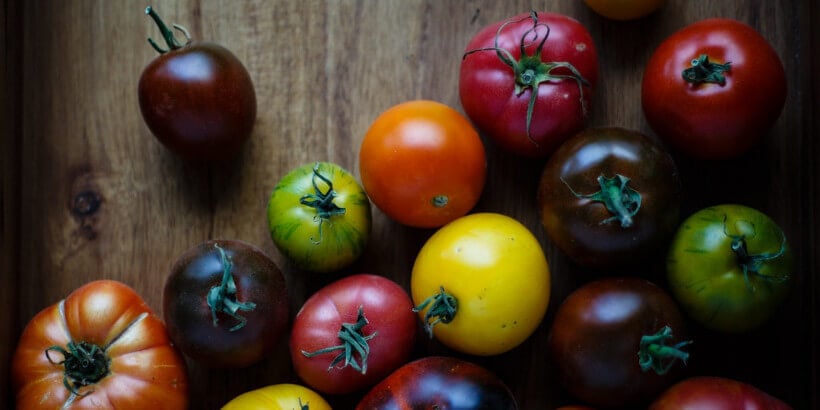
As your favorite variety of home grown tomatoes start ripening on the vine this summer, be sure to save those seeds for next year’s planting. It takes a bit of care to get the seeds out of the gelatinous tomato goo they’re suspended in, but once you’ve done it you can use those seeds to cherish and perpetuate the unique flavor of your tomatoes.
The following is an excerpt from The Seed Underground: A Growing Revolution to Save Food by Janisse Ray. It has been adapted for the web.
Photo by Jonathan Billinger, Wikimedia Commons
Pick nice tomatoes that would be perfect for a mean kid to mash up. If they’re large, slice them in half at the equator. Hold them over a canning jar. (Try not to use plastic for anything. Plastic is bad stuff.) Milk the pulp, meaning the gelatinous matrix that suspends the seeds, like frog eggs, into the jar. If you’re working with cherry tomatoes, you’ll have to hold the whole tomato between your fingers and squeeze. The only thing left will be the skin.
Put the jar lid on, give it a shake, and label it with the name of the variety inside. If you don’t label the jar, you will forget what it contains. If you have two tomatoes you’re saving, you think you can sit Yellow Mortgage Lifter on the right and Pruden’s Purple on the left and remember what’s what, and pretty soon you’re wondering if Yellow Mortgage Lifter was on the right or the left. Just do it.
The tomato hull can still be eaten. I think sauce is a good idea at this point.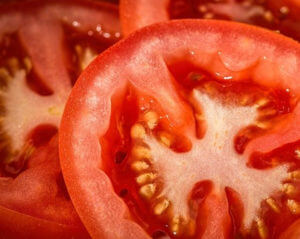
Fermenting, which is what you are doing with the goopy mess in the canning jar, is the best way to save tomato seeds because the process dissolves the gel—which contains chemicals that inhibit germination. Fermentation causes the seeds to germinate more quickly when you plant them the following spring. Fermenting also breaks down the seed coat where seed-borne diseases like bacterial canker, spot, and speck can lurk. Let the mess stand for two or three days in a warm location, longer if the temperature is below 70°F. The books say to stir daily but I don’t.
When a layer of blue-gray mold covers the surface of the tomato-seed funk, the process is complete.
Occasionally in hot weather (seven months a year here), I have had the seeds start to germinate inside the goop, which means that I’ve left them too long untended and they think they’ve actually been planted and it’s time to race off again into plant-building and fruit-making. Don’t be like me.
Look at the underside of the jar. The viable seeds will have sunk to the bottom. Pick off the scum, then fill the jar with warm water and begin to pour off the now-rotten goop, being careful not to pour out your seeds. You may have to add water or rinse seeds off the insides of the jar and pour again, slowly. Viable seeds keep sinking to the bottom. Do this until you have mostly seeds and water in the jar.
Now dump the seeds into a large metal strainer whose holes are smaller than the seeds, rinse, drain for a few minutes, then spread them on a screen or on a plate covered with newsprint or a clean rag (don’t buy paper towels). Leave the seeds until they dry.
Label—very important!—and store.
Recommended Reads
Read The Book

The Seed Underground
A Growing Revolution to Save Food
$24.95
You may like...
-
 $35.00
 -
$39.95
-
$29.95


Recent Articles

Testing soil in your garden is the first step to a more bountiful harvest. Simply take a small sample, get it examined, & you’ll be on your way to healthy soil.
Read More
The true pure seed is a myth. There are best practices that any seed grower should keep in mind; but once you understand seed integrity, the real fun begins.
Read More
Before yanking out the next patch of lambsquarter you find in your yard or garden, consider trying one of the many edible and medicinal uses of this “super weed.”
Read More
What’s a cheaper, easier, and surprisingly more efficient way to start your seedlings? Soil blocks! Find out how soil blocks work, how you make them, and what advantages they offer over traditional pots and trays.
Read More
America was once home to hundreds of small-scale agricultural seed producers, each of which developed seeds adapted to grow best in the surrounding region.
Read More