

How We’re Helping to Close the Food Waste Loop
By Jill Kiedaisch, Content and Brand Manager
In July 2020, Vermont’s Universal Recycling Law will go into effect.
It calls for a full ban on food waste scraps being sent to Vermont landfills. This is the final step transitioning food wastes out of the waste stream—a changeover that began in 2014. In light of this landmark legislation, the Chelsea Green Composting Committee reupped our commitment to closing the food waste loop by connecting with two community businesses that are ahead of the curve:
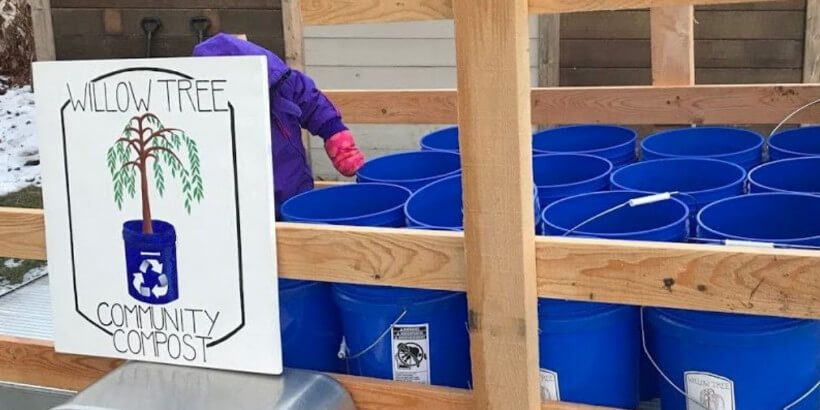
Willow Tree Community Compost, run by Wilder resident Jen Murphy with the help of her two young children, collects food wastes from about 15 area residences, a restaurant, and now, a publishing company. She composts the wastes in a large three-bin setup that she constructed herself (you can see a picture of it at her website, www.willowtreecompost.com). Jen partnered with Sunrise Farm (www.sunrisefarmvt.com), a former dairy operation transformed by Chuck Wooster and Sue Kirincich into a multi-enterprise organic business that includes a CSA, chickens, lambs, and maple syrup.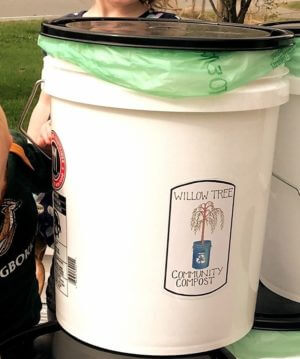
It’s an ideal partnership: Willow Tree provides needed time and equipment to pick up food wastes around the White River Junction area; Sunrise Farm has the space and infrastructure to carry out large-scale composting, as well as a steady supply of the other ingredients needed to provide the right balance of greens and browns for a nutrient-dense end product. The compost is then used to enrich Sunrise Farm soils and grow organic vegetables for sale to the local community.
As the leading publisher of books about organic farming and gardening, local food, and restorative living, Chelsea Green is no stranger to composting. We’ve published multiple books on the topic, including Community-Scale Composting Systems, The Humanure Handbook, and The Worm Farmer’s Handbook, each addressing different approaches to turning waste into wealth. Jeffrey Slayton, our staff lead on the project, says, “We want to embody the holistic philosophies and practices offered in our books, so we were delighted to be approached by Jen with the opportunity to help reduce local waste and work toward a sustainable future.”
To that end, Chelsea Green has donated $100 each to the crowdfunding campaigns launched by Willow Tree Community Compost and Sunrise Farm, and we are now donating all our food scraps as well. Collection at our White River Junction office began in January, and we are already producing enough compost for a weekly pickup. We’re also excited to report that, thanks to said campaign funds and a Working Lands Business Grant from the State of Vermont, Sunrise Farm will be building new physical infrastructure to improve their systems.
The employees at Chelsea Green are excited to be part of this local small business effort to “close the circle” and transform locally produced wastes into locally produced organic food!
Recommended Reads
You may like...
-
 $59.95
 -
$25.00
-
$29.95


Recent Articles

The true pure seed is a myth. There are best practices that any seed grower should keep in mind; but once you understand seed integrity, the real fun begins.
Read More
Before yanking out the next patch of lambsquarter you find in your yard or garden, consider trying one of the many edible and medicinal uses of this “super weed.”
Read More
What’s a cheaper, easier, and surprisingly more efficient way to start your seedlings? Soil blocks! Find out how soil blocks work, how you make them, and what advantages they offer over traditional pots and trays.
Read More
America was once home to hundreds of small-scale agricultural seed producers, each of which developed seeds adapted to grow best in the surrounding region.
Read More
Thinking about adding a laying flock to your backyard, but having trouble deciding between ducks and chickens? Agonize no more.
Read More