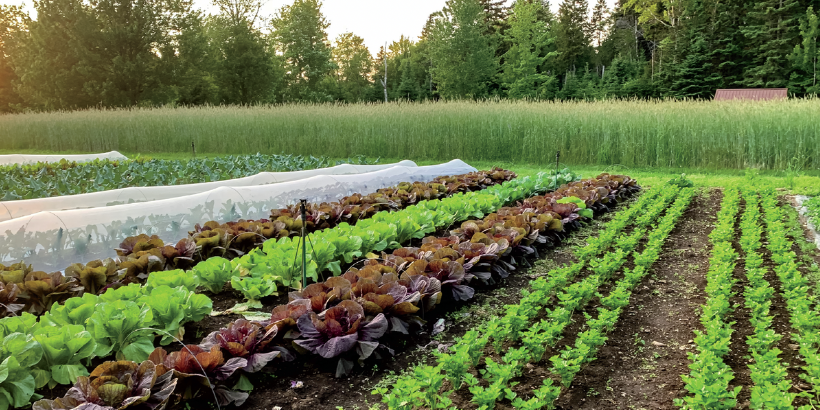
The roots of the organic farming movement lie in the dedication of farmers who enrich their soils through natural methods. Those traditional, farmer-managed, soil-improving processes have been replaced by purchased products from off the farm.
Prioritize organic soil care to produce clean, chemical-free food and join us in embracing a healthier, more sustainable future for food and farming!
“Every well-managed soil should grow richer rather than poorer; and, speaking broadly, the farm should have within itself the power of perpetuating itself.”
— Liberty Hyde Bailey, The State and the Farmer (1908)
Preface: Back to the Roots
When the organic growing movement began many years ago, the pioneering farmers created and maintained their fertile soils by partnering with the earth’s resources. They sowed green manures and cover crops and shallowly tilled them into the soil, they grew legumes to add nitrogen, they devised effective crop rotation systems for control of plant diseases and weeds, they spread rock powders as natural mineral sources, they made soil-nourishing compost from locally available, pure organic wastes, they used manure from their own livestock, and so forth. They created an exceptionally clean, safe, self-contained production system. Nowadays it is a much different world. Those traditional, farmer-managed, soil improving processes have been replaced by products—purchased products from off the farm.
My greatest concern is about the questionable quality of the compost products available for purchase today. Compost has always had a reputation for goodness among organic growers.
But what about the unavoidable residual environmental contamination of the ingredients from which the numerous municipal-waste and confined-livestock composts marketed today are made—contaminants such as pesticides, herbicides, antibiotics, veterinary drugs, hormones, heavy metals, and the like? Purchased inputs of industrially suspect manure from confined animal feeding operations (CAFOs) or purchased compost made from the municipal waste stream have become just as much of a crutch for today’s organic vegetable growers as chemical fertilizers are crutches for chemical farms.
Unfortunately, those purchased organic-in-name-only inputs no longer meet the traditional pure standards for inputs always associated with organic farming. The manufacturers of commercial composts are paid to dispose of waste products. Most of those composts, which are enthusiastically used by many organic vegetable growers, are not the high-quality compost celebrated by Sir Albert Howard, the renowned nineteenth century botanist and sustainable agriculture pioneer. The outward appearance of the finished compost doesn’t give any clues as to what was disposed of to make it.
One of the principal motivations for Four Season Farm’s preference for organic soil care has been to provide our customers with food free of the chemical pollution and the industrial toxins that pervade our world.
Because the only sure way to have both a clean as well as a fertile soil is to grow our own soil organic matter right on the farm, that is what we do. The aim of our “self-fed farm” project is to consciously separate our farm’s practices from the industrially influenced, inadequate shortcuts that so many organic farmers now rely on. The aim of this book is to detail the simple and productive methods we use to achieve our goal of producing clean and nourishing food in perpetuity.
A statement titled “Organic Farming as Practiced by Four Season Farm” is proudly posted at our farmstand. It reads as follows:
The popular press defines organic farming by its rejection of chemicals.
A better portrayal defines organic farming by its embrace of the soil’s biological systems.
Classical organic farming is based upon the creation and maintenance of a biologically active fertile soil.
Organic farming succeeds because of the benefits derived from that soil. Organic farmers focus on correcting the cause of pest problems (weak plants) by strengthening the plant through optimum soil conditions, rather than merely treating the symptom (pest damage) by trying to kill the pests that are attracted to weak plants. The production of pest-free plants and livestock with active immune systems is a direct outcome of organic soil care that, as scientific studies have consistently shown, induces pest and disease resistance.
Research into the marvelously complex soil microbiome (and the associated human microbiome) is revealing the vital microbiological truths that link both soil health and human health. That research underscores the intuitive brilliance of the founding organic farmers.
As a bonus, fertile soil produces food of the highest nutritional quality. That was one of the foremost initial aims of the soil care techniques that became organic farming.
Long-term soil productivity does not require frequent input of purchased fertilizer inputs from off the farm. It can be created and maintained by the use of farm made compost, crop rotations, green manures, cover crops, nitrogen-fixing legumes, grazing livestock, shallow cultivation, nutrient-dense powdered rock, enhanced biodiversity, and other time-honored practices that nurture the boundless energy and logic of the earth. Organic farming is a circle of endless renewal and it will succeed wherever there is soil.
The inclusion of deep-rooting forbs in rotationally grazed grass/legume pastures within the rotation helps to maintain fertility and make available the almost inexhaustible mineral supply from the lower levels of the soil. Grazing livestock benefit the soil; diverse pasture benefits the livestock.
Most significant of all, since soil fertility on the classical organic farm is not powered by purchased inputs from outside the farm but, rather, by easily understood and universally applicable soil management practices conducted within the farm, this food production system is accessible at low cost by farmers everywhere and can thus nourish the planet with exceptional food in perpetuity. As a further benefit, the self-fed organic farm avoids the accidental introduction of industrial contaminants from outside the farm which is a perpetual threat to the purity and integrity of inputdependent systems.
I first learned about plant health from Eliot Coleman when I was a college senior, deep in the throes of final exams—which is to say, I was procrastinating. Instead of studying, I wandered the library’s stacks, flipped through periodicals, made trips to the vending machine, and browsed the latest arrivals laid out on the wooden table by the entrance. That’s when I first spotted The New Organic Grower. Its author, Eliot Coleman, looked out from the cover with the kind of blue-eyed conviction that suggested he knew something the rest of us didn’t.
He did. Eliot’s idea—that healthy plants grown in healthy soil are naturally resistant to pests—arrived at the perfect moment for a college senior with vague anarchist sympathies (really, just a liberal arts major) hungry for ideas that were both radical and elegantly simple.
Feed the soil, and the tiny creatures living in it, with care and attention, and pests will almost always be incapable of inflicting damage.
I didn’t yet realize that Eliot’s dirt-first dogma would become the foundation for my own cooking. Chemical farming, I decided, was less a necessity than an elaborate misunderstanding. “Truth to power,” would have been something I muttered to myself, delighted by a worldview that turned conventional wisdom on its head.
Eliot, for his part, is fond of saying that the microbes in the soil should be fed first—let them have first pick at the buffet, and they’ll take care of the rest. It’s an ecological “if you build it, they will come”—except that if you feed the soil, the good microbes and nutrients will stay and, eventually, the pests will leave.
My radicalism tempered with age, but a decade after that first encounter with Eliot’s work, I had the good sense to reach out to him for help in designing the farm at Stone Barns Center for Food & Agriculture, which would become the home of my restaurant, Blue Hill. Eliot’s task was to identify the best land for growing strong, healthy vegetables without chemical intervention.
I’ve told the story of his first visit to the site more times than I can count, because that crisp November afternoon in 2002 marked yet another turning point in my life as a chef.
As the light faded on that cold, slow-burning day in the time of year best known for its impression of perpetual dusk, Eliot walked ahead of me, surveying the fields. He’d initially settled on a flat, healthy stretch of land, but then we came to a long, upward-sloping field beside the largest of the stone barns, once the heart of the property’s dairy operation. Eliot paused, scanning the six-acre expanse. “The cows probably pastured here,” he mused.
Then, in a flash, he dropped his bag and, in a move more reminiscent of a border collie than a consultant, started running—darting across the old pasture, weaving between rocks and thistles, head swiveling to track the setting sun. He passed what would later become rows of tomatoes, cucumbers, fava beans, and parsnips, finally reaching the highest point, where he raised his finger to the sky. Then he was off again, making his way to the northeast corner, stopping at last, hands on hips, to study the land.
Even in his early sixties (and still today), there was something wild and hopeful in his movements—curious, observant, energized by a deep, intuitive connection to nature, and filled with the hopeful energy of someone who finds joy in the possibility that the best answer is not the obvious one. I watched in awe.
“Hey, freaking cool,” he grinned as he returned, his blond hair gleaming in the fading light, eyes wide and sparkling. “This is the field. Forget the other one. I’m getting hungry just thinking about what you’ll grow here.” I asked if he’d changed his mind based on the angle of the sun. “The sun? Oh, hell, no. I was just admiring it. No, I wanted to be sure this had been pasture for the cows.”
Eliot explained that fields closest to the barns were usually the most heavily grazed—and thus the most richly fertilized by manure. In this case, he was right; we later confirmed that this pasture had once been grazed by the Rockefeller family’s dairy herd.
He scooped up a fistful of soil and turned his hand so I could see: “Black enough for you?” he laughed, marveling at its richness. In the dying light, I stared at his handful of earth, realizing that the true recipe for great cooking isn’t a recipe—it’s an idea. The idea is to honor the astonishing network of microscopic life in the soil—the full periodic table of elements, offered up if you let it.
Until then, I’d held on to two simple misconceptions: that chemical farming kills soil by poisoning it (which it can), and that eating those chemicals is unappetizing and harmful (which it probably is). But both miss the chef ’s larger point.
Chemical farming starves the soil’s complex community, depriving it of anything good to eat—and, in doing so, robs soil of its natural resilience and food of its flavor.
“Why limit the hand that feeds you?” Eliot asked, reading my mind. “Thinking we can substitute a few soluble elements for a whole living system is like believing an intravenous needle could deliver a delicious meal.”
What a pleasure, then, to introduce this new book and find Eliot’s ideas as vital and radical as ever, now distilled into a practical guide for anyone who wants to feed the farm that feeds them.
In this sense, what you’re holding is a pantry cookbook—and I mean that as the greatest compliment. Eliot’s blueprint for nourishing the soil with what’s already on hand is as accessible for every home gardener and farmer as it is essential.
That Eliot Coleman has continued, decade after decade, to deepen his thinking, remaining somehow both radical and accessible, is a testament to his curiosity, his generosity, and his refusal to accept the world as it is handed to him. May these pages do for you what Eliot once did for me: prompt you to look down, dig in, and realize that the revolution is still possible, and that, because of it, our food will taste good.
If you keep your hens in a stationary coop, you’re missing out on their soil building talents. Un-coop that poop by putting your flock in chicken tractors!